“24Seventy weeks have been decreed for your people and your holy city, to finish the wrongdoing, to make an end of sin, to make atonement for guilt, to bring in everlasting righteousness, to seal up vision andprophecy, and to anoint the Most Holy Place. 25 So you are to know and understand that from the issuing of a decree to restore and rebuild Jerusalem, until Messiah the Prince, there will be seven weeks and sixty-two weeks; it will be built again, withstreets and moat, even in times of distress. 26 Then after the sixty-two weeks, the Messiah will be cut off and have nothing, and the people of the prince who is to come will destroy the city and the sanctuary. And its end will come with a flood; even to the end there will be war; desolations are determined. 27 And he will confirm a covenant with the many for one week, but in the middle of the week he will put a stop to sacrifice and grain offering; and on the wing of abominations will come the one who makes desolate, until a complete destruction, one that is decreed, gushes forth on the one who makes desolate.” (Daniel 9:24-27)
The prophecy in Daniel 9, and verses 24-27 in particular, is a pivotal key to the futurist’s interpretation of not only Daniel, but their whole eschatological system. It is in this passage that we see a timetable laid out for the future according to the futurists (mostly Dispensationalists interpretations) which begins in the past. It begins with a decree from a ruler to restore and rebuild Jerusalem, when the prophetic clock begins ticking. Knowing that Daniel wrote this while in captivity in Babylon, it was prophetic from his perspective. He predicted that there would be a total of 70 weeks of years, or 490 years from the time of that decree to essentially the end, at least the end of this prophetic timetable. All of this of course only makes any sense if we look to other relevant scripture, and let scripture interpret scripture.
Bible scholars don’t all agree on the interpretation of the decree, and thus the historic dates marking the beginning of this timetable. Some believe it is a reference to the decree by Cyrus King of Persia (Ezra 1:1-4, Ezra 6:3-5, Isa. 44:26-28, Isa. 45:1-4&13, 2Chron. 36:22-23) dated around 450 BC. Others start with a decree by Artaxerxes (Neh. 2:7-8) dated by Ptolemy at 444 BC as depicted in the following chart.
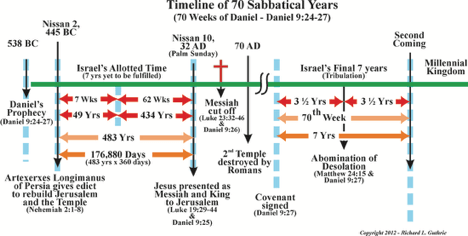
Depending upon which dates are assumed, including the actual date of Christ’s birth and His death, and the conversion of these years into actual days, some have calculated the prediction to be precisely accurate in actual days from that decree to the day of Christ’s death. Dr. Walvoord goes into some detail on this issue in his commentary on the book of Daniel, though he admits to uncertainty about the exact dates. He gives the following information:
“Sir Robert Anderson has made a detailed study of a possible chronology for this period of beginning with the well-established date of 445BC when Nehemiah’s decree was issued and culminating in A.D. 32 on the very day of Christ’s triumphal entry into Jerusalem shortly before His crucifixion. Sir Robert Anderson specifies that the seventy weeks began on the first of Nisan, March 14, 445 B..C. and ended on April 6 A.D. 32, the tenth of Nisan. The complicated computation is based upon prophetic years of 360 days totaling 173,880 days. This would be exactly 483 years according to biblical chronology. (Daniel, The Key to Prophetic Revelation, John F. Walvoord, Moody Press 1971, p. 228)
That number, 483 years, is exactly the 69 weeks prophesied by Daniel. However, what is perhaps more important is the interpretation with respect to the 70th week. Dispensationalists and hence futurists, interpret those first 69 weeks as being fulfilled in history, but the 70th week as being yet future. The 26th and 27th verses become key to this interpretation. The reference to the Messiah being “cut off” is taken to be referring to Christ’s death on the cross. However, what follows that is a matter of debate and disagreement, even between the Futurists. Some including Walvoord, interpret the rest of the verse as having been fulfilled in the destruction of Jerusalem and the temple in A.D. 70. It reads “the people of the prince who is to come will destroy the city and the sanctuary. And its end will come with a flood; even to the end there will be war; desolations are determined.” While that historic event would certainly seem to be a partial fulfillment, it is surprising that men like Walvoord would see it as the complete fulfillment, as he often sees other prophetic events as having a near term partial fulfillment, but a long range future complete fulfillment – such as in the case of the “abomination of desolation” mentioned in the next verse, and later in 11:31. He argues that this prophecy was completely fulfilled in A.D. 70, arguing from Zechariah 14:1-3 that there is no complete destruction of Jerusalem in that future end of the age event because the city is still in “existence although overtaken by war at the very moment Christ comes back in power and glory” (ibid p. 231). This interpretation itself is based on an incorrect interpretation of that passage, apparently failing to see that Zechariah is prophesying about that “day of the Lord” (for which he also has a very convoluted interpretation which includes the whole Tribulation Period as well as the whole Millennial Kingdom age), the second coming of Christ event, involving the Battle of HarMagedon, and the event prophesied by Peter in which the heavens and the earth are completely destroyed (2 Peter 3:10), and which according to Zephaniah includes the inhabitants of Judah and Jerusalem as well as the whole earth:
“2 ‘I will completely remove all things
From the face of the earth,’ declares the Lord.
3 ‘I will remove human and animal life;
I will remove the birds of the sky
And the fish of the sea,
And the ruins along with the wicked;
And I will eliminate mankind from the face of the earth,’ declares the Lord.
4 ‘So I will stretch out My hand against Judah
And against all the inhabitants of Jerusalem…’” (Zephaniah 1:2-4)
This is likely because of Walvoord’s misinterpretation of these “day of the Lord” events prophesied by Peter and Zephaniah as not happening until after the Millennial age, instead of at the second coming of Christ. This is at least in part because he interprets that “day of the Lord” as including that whole Millennium – which is counter to how that expression is used wherever it appears in scripture (get a concordance and check it out – its only about 23-25 passages depending on which version) . In reality what Zechariah is describing is part and parcel of the same “end of the world as we know it” event Peter and Zephaniah are describing. While the city and the temple were destroyed in A.D.70, it was not the end, as we see the city thriving today, and Judaism going strong, and it is clear from prophecy in both Daniel and Revelation that the temple will be rebuilt, and will again be desecrated by the Antichrist. Thus, the prophecy has not been completely fulfilled yet. Furthermore, it makes no sense to say that the rest of that prophecy, that “even to the end there will be war; desolations are determined“, has already been fulfilled in that singular very local historic event, especially in light of what we see prophesied about Israel, and Jerusalem in Revelation. However, those relevant passages in Revelation, such as the one Walvoord cites, Revelation 11:2, do describe what will be the complete fulfillment of Daniel’s prophecy in this 26th verse.
Walvoord’s full fulfillment in history interpretation seems quite incongruent with his interpretation of the following verse, which he then argues has not been fulfilled and thus is future:
“27And he will confirm a covenant with the many for one week, but in the middle of the week he will put a stop to sacrifice and grain offering; and on the wing of abominations will come the one who makes desolate, until a complete destruction, one that is decreed, gushes forth on the one who makes desolate.” (Daniel 9:27)
First, key to the accurate interpretation of this verse is the little pronoun “he”. To what or whom does this “he” refer? Again, Walvoord does a good job of giving us a fairly wide spectrum of diverging views on this, including the Amillennial as well as Premillennial interpretations. However, after telling us that the 26th verse is not about a future event, he now gives us the following with respect to the answer to this question as to whom the “he” is referring to in this 27th verse:
“…the normal antecedent of he is the prince that shall come [of the 26th verse], who is not to be identified with Titus but rather with a future enemy of the people of Israel who will bring them into the great tribulation anticipated as still future in the book of Revelation, which was written at least sixty years after the death of Christ and twenty years after the destruction of Jerusalem.” (ibid p.234)
Thus, what we have is a jump from AD 70 to yet future end-time events and personages. This is of course attacked and ridiculed by those who are not Futurists (Historicists, Preterists, Amillennialists, Postmillennialists), who also reject the literal approach to interpreting scripture (albeit very selectively), embracing instead the more spiritualized, symbolic or allegorical approaches – which gives them relative unconstrained liberty and latitude in how they interpret it. For the literalist, a big problem with the interpretations which do not see this 27th verse as about the future is the fact that while those first 69 weeks of Daniels’s prophecy find fulfillment in history only if they are interpreted quite literally, there is no 70th week or 7-year period in history which fulfills what is prophesied here in this 27th verse. However, we do find a 7-year period clearly described in Revelation, both in months and days, which is called the “Tribulation Period”. While the non-literalists are able to find ways to interpret Revelation as well to accommodate their various views (and there are many as is predictable given such an approach in which only the imagination is the limit) they lack any kind of evidence or basis in reality – just many theories, and circular reasoning. The fact is that we need Daniel to interpret Revelation, and we need Revelation to interpret Daniel, as well as all the other relevant passages of scripture. But, if we don’t take any of them literally recognizing the symbology and figurative language where it is used (which is not really that difficult), then scripture interpreting scripture doesn’t really mean much, as they will all be interpreted subjectively to conform to their own presuppositions and prejudices and preferences.
However, even among those who claim to be literalists, and futurists, there are manipulations of the words to accommodate preconceived theories and other presuppositions, and the interpretation of this word “he” in this passage is a good example of that. While it seems that Walvoord gets it right (finally) about to whom “he” refers in this verse (a simple matter of exegesis, following rules of grammar), another professing literalist and futurist, Chris White tells us the following about the preferred interpretation of the word here:
“If one were to consider this verse from a grammatical perspective, not a theological perspective, one would have to conclude that the “people” as in the “people of the prince to come” are the antecedent for this ‘he’ in verse 27″ (Daniel, Chris White, p. 228).
So far so good. He seems to agree with Walvoord on this, and gives a very rational reason. But, not so fast. He goes on to say:
“…if the ‘he’ of verse 27 is supposed to look back at anything, it must look back to the ‘people’ but the problem is that makes no sense, not grammatically, contextually, or anything else.
This brings us back to the last good possibility for the antecedent for ‘he’ of Daniel 9:27…
There is none.
…The ‘he’ in verse 27 just comes out of nowhere…” (Ibid, pp. 229-230)
This would sound like a blatant contradiction, except that he tells us that his interpretation is not based on accurate interpretation of the grammar, but based on his theology – i.e. his eschatological theories. It becomes quite apparent that in studying his arguments that indeed all of his interpretations are driven by his theological, eschatological presuppositions, which are discussed later in the following.
Professor Charles Dyer of Dallas Theological Seminary, in his commentary on Ezekiel (The Bible Knowledge Commentary – Old Testament), and in his book, World News and Bible Prophecy, makes the case for the resurgence of what are currently Islamic nations. Chapter eleven of the book is entitled “Turkey, Iran and the Islamic Alliance Against Israel” and Dyer wraps up that chapter with the following statement:
“Turkey, Iran, and the Islamic republics of the former Soviet Union are now fashioning their version of a New World Order. Libya and Sudan also seek closer ties with this group of Muslim nations. Whatever twists and turns that relationship takesin the years ahead, it will someday lead these countries to a disastrous invasion of Israel.” [1]
This sounds like he is getting away from the normal party line of the Pretribulation Rapturists, perhaps agreeing more with Joel Richardson (discussed in the following) that the beast may be more of a coalition of Islamic nations than a Revived Roman Empire in the form of the EU, or EEC. However, because he has already decided that the ten-horned beast of Revelation must be the revived Roman Empire, he interprets this Islamic coalition as the Gog and Magog of Ezekiel 38 and 39, launching an attack against Israel. Then he goes on to theorize that this attack occurs during the first half of the 70th week of Daniel commonly known as the Tribulation Period. This theory is addressed in detail and completely refuted in my book Gog-Magog Revisited, and in the discussions concerning Revelation 20:9 in The Mysteries of Revelation Demystified, where Gog and Magog are specifically addressed. Such an interpretation of those relevant passages are further examples of such circular reasoning and eisegesis (reading into scripture something that isn’t actually there) to make scripture fit their presuppositions and predetermined scenarios. Incredibly professor Dyer apparently fails to see any connection between those Islamic nations and the symbology discussed above in both Daniel seven and Revelation thirteen, or the “little horn” of Daniel seven and eight, and the “despicable person” of Daniel eleven.
Furthermore, Dyer has developed a scenario which John somehow completely missed or ignored in his divinely inspired accounts, as virtually none of it appears in Revelation as an event which will occur during the 70th week of Daniel (except in very vague terms if you accept Dyer’s forced interpretations of those few selected passages – another case of grasping at straws). The fact is of course that Gog and Magog do appear leading a rebellion in Revelation, and God intervenes supernaturally to destroy them, exactly as prophesied by Ezekiel – but this occurs in chapter twenty after the Millennium, and after the general resurrection of the rest of the dead, and after Satan is released from his 1000 year imprisonment.
Going on in this 27th verse we see that this “he”, the prince who is to come (clearly not the historic Titus or Vespasian) will “confirm a covenant with the many for one week, but in the middle of the week he will put a stop to sacrifice and grain offering.“So here again we have this “week”, the final week of 70 weeks of Daniel’s prophecy. Given all the other weeks were periods of seven years (the Hebrew word translated “weeks” just meaning “sevens”), to be consistent this must also be just a 7-year period. And in fact, what we see prophesied by John in Revelation is a 7-year period, spelled out even in terms of months and days. It is broken down into halves, also referred to in Revelation as “times, time and half a time“, which is explained as being 42 months, or 1260 days (Revelation 11:2-3, 12:6 & 13, 13:5). Thus, when we see here in Daniel that this future ruler is going to make a covenant, a 7-year treaty with Israel, which he will break halfway through, as in 42 months or 1260 days, it is difficult to miss that what Daniel is writing about corresponds to what John was writing about – just do the math, it all adds up. This is not about trying to make it all fit into a preconceived theory and scenario, it is about letting these details speak for themselves and paint the picture for us. It is like putting a puzzle together without trying to force the pieces to fit, or leaving pieces out, or adding pieces that don’t belong, as is too often the case with eschatological theories. While men with other theories and interpretations often scoff at the idea that this prophecy in Daniel 27 is about the future, meaning there is a gap at least 2000 years in Daniel’s prophetic timetable between the 69th and the 70th week, their alternative explanations don’t make sense and are usually self-contradictory. But the biggest problem is that they are not true to scripture, as it is written, without forcing pieces to fit that really don’t fit, or just leaving out key pieces of information, usually overlooking or just ignoring them.
However, even those like Walvoord and Dyer who do get this right (actually a no-brainer), then go on to use it to come up with other interpretations which are not consistent with either scripture, or logic. First, having already decided that the “prince” referred to was the Roman general Titus, or the Roman Emperor in AD 70 Vespasian, they contend that the “people of the prince” has to be a reference the Roman Empire – not the one in history but the one which will reappear as the “Revived Roman Empire” (the Beast of Revelation) – and most think already has appeared in the form of the European Union (EU) or the European Economic Community (EEC). This they theorize and argue will be the 7th Beast of Revelation 13 and 17, the 8th beast being the Antichrist which will be the head of this Revived Roman Empire, which most then also interpret as actually now existing in the form of the EU or EEC. This is all part of what is known as the Pretribulation Rapture view and scenarios. (Alternatively, some still see the Roman Catholic church as that final beast, or the Harlot Babylon, with the Pope as the Antichrist. Others like Chris White, and pastor John Hagee, however, insist the Beast must be Jewish, or a Jewish Messiah figure). They try to base this interpretation on their very flawed interpretation of the image of Daniel 2, in which they insist the legs of iron are about Rome. The problems with this interpretation are discussed in following paragraphs.
Sadly, even the views and explanations and interpretations and ensuing scenarios and theories of the school of thought that Walvoord and Dyer represent, the Pretribulation Rapture view, while much more scriptural and viable than those of the Historicists, Amillennial, Postmillennial and Preterists’ interpretations, are riddled with interpretive discrepancies, even with respect to their theories derived from this key passage. While they do get the future aspect of it right, it is incredible what they do with the relevant scripture, as well as historic and current realities, to come up with their Revived Roman Empire scenario, and for that matter, a rapture of the church before that future Tribulation Period begins.
Biblical Problems with the Revived Roman Empire Theory
The first big problem with the view articulated above is the fact that the prophecy in the seventh chapter of Daniel goes from the Alexandrian Empire (the third beast of Daniel 7:6), directly to the last end-time ruler, the fourth beast with 7 heads and ten horns (of Daniel 7:7), and skips the Roman Empire completely. Hence there is no one-on-one correlation between the prophecy in the second chapter, and that appearing in the seventh chapter, as some would like for us to believe. This is explained further in the following.
It is clear that the interpretation of John’s revelation in our text must take into consideration the prophecies that have been given through Daniel – in particular the interpretation of King Nebuchadnezzar’s dream in the second chapter of the book, of the great statute of gold, silver, bronze, iron, and iron mixed with clay. It is not difficult to discern which kingdoms are symbolized by the first three elements, the head of gold, the breasts and arms of silver and the belly and thighs of bronze, since they correlate to the beasts in the seventh chapter, which are interpreted by Daniel and specifically named in the eighth chapter. There we have the head of gold in the image of chapter 2, which corresponds to the lion with the wings of an Eagle of chapter 7, which Daniel had already interpreted in chapter 2 as Nebuchadnezzar and the Babylonian Empire. Then we have the breast and arms of silver in 2, corresponding to bear raised up on one side in chapter 7, which we see in the 8th chapter (8:3-4 & 20) is symbolized as a ram with two horns, which Daniel tells us is the Medo-Persian Empire – which we know from history conquered and succeeded the Babylonian Empire. Then we have the belly and thighs of bronze in chapter 2, which corresponds to the leopard with wings and four heads in 7, which in turn corresponds to the shaggy male goat in 8, which kills the ram, but then his conspicuous horn is broken and is replaced by four conspicuous horns (Daniel 8:5-8). Again, this is explicitly interpreted for us as being the Greek or Alexandrian Empire, which was divided between Alexander’s four generals (Daniel 8:21-22), which we know from history to be Ptolemy, Seleucus, Cassandra and Lysimachus. This also corresponds accurately with known history as it was Alexander the Great who conquered and succeeded the Medo-Persian empire. So far so good – no problems with this much of the popular interpretation. Most Bible scholars, at least in the literalists futurists camp know this and agree with this (Chris White being one notable exception).
However, it is also commonly believed by many that the fourth element of the image in chapter 2, the two legs made of iron, is the Roman Empire. This sounds logical to the unsuspecting, since we know that historically it followed the Alexandrian Empire. While this seems feasible it is also questionable at best. Joel Richardson for one, in his book Mideast Beast challenges this interpretation and makes a strong case for the view that the Roman Empire is not even in view at all in Daniel’s prophecies. As is discussed in the my book (The Beast, the Antichrist, and the Harlot Babylon) in the chapter entitled “The Revived Mesopotamian Empire Theory”, Daniel’s prophecies seem to be dealing with a specific region geographically speaking, and as such the cultures associated with that region. Anyone who takes the maps of the territories covered by the empires which Daniel specifically identifies in Daniel 2 – The Babylonian, Medo-Persian and Grecian or Alexandrian Empires – and overlays them on each other, will see that there is a common core of geographical area shared by all of them. But if we go the next step and take a map of the territory covered by the Roman Empire, we find they don’t really cover the same regions, except for a relatively small amount of overlap between them. While the former are all primarily eastern covering what we now call the Middle-east, with what was formerly known as Mesopotamia, with Babylon pretty much at the center, the Roman Empire was primarily western and never really covered that Mesopotamian Babylonian region. In fact, the Babylonian Empire in the area known as Mesopotamia, was never really absorbed into the Roman Empire. After repeated attempts to take that area, Caesar Augustus was eventually forced to accept the Euphrates frontier as a division between the Roman Empire and what was then still under the control of the Parthians. The Roman general Trajan did make a successful incursion into the region in AD 114, even capturing the Parthian capital of Ctesiphon, but he failed in his attempt to take the fortress of Hatra, and his conquests did not last. Later attempts in AD 165 by Avidius Cassius, and Septimius Severus in AD 198 similarly did not last and the Roman forces were pushed out of the area by the Parthians, returning to the Euphrates frontier. Four centuries of Parthian dominance in the region was followed by another 400+ years of dominance of the Sassanid Dynasty, which was followed by the Muslim conquest in 651 under Caliph Umar. Since that time it has remained under the control of the Islamists up to today.
Thus, with respect to “Babylon,” and Mesopotamia, the Roman Empire was not a very significant influence, as compared to the Chaldean-Babylonian Empire, the Medo-Persian, and the Alexandrian Empires and the ensuing Seleucid Empire down to 64 BC. It would seem that Richardson’s interpretation may be more credible, contending that the 4th kingdom in Nebuchadnezzar’s image, represented by the legs of iron, is the Islamic Caliphate which was the next major world power to gain and maintain dominance over that region which is the focus of Daniel’s prophecy.
Richardson also makes several very substantial points with respect to scripture, demonstrating that the Roman occupation of some of the areas and cultures common to the other empires beginning with the Babylonian Empire, does not seem to fulfill such prophecies as we see in Daniel 2:
“40Then there will be a fourth kingdom as strong as iron; inasmuch as iron crushes and shatters all things, so, like iron that breaks in pieces, it will crush and break all these in pieces.” (Daniel 2:40)
The Roman Empire never crushed into pieces the rest of the image of Daniel 2, the gold, silver and bronze, since it never really conquered most of Babylon, Media-Persia or the Grecian empire. Nor did she have that much affect on the cultures in the area, as even those areas under her control were allowed to carry on with their customs, religions, and even to some extent to govern themselves (as was the case in Israel in Jesus time). However, the Islamic invasion was far more pervasive and invasive, involving the forced submission to the religion of Islam, and the Islamic form of governance (now known as “Sharia Law”).
Furthermore, in the mainstream Revived Roman Empire view, Rome has also been identified as the fourth beast of Daniel seven, which is also a ten horned beast corresponding closely to the seventh beast in Revelation seventeen. Many, if not most conservative evangelical theologians interpret these four beasts of Daniel seven (the winged lion, the bear, the leopard and the ten horned beast) as corresponding to the first four kingdoms of Nebuchadnezzar’s image in Daniel two (the head of gold, breast and arms of silver, belly and thighs of bronze, and legs of iron). Hence according to that interpretation, the legs of iron of Daniel two, which they contend is symbolic of the Roman Empire, correspond to the fourth beast of Daniel seven, the ten horned beast. Since they interpret the fifth kingdom of Daniel two (feet of clay and iron) as an extension or revision of the fourth Kingdom (legs of iron – the Roman Empire), they therefore contend that this fourth beast of Daniel seven is also the Roman Empire in a “revived” form. Therefore, according to their reasoning, the ten horned beast of Revelation seventeen must also be the revived Roman Empire, since it clearly corresponds to the fourth beast of Daniel seven, inasmuch as both are ten horned beasts. There are clearly merits to this view with good arguments to be made in support of it, but there are also again many problems if we pay attention to the details, such as the following:
a. The first four kingdoms in Daniel two are clearly historically fulfilled by John’s time, including the fourth kingdom if it was as they maintain the original Roman Empire. However, the fourth kingdom of Daniel seven (the ten horned beast) was yet future, not only as of John’s day, but apparently still yet to be fulfilled as of our day. Even those who hold to the “Revived Roman Empire” view admit that there is no corollary to the ten horns, or the ten toes, in the historic Roman Empire. Thus, even if their interpretation of the fourth kingdom of the second chapter of Daniel (legs of iron) as the Roman Empire is correct, it is a real stretch to believe that it bears any correlation to the fourth kingdom of the seventh chapter of Daniel (the ten horned beast). The imagery doesn’t match, nor does the timing, in that the fourth beast of chapter seven is the end-times beast, whereas the fourth kingdom of chapter two (legs of iron) is clearly not the end-times beast, if it is the Roman Empire.
This raises the question as to why Daniel would skip the Roman Empire in his list in Daniel 7, and for that matter in chapter 8, if it is that Roman Empire that was intended in chapter 2? Why would he go from the Alexandrian Empire directly to that final end-time world empire which is the 10 horned beast of chapter 7, and the “small horn” which is clearly the Antichrist, of chapter 8? As just discussed in the preceding, in fact the Babylonian Empire in the area known as Mesopotamia, was never really absorbed into the Roman Empire. Thus, with respect to “Babylon,” and Mesopotamia, the Roman Empire was not a very significant influence, as compared to the Chaldean-Babylonian Empire, the Medo-Persian, and the Alexandrian Empires. Daniel seven then is prophecy concerning this Mesopotamian area, not the whole world, and not even Europe. If that were not the case then we have many other empires that were left out of these prophecies.
For that matter it does seem likely that even the prophecy in Daniel 2 was only focused on this same region. That strongly implies that the legs of iron may represent the Islamic Empire. The Islamic Empire indeed has a logical connection to what is appearing to be the last empire of the end-times: a coalition of ten Islamic nations as represented by the feet and toes of iron and clay of Nebuchadnezzar’s image, corresponding to the ten horns of the beast in Revelation 17:11-12.
One might well question why Daniel would limit his scope to Mesopotamia in Daniel seven, and not include Europe. The answer is for the same reason that we do not see the rest of the world, including the United States, anywhere in Daniel’s prophecies. The key players on the stage in those last days will be those middle-eastern nations surrounding Israel. By that time both the United States and Europe and probably Russia and China, today’s major players and superpowers, will probably be neutralized, possibly by the coalition of Islamic Arabic/Persian oil producing nations (now known as OPEC) cutting off their oil supply and causing a global economic collapse.
This explanation is supported by the fact that the fourth beast of Daniel seven is associated with the “little horn” (Daniel 7:8-11), which appears again in the eighth chapter (Daniel 8:13-19). However, unlike the previous two symbols which are expressly interpreted for us as representing the Medo-Persian and Greek empires, this final “little horn” end-time ruler is not identified as Rome, which it should be if it represented Rome, just as the 4th Beast of chapter 7 does not match with Rome. Nothing identifies this final beast as the Roman Empire, in any form. Instead, what we see in chapter 8 is the following telling us who or what this final beast is, and where he comes from;
“ 21 The shaggy goat represents the kingdom of Greece, and the large horn that is between his eyes is the first king. 22 The broken horn and the four horns that came up in its place represent four kingdoms which will arise from his nation, although not with his power.
23 And in the latter period of their dominion, When the wrongdoers have run their course, A king will arise, Insolent and skilled in intrigue.
24 And his power will be mighty, but not by his own power, And he will destroy to an extraordinary degree And be successful and do as he pleases; He will destroy mighty men and the holy people.
25 And through his shrewdness He will make deceit a success by his influence; And he will make himself great in his own mind, And he will destroy many while they are at ease. He will even oppose the Prince of princes, But he will be broken without human agency.” (Daniel 8:21-23)
Paying attention to the important details (which many do not do), this last and final end-times ruler, referred to as the “small horn” in 8:8-12, comes out of the four horns of the male goat, identified in 8:21-22 as Greece and the four successors to Alexander’s empire, and is again identified as one who arises to power “in the latter period of their dominion“. There it is made as clear as it can be, that this king comes from one of those four divisions of the Grecian, Alexandrian Empire. Furthermore, one would have to be blinded by their presuppositions to fail to recognize, or admit to the obvious correlation of this “small horn“, the final ruler of this 8th chapter, to the “little horn” of the 4th beast of the 7th chapter:
“7 After this I kept looking in the night visions, and behold, a fourth beast, dreadful and terrible, and extremely strong; and it had large iron teeth. It devoured and crushed, and trampled down the remainder with its feet; and it was different from all the beasts that were before it, and it had ten horns. 8 While I was thinking about the horns, behold, another horn, a little one, came up among them, and three of the previous horns were plucked out before it; and behold, this horn possessed eyes like human eyes, and a mouth uttering great boasts.” (Daniel 7:7-8)
“23This is what he said: ‘The fourth beast will be a fourth kingdom on the earth which will be different from all the other kingdoms, and will devour the whole earth and trample it down and crush it. 24 As for the ten horns, out of this kingdom ten kings will arise; and another will arise after them, and he will be different from the previous ones and will humble three kings. 25 And he will speak against the Most High and wear down thesaints of the Highest One, and he will intend to make alterations in times and in law; and they will be handed over to him for a time, times, and half a time. 26 But the court will convene for judgment, and his dominion will be taken away, annihilated and destroyed forever. 27 Then the sovereignty, the dominion, and the greatness of all the kingdoms under the whole heaven will be given to the people of the saints of the Highest One; His kingdom will be an everlasting kingdom, and all the empires will serve and obey Him.’” (Daniel 7:23-27)
Keeping these in context of the rest of end-time prophetic scripture, it is pretty clear that these are about the final end-time ruler, which in Revelation is called the Beast, the ten-horns being the 10 kingdoms of the 7th Beast, and the last ruler known as the Antichrist, being the 8th beast, as described in Revelation 13 and 17.
However, if we just let Daniel interpret Daniel, continuing on in the following chapters, we see another reference to him with more information about this last “small horn” end-time ruler. In chapter 11 Daniel lays out what would happen in the future from his perspective, leading up to that end-time, which was amazingly predictive with incredible detail which we know from history has actually happened. There he focuses on what he refers to as the king of the North and the king of the South. Part of those detailed predictions, in 11:21-35 were about what is a historic figure which we now recognize as Antiochus IV Epiphanes, the description of him matching the description of this final ruler in chapters 7 and 8. This Antiochus is widely recognized as a type of the eventual Antichrist of Revelation. Part of this prophecy in 11 has already been fulfilled, and is just a matter of known history, which was the near-term partial fulfillment. But the rest of that 11th chapter has no known correspondence to anything in history, and Daniel tells us in the 35th verse that it is about the “end time“.
There in the 31st verse we see this reference again to “the abomination of desolation“, which is first mentioned in our original text in 9:27, which Jesus also alluded to in the Olivet Discourse in Matthew 24:15. What is of particular interest here, and pertinent to this discussion, is the fact that this prototype of the Antichrist, Antiochus Epiphanes, came from one of the four kingdoms (the “four horns” of Daniel 8:22) – that of Seleucid, which came out of the Alexandrian Empire (the “large horn” and the “shaggy goat” of Daniel 8:22). Even those who subscribe to the Revived Roman Empire theory recognize Antiochus IV Epiphanes as a symbolic prototype of the end-time Beast we call the Antichrist. Hence, all the indications we have from scripture seem to be that the end-time ruler will come from those roots, distinctively Mesopotamian, as opposed to Roman (probably even Syrian as was Antiochus Epiphanes).
b. It is very difficult to articulate the logic chain involved in deriving the conclusions that the Roman Empire is to be found in the fourth chapter of Daniel as the fourth Beast, thereby identifying the ten-horned Beast of revelation 17 as a Revived Roman Empire. Surely those who have subscribed to such explanations are unaware of the circuitous route by which they get to their conclusions. The root of the difficulty is that there are really only two links in this logic chain that are actually explicitly scriptural. The other links are mostly speculation that actually involve ignoring elements of what scripture explicitly states. The fact is that it is only the fifth kingdom (feet of iron and clay) not the fourth kingdom (legs of iron) of Daniel two that corresponds to both the fourth beast of Daniel seven, and the eighth beast in Revelation seventeen (the ten horned beast).
The fourth kingdom of Daniel chapter two (the legs of the statue) could conceivably be the Roman Empire (“iron”) – though for many reasons it would seem that the Islamic Empire, or Caliphate, the final and lasting empire up to today, is a much better candidate (see Joel Richardson’s Mideast Beast). But even if it is the Roman Empire, that is not the kingdom that is to be the final kingdom, which will be in existence in the last days before Christ’s second coming. Rather it is the fifth kingdom (the feet – “iron mixed with clay”) which will be the end-time kingdom, which is not the same as the fourth, hence not the Roman Empire. The only connection between these two kingdoms is the iron which appears in both – which certainly does not necessarily indicate that the latter will be a revived form of the former. While the iron part could be (and often is) interpreted as the Roman influence, or elements of that Roman form of government, it is literally interpreted by Daniel as referring to the iron-like strength of part of the kingdom (see Daniel 2:42), as opposed to the “brittle” clay, which is what is holding it all together.
Furthermore, there are no specific corollaries in that prophecy of the second chapter of Daniel with regard to the fourth empire which they identify as Rome, to the seventh and eight kingdoms of Revelation 17:7-11, which John wrote about. John does mention it (Rome) in that context however, as the sixth head of the seven headed Beast. He refers to it as “one is” (Revelation 17:10) clearly meaning the one that was in existence at the time he was writing the prophecy – which was indeed Rome. But then he goes on in the same passage to tell us that the king or kingdom he is prophesying about, is not the one that “is”, but is the one that “will come” (17:8) or “has not yet come” (17:10). To make it unmistakably clear he restates it again, that he is referring to “the beast which was and is not” (17:11). This is telling us that the beast he is writing about is distinct from the one that was in power when John was writing this, but is one that “was”, as in existed previous to John’s time.
However, we can safely assume that the seventh kingdom of our text in Revelation (17:9-10 – the seventh head of the seven-headed beast) is included in Daniel’s fifth kingdom symbolized by the iron mixed with clay (Daniel 2:33 & 41-44). We know this because in Daniel’s prophecy that fifth kingdom is the final form of government, which will be crushed by the “stone” which is “cut out without hands” (which is symbolic of Christ’s return – Daniel 2:34-35 & 44-45). Similarly, John’s seventh beast is one that “goes to destruction” (17:11c) and “will wage war against the Lamb and the Lamb will overcome them” (Revelation 17:14) – the battle of HarMagedon and the second coming of Christ (the “day of the Lord”). Thus, the timing of the two coincide indicating that they are referring to the same kingdom. Furthermore, we do have a correlation between the 10 toes of the feet of Daniel’s image, and the ten horns of the Beast of Revelation, another clear indication that they refer to the same end-time kingdom.
If we accept the interpretation that the “legs of iron” (4th kingdom of Daniel 2) represent the Roman Empire, then it does not correspond to any of the beasts of Daniel seven (or for that matter any of the ensuing symbols of chapter 8, or the rest of Daniel), certainly not the ten-horned beast, unless one blurs the distinction being made between the 4th and the 5th kingdoms, just combining the legs and the feet and toes as being one kingdom – which is not what Daniel wrote. This is an example of a forced interpretation, leaving out an important detail, to make it fit the presupposed theory. In such a case, the distinction between the fourth (the legs of iron) and the fifth kingdoms (feet of iron and clay) of Daniel two, have to be ignored to make them both be corresponding to the fourth kingdom of Daniel seven (the ten-horned beast) and the 7th Beast of Revelation 17 – also a ten-horned beast.
However, if the 4th kingdom of Daniel 2 (legs of iron) is interpreted as the Islamic Caliphate, it will make a lot more sense when we also see the end-time Beast as being a coalition ten Islamic nations – as is developed more in the following paragraphs and chapters (see chapter 3 of The Beast, the Antichrist, the Harlot Babylon entitled “The Revived Mesopotamian Empire Theory”). In that case the two would be quite connected, the one (Islamic Empire which is divided into 2 major sects, Sunni and Shia) morphing into the final empire of the end-time beast with ten horns, or toes
c. Furthermore, as mentioned above, the Roman Empire is explicitly ruled out by John as a possibility as we see in Revelation chapter 17:
“8The beast that you saw was, and is not, and is about to come up out of the abyss and go to destruction. And those who dwell on the earth, whose name has not been written in the book of life from the foundation of the world, will wonder when they see the beast, that he was and is not and will come. 9Here is the mind which has wisdom. The seven heads are seven mountains on which the woman sits, 10and they are seven kings; five have fallen, one is, the other has not yet come; and when he comes, he must remain a little while. 11The beast which was and is not, is himself also an eighth and is one of the seven, and he goes to destruction.” (Revelation 17:8-11)
Rome is the kingdom that was in power at the time he was writing, and he says in 17:8 &11 that the beast that is to come, “was, and is not,” though he is “of the seven”. He also articulates that “one is” (which was the Roman Empire) but the one he is prophesying about “has not yet come” (17:10). In fact, he repeats this three times in these four verses. The “is not” tells us clearly that it is not the Roman Empire. This should be all we need to conclusively refute such a theory – if we let the Word of God be the final authority.
Some may argue that John refers to it as a kingdom that “is not” because it is the Revived Roman Empire, not the original Roman Empire, and of course that had not yet come into existence. But John also told us there the kingdom he was talking about was “of the seven” (the word “one” as in “one of the seven” is not in the original Greek but is supplied by the translators, which is why it is italicized in the English). What it quite significantly does not say is that it is of the sixth, the Roman Empire, nor is there any indication in anything John has written to suggest that there is any connection between the sixth and the seventh beasts. Rather all we are explicitly told is that it is definitely not the sixth beast, i.e. not the Roman Empire. Yet, John also tells us that this 7th beast “was” – which can only mean that it existed previously in some form in one or more of the previous five kingdoms which had fallen, Rome being the only one specifically excluded. Nevertheless, ironically, men are telling us that this seventh beast is that Roman Empire in a revived form – who should we believe?
d. According to Revelation 13:1-2, this beast of our text in chapter seventeen is really a combination of the symbols used by Daniel in Daniel seven: the lion, the bear and the leopard. There (in Revelation thirteen) John describes the beast as appearing to have a body like the leopard, a mouth like a lion, and feet like a bear. We know from Daniel’s own interpretation of these symbols that the lion, which corresponds to the head of gold of the great statue, symbolized the Babylonian Empire. The bear, which corresponds to the bear of chapter 7, and the“ram” of Daniel 8, symbolizes the Medo-Persian Empire. The leopard corresponds to the leopard of chapter 7, and the “shaggy goat” of Daniel 8:21, which he identifies as “the kingdom of Greece” or the Alexandrian Empire.
However, it is interesting, and perhaps quite significant that again, as in Daniel 7, no symbol is included for the original Roman Empire. This is explained by some as meaning that the fourth beast of Daniel, and hence the beast of Revelation thirteen, are the Roman Empire in a revived form. However, this explanation still ignores the fact that the original Roman Empire is not included either here in chapter 13 of John’s revelation, nor in Daniel 7 or 8. They seem to suggest or believe that both Daniel and John just skipped it here in these passages (as opposed to their interpretation of the “legs of iron” of Daniel two) and jumped right to the end-time version of the so-called “revived Roman Empire”. How much sense does that make?
It is very difficult to see in what sense the Roman Empire, or a revived Roman Empire, would satisfy this symbology used here by Daniel and John. A common explanation given is that the Roman Empire was known for absorbing rather than destroying the cultures that were incorporated as part of their empire. While this is true, it is certainly not unique to the Roman Empire, nor would it seem to satisfy the symbology used here. It is particularly questionable if one accepts their explanation (discussed above) that defines only the fourth or ten-horned beast of Daniel seven as being the Roman Empire albeit in a revived form (which has no connection and very little resemblance to the original Roman Empire), when there is no recognizable correlation between the Roman Empire and the ten horns.
Furthermore, according to Daniel 7 the 4th beast “devoured and crushed and trampled down the remainder with its feet”. This was not the methodology of the Roman Empire, but it is even historically true of Islamic conquests – although of course this is referring to that final end-time beast.
It does seem quite significant that the symbols selected by John in chapter thirteen of Revelation (the lion, the leopard and the bear) correspond to those used previously by Daniel in chapter seven. Thus, again, to ignore this relevant piece of information, or to deny its relevance (probably because one cannot see how it fits into their theoretical construct) is somewhat less than the best approach to exegesis and interpretation of scripture.
Of course, not all Bible commentators completely ignore this symbology, but Dr. Walvoord for example explains it as follows:
“The selection of these three animals is related to the similar revelation given in Daniel 7, where the successive world empires are described by the lion, referring to Babylon, the bear, referring to Medo-Persian, and the leopard, referring to the Alexandrian Empire. The fourth empire gathers all these elements and characteristics in itself and is far more dreadful in its power and blasphemy than the preceding empires.” (Walvoord, The Revelation of Jesus Christ, pp. 198)
Up to this point one would have to say Walvoord is quite right. However, unfortunately he goes on:
“The beasts selected, as many have pointed out, are typical of the revived Roman Empire in the great tribulation, having the majesty and power of the lion, the strength and tenacity of a bear, and the swiftness of the leopard, so well illustrated in the conquest of Alexander the Great.” (ibid, p. 199).
This explanation may satisfy some with respect to the meanings of the symbols used, but seems to be a very weak connection when interpreted in such broad and general terms as “strength”, “tenacity”, and “swiftness”. Instead, it opens the door to speculation more than really defining who or what this beast really is. Certainly, there are a number of historic figures, such as Napoleon, and Hitler, who have in many respects met these requirements and satisfied such general descriptions. Perhaps this is one of the reasons why they have in the past been believed by many to be that very beast of Revelation thirteen. Like the explanations for the four beasts of Daniel seven, such innocuous and vague interpretations are not very helpful if one is really intellectually honest. They contribute virtually nothing to our discernment of the true and accurate meaning of this beast as opposed to the many false interpretations that could be, and in fact have been, ascribed to it. Certainly, they are weak as support for the contention that it is the revived Roman Empire.
On the other hand, the implication of this symbology, as it is used in this context of Revelation thirteen, would seem to be that in some way this beast is a combination of the other three beasts, or the other three kingdoms symbolized by those beasts. If indeed they represent the Babylonian, Medo-Persian and Alexandrian Empires, then there are some elements characteristic of those empires that are going to be combining to be key elements characterizing this empire of the Beast. This also explains what was meant in the prophecy in Daniel 2 as follows:
“ 34You continued watching until a stone was broken off without hands, and it struck the statue on its feet of iron and clay, and crushed them. 35Then the iron, the clay, the bronze, the silver, and the gold were crushed to pieces all at the same time, and they were like chaff from the summer threshing floors; and the wind carried them away so that not a trace of them was found. But the stone that struck the statue became a great mountain and filled the entire earth” (Daniel 2:34-35)
“ 44And in the days of those kings the God of heaven will set up a kingdom which will never be destroyed, and that kingdom will not be left for another people; it will crush and put an end to all these kingdoms, but it will itself endure forever. 45Just as you saw that a stone was broken off from the mountain without hands, and that it crushed the iron, the bronze, the clay, the silver, and the gold, the great God has made known to the king what will take place in the future;...” (Daniel 2:44-45)
This is telling us that when Christ returns he will not just be destroying the kingdom represented by the feet and the toes, but that this final end time kingdom will be a combination of all the other three, the gold head or Babylon, the silver arms and breasts or Medo-Persia, and the bonze belly and thighs or Greece, the iron legs of the Islamic element, and the last empire of the Antichrist. And indeed, already today the Islam nations and people groups are a combination of the former Babylonians, the Medes and Persians, and the Greeks as descended through the Seleucid line, Assyrians and Syrians. All these puzzle pieces fit together perfectly to make a very coherent picture, which is very consistent with the actual geopolitical and geographic world of our day.
But, Once again, it would be very difficult to find this in the Roman Empire, or a revived Roman Empire, or at least no such connection has been demonstrated. It would however, be quite apparent in a revived Mesopotamian Empire which would consist of people groups and nations that are modern descendants of those former empires, in the same area geographically, and connected culturally.
e. With respect to the interpretation of Daniel 9:26-27 as indicating or even implying a revived Roman Empire, we have the following problems exegetically speaking. Dyer (quoted above) makes the point that the “people of the prince who is to come” of verse 26, and the “he” of verse 27, refer to the Antichrist and his followers. But, he also then introduces the notion that what Daniel had in mind here was the Roman invasion and destruction of the temple in AD 70 (go figure).
First it should be noted that “the people of the prince” who destroyed Jerusalem in AD 70 were not actually Roman. If we accept their very unlikely premise that the “prince” who was to come was referring to the General who led the army that destroyed Jerusalem, he was indeed the Roman General Titus. But the forces he led to accomplish that ignominious feat were actually Assyrian – one of three legions of Assyrian soldiers in the Roman army (this might rather suggest an Assyrian connection, discussed in the following). Thus, technically the people of that prince were not Roman anyway.
While that event in AD 70 is a fact of history, there is nothing in the text to suggest that Daniel is referring to it at all. Rather Daniel has gone from the end of the 62 weeks, which is actually the end of the 69 weeks when “the Messiah will be cut off” (v. 26a), to talk about what will happen in the 70th week. But Dyer himself recognizes (as do virtually all Futurists who are Dispensationalists) that there is a long gap in time between the 69th week, and the 70th week of Daniel – which is the present “Church Age”. Clearly the “prince who will come” of the 27th verse is referring to the end-time ruler, and the events associated with his appearance are all to happen during that 70th week. How capriciously confusing it would be for God to arbitrarily interject into this discussion about the 70 weeks, a prophecy about an event that would happen sometime in the long gap between the 69th and 70th week (the 70th week being what we know as the “Seven Year Tribulation Period”). The event in AD 70 obviously falls in that very time period which these same men, Dyer and Walvoord, contend is neither in the first 69 weeks, nor in the 70th week, thus it occurs in that long 2000+ year gap which they correctly tell us is not being addressed in this prophecy. They can’t have it both ways.
Furthermore, the description of that event – the destruction of the city and the sanctuary by the people of the prince who is to come – corresponds to what is described in Matthew 24, Revelation 12, and also mentioned in Revelation 11, with respect to the fate of Israel during that 70th week (Tribulation Period):
“15Therefore when you see the abomination of desolation which was spoken of through Daniel the prophet, standing in the holy place (let the reader understand), 16then those who are in Judea must flee to the mountains; 17Whoever is on the housetop must not go down to get the things out that are in his house. 18Whoever is in the field must not turn back to get his cloak. 19But woe to those who are pregnant and to those who are nursing babies in those days! 20But pray that your flight will not be in the winter, or on a Sabbath. 21For then there will be a great tribulation, such as has not occurred since the beginning of the world until now, nor ever will. 22Unless those days had been cut short, no life would have been saved; but for the sake of the elect those days will be cut short.” (Matthew 24:15-22)
How is the “abomination of desolation” related to the AD 70 destruction of Jerusalem? How were those days cut short thereby saving lives? Clearly this prophesy was not about AD 70, but it is about what is prophesied in Revelation, the time of great tribulation, the time when the Antichrist sets himself up in the temple as being God (as per 2 Thessalonians 2:3-4), requiring everyone to only worship and obey him, as per the following passages in Revelation:
“13And when the dragon saw that he was thrown down to the earth, he persecuted the woman who gave birth to the male child. 14But the two wings of the great eagle were given to the woman, so that she could fly into the wilderness to her place, where she was nourished for a time and times and half a time, from the presence of the serpent. 15And the serpent poured water like a river out of his mouth after the woman, so that he might cause her to be swept away with the flood. 16But the earth helped the woman, and the earth opened its mouth and drank up the river which the dragon poured out of his mouth. 17So the dragon was enraged with the woman, and went off to make war with the rest of her children, who keep the commandments of God and hold to the testimony of Jesus.” (Revelation 12:13-17)
“2Leave out the court which is outside the temple and do not measure it, for it has been given to the nations; and they will tread under foot the holy city for forty-two months.” (Revelation 11:2)
Letting scripture interpret scripture, the “prince who is to come” will be the human instrument of “the dragon” of Revelation 12. He will be the fulfillment of the “Abomination of Desolation” prophecy in Daniel, alluded to by Jesus in Matthew 24. He will attempt to destroy Israel – and most particularly those who are the faithful remnant of Israel, whom God protects supernaturally (Notably He protects them by enabling them to escape “into the wilderness,” not by preventing the destruction of Jerusalem – per Revelation 12). While that Dragon, or the human instrument of the Dragon, will not be able to get to that faithful remnant, he will desecrate the temple, and put an end to sacrifices, again (as did his prototype, Antiochus IV Epiphanes around 167 BC).
The 27th verse of Daniel 9 expands upon and explains what is introduced in the 26th verse. Clearly verse 26 takes us all the way to the end: “…its end will come with a flood; even to the end there will be war; desolations are determined” (Daniel 9:26). Clearly then the 27th verse takes us back to explain further what was meant in the 26th verse. How strange and forced to insert into a prophecy about the 70th week an event which occurred during the first century of the more than 2000 years between the 69th and 70th week. Even Jesus’ prophecy in Matthew 24:2, concerning the destruction of the temple, though it may have been partially fulfilled in 70 AD, was not primarily a reference to that event, but according to His own explanation in the rest of the chapter had a future end-time fulfillment in view.
Theologians, with their secular knowledge of history have introduced this into both Daniel’s and Jesus’ prophecies, which has only confused the issue. In this case, however, they have used it to prop up their eschatological theory that the end-time ruler will come from a revived Roman Empire. Such a theory, which is clearly a presupposition when they approach this text in Daniel nine, is not coming from this text. Nor can it possibly be coming from the related texts in Revelation. Nor does it come from a natural interpretation of the 4th beast of Daniel seven, which is clearly not the same as the 4th empire of Nebuchadnezzar’s image of Daniel two (the legs of iron), which is itself probably not a reference to the Roman Empire. Only circular reasoning allows them to use their forced interpretation of the one text to substantiate their interpretations of the other text. Without such manipulations and interjections, one is very hard pressed to find any hint of a revived Roman Empire in Daniel 9:27, or otherwise. The invention of one has brought with it a host of problems requiring a network of inventions, and very fanciful interpretations, of which this is a prime example.
The same scholars make the same mistake with respect to Jesus’ prophecy in the Olivet Discourse in Matthew 24. Jesus prophesied in Matthew 24:2 concerning the destruction of the temple. This prophecy was partially fulfilled in AD 70, as were many of the end-times prophecies which had a near term partial fulfillment but a much more distant future fulfillment – as these same scholars often point out about other prophetic passages (such as the “abomination of desolation” prophecies of Daniel,[2] alluded to by Jesus in this same chapter in Matthew 24:15). There to, according to Jesus’ own explanation in the rest of the chapter this destruction of the temple in the second verse of that 24th chapter, kept in context, had a future end-time fulfillment in view. It was not primarily a reference to the near-term partial fulfillment in AD 70.
In this case however, they have used it to prop up their eschatological theory that the end-time ruler will come from a revived Roman Empire (or in at least one case the theory that he will be a Jewish Messiah figure – see Chris White). Such a theory, which is clearly a presupposition when they approach our text in Daniel 9, is obviously not coming from the text itself. Nor can it possibly be coming from the related texts in Revelation. Nor does it come from a natural interpretation of the 4th beast of Daniel seven (the beast with ten horns), which is clearly not the same as the 4th empire of Nebuchadnezzar’s image of Daniel two (the legs of iron), which is the only other possible prophetic reference to the Roman Empire. Only circular reasoning allows them to use their forced interpretation of the one text to substantiate their interpretations of the other text. Without such manipulations and interjections one is very hard pressed to find any hint of a future revived Roman Empire, and the invention of one has brought with it a host of problems requiring a network of inventions, and very fanciful interpretations, of which this is a prime example.
Practical Problems with the Revived Roman Empire Theory
Although the Roman Empire has disintegrated and died as a governmental agency per se, the vestiges of it can be said to still remain in what we now call “democratic” forms of government. The Roman concept of a representative government and the highly developed system of Roman law exists in various forms today in governments around the world. Modern Bible scholars, such as Dr. Walvoord, theorize that we will see a federation or coalition of ten nations, or governments that will become this revived Roman Empire, from which will come the one-world government dominated by the Antichrist. Some have speculated that the European Union (EU), or the European Common Market, currently also known as the European Economic Community (EEC), will be that coalition. But the reality is that nationalism around the globe is still very strong, despite the proliferation of globalists who endorse the ideal of one-world government. Short of some type of major worldwide economic disaster, or global catastrophe, it is not at all apparent how any one ruler could ascend to power over the EEC, let alone the rest of the nations worldwide, especially the Islamic nations. In fact, there is a current trend to break away from the EU, as in the recent case of Britain’s Brexit.
Furthermore, the global economic situation today is also, in the opinions of an ever-increasing number of experts, extremely vulnerable. Worldwide, banks are heavily invested in third-world countries that have already been defaulting on their loans. Our highflying economies are very dependently enmeshed, in part due to the international stock market, which is highly volatile, and problems in one area can and do affect economies around the globe. It is not hard to imagine a scenario in which the current fragile system could unravel rapidly like a house of cards, and the whole world could be thrown into turmoil not unlike the depression of 1929 in the U.S.. The popular explanation among those who hold to the Pretribulation Rapture view is that the disappearance of all the Christians in the rapture will be the precipitating event causing the worldwide economic disruption which will set the stage for the new world order – the ascendency of the Antichrist to power. It is hard to imagine, however, how the EEC block of nations (the modern day EEC is now closer to 30 member nations than 10 – 27 as of this writing) would emerge as the dominate power should such a worldwide collapse occur, as they will likely be the most affected by it. As of this writing the EEC is on the brink of economic collapse and completely dependent upon mostly Middle Eastern nations (OPEC) and other countries for their most critical resource – oil. Furthermore, it is not all that clear how such a coalition would fulfill the prophecies as a revived Roman Empire, as the connection with the original Roman Empire is not really that apparent.
Furthermore, the connection between such a political and economic entity as the EEC and the false religious systems of the world (as symbolized by the Woman, The Harlot), would seem to be somewhat more remote in reality than Revelation 17 and 18 portray it to be. Certainly, neither the governments of the EEC nations, nor their economies, are controlled by any existing religious system – nor would they be decimated by the fall of any religious system. Instead, what we see in Western Europe is a strong element of secularism with insistence upon a “wall of separation between church and state”, much like the trend in the United States only even further down that road. Nor is there any reason to believe that the dominant Anglican or Roman Catholic Churches will be the “Great Harlot” of Revelation 17, and regain power over the European nations (unless we subscribe to the conspiracy theories about the CFR, the Trilateral Commission, the Bilderbergers, etc., which claim that the pope is involved with the bankers of the world in this great conspiracy – a theory which has many contraindications).
Then too we also have the prophecy in Revelation chapter 13 that the whole world will be amazed by this revival:
“3I saw one of his heads as if it had been slain, and his fatal wound was healed. And the whole earth was amazed and followed after the beast;” (Revelation 13:3)
This would seem to suggest that it will be more like a momentous and unexpected turn of events bordering on the miraculous, as opposed to a slowly evolving development that only a few will even recognize is occurring. It is difficult to conceive of a scenario in which this revived Roman Empire, as it is now supposedly being played out in Europe, will amaze the whole world.
Earlier theories that the Woman, Babylon, symbolizes the Roman Catholic Church (hence again the Roman Empire connection), leave a lot to be desired with respect to our real-world situation. The Catholic Church is influential and widespread today in some areas of the world, but probably less so than Islam, or other religions. In fact, it is difficult to deny that it is becoming less influential every day, while other religions are spreading and growing in influence at a frightening rate. Various forms of eastern religions centered around Pantheism and Spiritism combined with humanism, have been spreading rapidly in the western world under the broad mantle of the New Age movement. Experts on Islam, such as author Joel Richardson, tell us that Islam is the fastest growing religion and already claims one fifth of the world’s population (Joel Richardson, The Islamic Antichrist, p. 3). It is a stretch of the imagination to suggest that the Roman Catholic Church will regain its position of power relative to any existing entity of government, anything like what it enjoyed in the early era of the Church.
Furthermore, the Catholic Church does not seem to fit the description of the Woman, the Great Harlot, anymore than other religious systems, including Judaism of past times, or Islam today, with respect to “the blood of the saints” (Revelation 17:6). Once we realize that the “seven mountains” of Revelation 17:9, are not the seven hills of Rome (as some scholars in the recent past have maintained), then the arguments for the Roman Papacy, and the Roman Catholic Church as the Woman, and the revived Roman Empire as the “scarlet beast”, become much less interesting or defensible (notwithstanding the interesting argument put forth by Alexander Hislop in The Two Babylons or The Papal Worship, 1916).
An alternative Futurist Interpretation – the Jewish Antichrist theory
Another explanation by an author of several books on Bible prophecy, Chris White, is given in his book Daniel.[3][4] It begins with a different interpretation of 9:25, based on what he considers a better translation, such as rendered by the ESV:
Know therefore and understand that from the going out of the word to restore and build Jerusalem to the coming of an anointed one, a prince, there shall be seven weeks. Then for sixty-two weeks it shall be built again with squares and moat, but in a troubled time. (Daniel 9:25 ESV)
The interpretation here is that the first 7 weeks of years, or 49 years, was the time from the original decree issued by Cyrus to rebuild the city and the temple up to the arrival of Nehemiah, which was exactly 49 years. Thus the “anointed one, a prince” was referring to Nehemiah. The remaining 62 weeks of years, which would be 434 years, is the time this rebuilt city and temple would last until it would be destroyed. However, this involves another departure from the mainstream translation and interpretation of this passage with respect to the 26th verse. There we see again this Hebrew word translated “anointed one” in the ESV, or “Messiah” in the NASB, which White argues is better interpreted as referring to a place rather than a person. In this case the place is the temple or “holy place” in Jerusalem. To make his case he goes back to the 24th verse:
24“Seventy weeks have been decreed for your people and your holy city, to finish the transgression, to make an end of sin, to make atonement for iniquity, to bring in everlasting righteousness, to seal up vision and prophecy and to anoint the most holy place.
White applies this then to the 26th verse, which reads as follows:
26Then after the sixty-two weeks the Messiah will be cut off and have nothing, and the people of the prince who is to come will destroy the city and the sanctuary. And its end will come with a flood; even to the end there will be war; desolations are determined. (Daniel 9:26 NASB)
He argues that this verse is better rendered by Charles Cooper as follows:
“After the sixty-two weeks, the anointed place shall be cut off and there will be nothing left of it.” Thus, instead of this being about Christ coming and being crucified at the end of the sixty-two weeks, which is a more mainstream view (not that that should carry much weight), he argues it is about the destruction of Jerusalem in AD 70. However, when it comes to the 27th verse White seems to agree with the others discussed above, with respect to the fulfillment of at least part of this prophecy in AD 70:
“When it says the people of the prince who is to come shall destroy the city and the sanctuary, I believe it is trying to convey what actually happened in AD 70.” (p. 223)
Thus, when we see the reference to “the people of the prince who is to come” it is about the armies of Titus, The Roman General, son of Emperor Vespasian. White goes to some lengths to make the point that this is quite accurate about what happened in AD 70, as according to Josephus the soldiers got out of control in their rage or zeal and disobeyed Titus’ orders in burning and completely destroying the city and the temple.[5]
This then drives him to the following position with respect to his interpretation of this 27th verse:
“I believe the ‘he’ of verse 27 does speak of the Antichrist, so I have no reason to argue this point other than the fact that it is wrong to say ‘the prince to come’ in verse 26 is also referring to the Antichrist. The ‘he’ in verse 27 just comes out of nowhere.” (p. 229-230)
This is repeated in his book False Christ: Will the Antichrist Claim to be the Jewish Messiah? (p.124). The context there is allowing that the Antichrist could be a Roman but he doesn’t think such a theory is very well supported scripturally, though in any case he argues that he will be presenting himself as a Messiah to the Jews, not an Islamist (229-230). So while White recognizes that the “he” is about the future Antichrist, he has to work hard to deny the rather obvious connection between this person referred to as “he” in the 27th verse, and the “the prince who is to come” of the immediately preceding phrase. This appears to me to be an all too obvious case of trying to manipulate scripture to make it fit a preconceived theory about what it must be saying.
At this point several rather obvious rules of interpretation seem to apply, as always. The first is one to which all of the above Bible scholars would claim to subscribe, that the most literal and natural interpretation should be the preferred interpretation, unless there is a scriptural reason to look for another interpretation. Another is to let scripture interpret scripture, applying the first rule to each of the other related passages. I submit that what Daniel wrote doesn’t really take a great deal of secular knowledge of history, nor a great deal of expertise in the Hebrew language, to get what Daniel meant. It is actually rather straight forward – the way God reveals most things in His word. It simply means the following:
25So you are to know and discern that from the issuing of a decree to restore and rebuild Jerusalem until Messiah the Prince there will be seven weeks and sixty-two weeks; it will be built again, with plaza and moat, even in times of distress. 26Then after the sixty-two weeks the Messiah will be cut off and have nothing, and the people of the prince who is to come will destroy the city and the sanctuary. And its end will come with a flood; even to the end there will be war; desolations are determined. 27And he will make a firm covenant with the many for one week, but in the middle of the week he will put a stop to sacrifice and grain offering; and on the wing of abominations will come one who makes desolate, even until a complete destruction, one that is decreed, is poured out on the one who makes desolate.” (Daniel 9:24-27)
Or, in other words: After a decree to restore and rebuild Jerusalem there will be a period of seven weeks (which is interpreted by Daniel himself as referring to years, a week being a period of seven years), followed by another period of 62 weeks (7×62=434 years) until the Messiah will come. Probably almost everyone will agree that this is referring to Christ coming at His first advent – which is the most natural and obvious interpretation. That Messiah will be “cut off” – which most naturally would be taken as referring to when Jesus was crucified – killed. After that this Messiah was said to “have nothing”. He was dead, humanly speaking! He had no more earthly human authority, nor did He have an earthly kingdom, or even an existence on this earth – not as the Jewish Messiah anyway. Surely this is not hard to understand or discern the meaning of.
Then we have a “Prince who is to come”. This clearly refers to a person, who will have some role referred to as a “prince”. It is a prince who will come some time after the Messiah was to be “cut off”. This prince will be followed by people here referred to as “people of the prince who is to come”. They will do his dirty work, and destroy the city and the sanctuary – as is always the case with any conqueror, it is always their followers that do the actual works of destruction.
This is where the principle of letting scripture interpret scripture comes into play. What else does Daniel prophesy about a coming prince, or ruler, who will come with an invading army of his people to destroy the city and the sanctuary. Of course, how we interpret the prophecies of Daniel 2, and 7, and 11, will and should determine how we interpret this passage, but all of these should also be informed by the prophecies found in Revelation, chapters 10-20 in particular.
Chris has to work a little too hard to make this passage be about the destruction of Jerusalem in AD 70, which is driven by his presuppositional theory that the Antichrist will come from the Revived Roman Empire, but will himself probably be a Jew, or at least a Jewish Messiah figure, claiming to be the fulfillment of prophetic scriptural Messianic promises. However, he fails to make the case for such presuppositions from scripture. He rejects the interpretations of the connected prophecies widely accepted by most futurists, which are accepted because they are so readily apparent and obviously matters of letting scripture interpret – such as connections between the Statue of Daniel 2, the Beasts of Daniel 7, their interpretation in Daniel 8 and 11, part of which clearly corresponds to historic figures and developments as partial fulfillment, but part of which is not yet fulfilled. That part which is partially but not yet completely fulfilled includes the prophecy about the “abomination of desolation” first alluded to in 9:27, then explained more in 11:29-35, and referred to by Jesus in Matthew 24:15, and its fulfillment described in 2 Thessalonians 2. The figure described in Daniel 11:31, there called the “abomination of desolation“, is widely recognized by Bible scholars in the futurist camp (to which White claims to subscribe) as being a prototype of the Antichrist, because it is a very good fit. But this figure, which finds partial fulfillment in Antiochus Epiphanes IV in his invasion of Israel and desecration of the temple in 164, BC was not Jewish, but Syrian. He did not come as a Jewish Messiah trying to deceive the Jews, but as an enemy and conqueror of the Jews. If in fact the complete fulfillment of that prophecy is about an Antichrist which is to be either a Jew, or presenting himself as the biblically promised Jewish Messiah, then this partially fulfilled prophecy is very misleading, and Antiochus was no prototype.
Furthermore, Whites’ forced interpretation that the Harlot Babylon is actually the holy city Jerusalem, instead of actual Babylon, involves a great deal of manipulation and cherry picking of scripture, and has significant problems scripturally, exegetically, and logically. Some of his arguments do make a lot of sense if one accepts his many unique (unique with respect to the Eschatology of Futurists) presuppositions – but therein lies the rub. The problems with his presuppositions and arguments are addressed in more detail in the book The Beast, the Antichrist, the Harlot Babylon Revisited (by this author, J. Mike Byrd). More exegetically accurate interpretations which take into consideration many prophetic details and passages which the Jewish Antichrist theory interpreting “Babylon” as Jerusalem fail to consider or address, are put forth in The Mysteries of Revelation Demystified (also by this author). Citing just one example, according to Revelation 17:18, the “great city” which is clearly only referring to this “Babylon”, the Harlot, is described as “the great city which reigns over the kings of the earth” and is described in the 18th chapter as a dominant city which is the center of global trade and commerce. While the literal “Babylon” is quite famous for matching both descriptions, neither Jerusalem, nor Israel nor Judaism ever have in any realistic sense. White appeals to a logic fallacy in taking the expression “great city” as necessarily always referring to the same entity, which must be Jerusalem, since in some passages which He cites selectively it does appear to be referring to Jerusalem. Certainly, there can be, and in fact were, more than one city which would fit this descriptive reference, one of which would certainly be the ancient city of Babylon, the center of origin of many of the world’s false religions, in particular today’s Islam. This latter is a much better fit as the Harlot Babylon, the idolatrous religion of Islam actually being the Harlot based on all the relevant prophetic scriptures about the Beast and the Antichrist and this Harlot, beginning with Daniel interpreted in the light of Revelation.
Conclusions
In conclusion, none of the prophecies in Daniel are about the Roman Empire in any form, including the theoretical Revived Roman Empire. Nor is the prophecy in 9:26-27 primarily about the Roman conquest and destruction of Jerusalem in AD 70. It is about the Antichrist. But contrary to some, that Antichrist will not be Jewish, nor does He present Himself as the Jewish Messiah, or as Jesus Christ. He is in every respect anti Jewish, anti Christ, and anti Christian, as we see from the prophecies about him in Revelation. There is also no real biblical evidence that he, the Antichrist will be Roman, or European, or the head of the European Union, nor are such theories consistent with recent and current developments in our world today. There is however a great deal of evidence that this Antichrist will be primarily from the global Islamic community, probably Syrian (like his prototype Antiochus IV Epiphanes), and that the end-time beast will be a coalition of 10 Islamic nations of which the Antichrist will be the leader.
[1] Dyer, Charles, World News and Bible Prophecy, p. 180.
[2] Most Bible scholars who are literalists and futurists, agree that the “abomination of desolation” prophecies in Daniel were partially fulfilled by Antiochus IV Epiphanes in the 2nd century BC, but have a future complete fulfillment in the coming Antichrist. They refer to this Antiochus as a prototype of the future Antichrist.
[3] Daniel, A Commentary by Christ White, chapter 9.
[4] White seems to have more than one interpretation of this passage in Daniel, depending upon which of his books one is reading. In False Christ: Will the Antichrist Claim to be the Jewish Messiah? he writes: “I believe the ‘he’ of verse 27 does speak of he Antichrist, so I have no reason to argue this point other than the fact that it is wrong to say ‘the prince to come’ in verse 26 is also referring to the Antichrist. The ‘he’ in verse 27 just comes out of nowhere.” The context there is allowing that the Antichrist could be a Roman but he doesn’t think such a theory is very well supported scripturally, Though in any case he argues that he will be presenting himself as a Messiah to the Jews, not an Islamist.
[5] Interestingly several others go to great lengths to point out that it wasn’t really Romans that were mostly involved in the actual destruction of the city, but non Romans who were fighting for the Romans. So based on similar lines of evidence and reasoning they argue that the “people of the prince” here are actually not a reference to Rome, as in the Roman Empire. Rodrigo Silva, in his 6th chapter entitled “The Middle Eastern Antichrist,” in his book The Coming Bible Reformation, goes into excruciating historic detail to show that the people who destroyed Jerusalem were actually of Syrian origin, not Roman, or Italian, though they were fighting for the Roman army. On this basis he uses this phrase in Daniel 9:26 to argue for an Islamic Antichrist.
 end times revisited