A prominent aspect of the current (2024) mainstream view among Futurists, which seems to be part of the Dispensationalists’ Pretribulation Rapture, is the interpretation of Ezekiel 38-39 that features modern day Russia as a key player in the Gog/Magog coalition which will attack Israel. Because of their presuppositions they insist on making this whole prophecy somehow fit into a contemporary or very imminent time frame, as discussed above – either before the Tribulation Period begins, or during that 7-year Tribulation Period. Refusing to let scripture interpret scripture, which tells us exactly when this whole prophecy will be fulfilled as in Revelation 20, they have to fit Russia into the picture, as that is obviously a major world power today, and quite involved tangentially in the current middle east conflicts with Israel center-stage. Their apparent intentions and motivations are commendable as they are trying to demonstrate how Bible prophecy is very accurate and relevant today, and to stimulate a sense of imminence with respect to our living in the end times. But their methodology and approaches to doing so are not quite so commendable, despite their good intentions. The result is that it is not God’s truth that they are proclaiming, but their own preferred versions of that truth. As has been the case throughout history, wrong interpretations of prophetic revelations will not produce their desired results when in fact the predictions they are making do not come to pass.
As mentioned, it is because of presuppositions that men are finding it necessary to read Russia into the prophecy in Ezekiel 38-39. Those presuppositions go back to their method of interpretation, which is mostly literal, but as Dr. Dwight Pentecost stipulates, with a necessary adjunct of Dispensationalism. Associated with this Dispensational system of Theology is the very prevalent Pretribulation Rapture theory, which requires very non-literal and forced interpretations of much of end time prophecy. As a result we have the ensuing presupposition that the Gog/Magog of Ezekiel 38-39 is not the same as that of Revelation 20, based on arguments that are at best very specious in nature, as addressed in the following chapter.
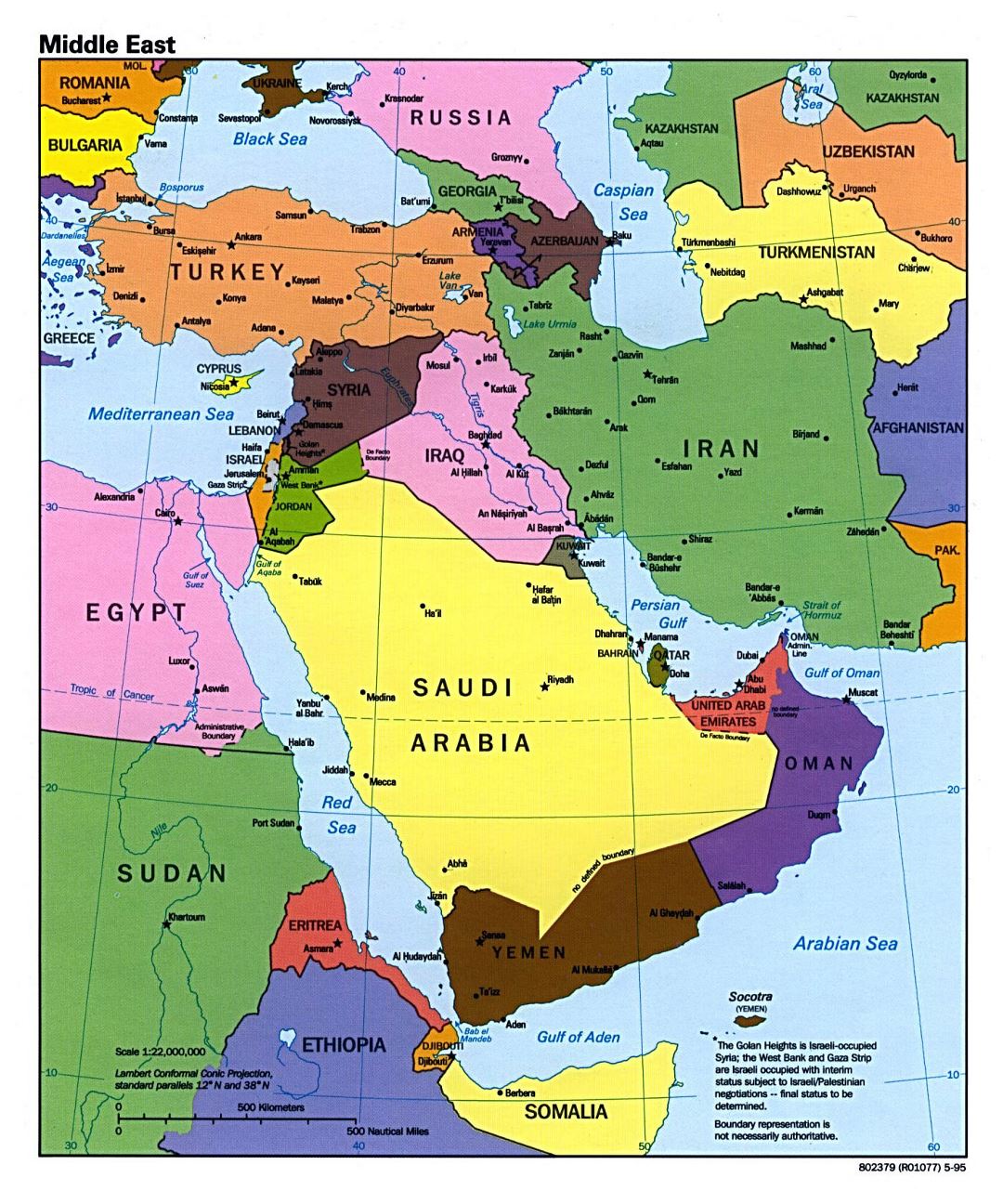
There are several aspects to this relatively recent interpretation which finds Russia in Ezekiel. First, some base their interpretation on a word which in Hebrew is “rosh”, which they then transliterate (instead of translating) as “Rosh”, which sounds like Russia, as discussed in the following. Others try to make a connection between Magog and the territory that it may have included historically, and a people group (not a nation) which came from the north and areas including what is now Russia, known as the Scythians – thus Magog is Russia. Still others mostly point to the phrase “from the remote parts of the North” referring to Gog, pointing out that Russia (the western part including Moscow) is pretty far north of Israel, almost the furthest North. Each of these and all of them are considered and evaluated in the following.
First, with regard to the word “rosh”, it first appears in the 2nd and 3rd verses of that 38th chapter:
2“Son of man, set your face toward Gog of the land of Magog, the chief prince of Meshech and Tubal, and prophesy against him, 3 and say, ‘This is what the Lord GOD says: “Behold, I am against you, Gog, chief prince of Meshech and Tubal.” (Ezekiel 38:2-3 NASB)
This key Hebrew is “Rosh” (רֹ֖אשׁ), which Strong’s renders as: (7218) “head”, “chief” (91x in KJV)
According to Brown-Driver-Briggs, “rosh” is translated: “a. head = chief (man) Judges 10:18; Judges 11:8,9,11; Exodus 18:25 (E), Numbers 1:16 (P), Deuteronomy 1:15; Hosea 2:2; Micah 3:1 + often; apparently combined with idea of first in a series 1 Chronicles 12:10. (van d. H. v.1 Chronicles 12:9, series of 11); of God 2 Chronicles 13:12.
It is translated “chief” in KJV, RSV, NASB, NIV, ESV, BSB, NAB, ESRV, CEV, NETB, NRSV, WBT etc. It is transliterated “Rosh” in NKJV, NASB 1995, 1977, NHEB, WEB, and YLT
Commentary on this word as used in Ezekiel 38 is as follows:
“The chief prince of Meshech and Tubal.—Rather, the prince of Rosh, Meshech, and Tubal. Our version has followed St. Jerome in translating Rosh “chief,” because formerly no people of that name was definitely known; but they are frequently mentioned by Arabic writers as a Scythian tribe dwelling in the Taurus, although the attempt to derive from them the name of Russian cannot be considered as sufficiently supported. In Revelation 20:8, Gog and Magog are both symbolic names of nations. For Meshech and Tubal see Note on Ezekiel 27:13.
…‘Magog’ is mentioned in Genesis 10:2 (1Chronicles 1:5) in connection with Gomer (the Cimmerians) and Madai (the Medes), as the name of a people descended from Japhet. Early Jewish tradition, adopted by Josephus and St. Jerome, identifies them with the Scythians; “ (Ellicott’s Commentary for English Readers, highlight added)

“Gog … – Gog of the land of Magog, prince of Rosh, Meshech and Tubal. ‘Gog’ is here the name of a captain from ‘the land of Magog’ (compare Genesis 10:2) the name of a people of the north, placed between ‘Gomer’ (the Cimmerians) and ‘Madai’ (the Medes). In the History of Assurbanipal from cuneiform inscriptions, a chief of the Saka (Scythians), called Ga-a-gi, is identified by some with Gog. Rosh, if a proper name, occurs in this connection only.” (Barnes Notes on the Bible)
“The chief prince of Meshech and Tubal — The king or head of all those northern nations which lie upon the Euxine sea: see note on Ezekiel 27:13.The LXX. take the word Rosh, here translated chief, for a proper name, and render the clause, The prince of Rosh, Meshech, &c. So taken it may signify those inhabitants of Scythia from whom the Russians derive their name …” (Benson Commentary)
With respect to the commentary about the use of the word in the Septuagint (LXX), in reality it is the same Hebrew word which is rendered Ῥώς in the Greek (for which no Strong’s number is given), which is then transliterated instead of translated. As such it becomes “Rosh” (a noun), for which the Strong’s number is again 7218, though some sources give it a different number of 7220, but then tell us it is probably the same as 7218, just “head’ or “chief” (confused and confusing at best).
“Gog is still further described as the prince of Rosh, Meshech, and Tubal. It is true that Ewald follows Aquila, the Targum, and Jerome, and connects ראשׁ with נשׂיא as an appellative in the sense of princeps capitis, chief prince. But the argument used in support of this explanation, namely, that there is no people of the name of Rosh mentioned either in the Old Testament or by Josephus, is a very weak one; whilst, on the other hand, the appellative rendering, though possible, no doubt, after the analogy of הכּהן ראשׁ in 1 Chronicles 27:5, is by no means probable, for the simple reason that the נשׂיא occurs again in Ezekiel 38:3 and Ezekiel 39:1, and in such repetitions circumstantial titles are generally abbreviated.” (Keil and Delitzsch Biblical Commentary on the Old Testament)
These commentators consider the fact that “there is no people of the name of Rosh mentioned either in the Old Testament or by Josephus” a weak argument. But the fact that “the נשׂיא occurs again in Ezekiel 38:3 and Ezekiel 39:1, and in such repetitions circumstantial titles are generally abbreviated” is a strong argument for “Rosh” being the name of such a people group. It would seem that the reverse makes more sense, an argument made also by others for “rosh” being the “appellative”, “chief”.
Perhaps the most popular commentary today, at least among conservative evangelicals who are futurists, gives us the following:
“The NIV translates the word rō’š in 38:2 as ‘chief.’ However, other translations have taken the word as a proper noun and translated it ‘Rosh.’ Should the Hebrew word, which means ‘head,’ be taken as an adjective (‘head prince,’ i.e., ‘chief prince’) or as a proper noun (‘Rosh’)? The evidence seems to favor taking it as an adjective. ‘Rosh’ never appears as a nation in any other biblical list of place names while all the other names are well attested (cf. Gen. 10:1-7; 1 Chron. 1:5-7; Ezek. 27:13-24; 32:26). One possible exception might be Isaiah 66:19 (NASB) but this is doubtful (see NIV). Should these names be connected with the Soviet Union? One must first identify the areas against which Ezekiel prophesied and then determine the countries that occupy those land areas today. Ezekiel‘s rō’š does not point to ‘Russia’ merely because the words sound similar. Neither should one identify ‘Meshech’ with ‘Moscow’ or ‘Tubal’ with ‘Tobolsk.’ Ezekiel had historical places in mind (not modern-day names) and these areas must be located in Ezekiel’s time. However, while one must avoid dogmatic assertions, three reasons suggest including the Soviet Union within Ezekiel’s prophecy: (1) Some of the countries named by Ezekiel were located in what is now Russia. (2) The armies are said to come ‘from the far north’ (Ezek. 38:6, 15; 39:2). This probably includes the land bridge between the Black and Caspian Seas, now part of the Soviet Union. (3) Ezekiel spoke of a coalition of several nations, many of whom are today aligned with or under the influence of the Soviet Union. These include Iran (‘Persia’), Sudan and northern Ethiopia (‘Cush’), Libya (‘Put’), and Turkey (‘Meshech,’ ‘Tubal,’ ‘Gomer,’ and ‘Beth Togarmah’). All these nations (see 38:2-3, 5-6), possibly led by the Soviet Union, will unite to attack


Israel.” (Charles Dyer, “Ezekiel”, The Bible Knowledge Commentary Major Prophets).
Magog ((Ge 10:2; 1Ch 1:5) is referred to in scripture as a land and a people group, descendants of Noah’s son Japeth (of course all living people groups are descendants of one of Noah’s three sons). Meshech and Tubal are people groups in scripture which are almost always mentioned together. They are also all identified as descendants of Japeth, son of Noah in Genesis 10:2. As noted in some of the commentaries cited above, nowhere do we see in scripture the word Rosh referring to a people group or a land. That connection is only said to come mostly from some Arabic sources.
As with so many of the more popular and now mainstream interpretations of scripture today, this idea that “rosh” in Ezekiel 38 is a proper noun referring to the modern nation of Russia may have been popularized by C.I. Scofield in his notes in the Scofield Reference Bible, which reads:
“(38:2) The reference is to the powers in the north of Europe, headed by Russia…. Russia and the northern powers have long been the persecutors of dispersed Israel, and it is congruous both with divine just and with the covenants of God that destruction would fall in connection with the attempt to exterminate the remnant of Israel in Jerusalem.”
This seems to be part and parcel with the Dispensationalists’ Pretribulation Rapture Theory, also popularized by Scofield’s notes. Until the latter part of the 20th century virtually all the various translations of this passage recognized and consistently translated the Hebrew word for “rosh” as “chief” or “head” when it was related to men and people groups. Thus, it was translated as “Gog the chief prince of Meshech and Tubal”. Only in relatively recent times, with the rise of Russia and the former Soviet Union, have men decided they need to change it to reflect or accommodate their theories that Russia will be this key player – with no actual grammatical or biblical reason for making such a change. As many Bible scholars have pointed out, to attempt to make the connection because the Hebrew word “rosh” sounds a little like the modern English word Russia, some even attempting to make the same connection between Meschech and Moscow and Tubal and Tobolsk in Russia, is not acceptable nor very rational. Furthermore, the historical connection with the ancient Scythian invaders is just as associated with what is now modern Turkey (Beth Togarmah) as it is with modern Russia.
This is just another case of the need to apply the most fundamental hermeneutic (rule of interpretation) of letting scripture interpret scripture, instead of relying on the knowledge and wisdom of men. Over the past few centuries at least, men interpreting scripture in light of the contemporary situations and events could have seen this Rosh as being Germany in WWII, or Rome, or Alexander the Great which actually did invade Israel, or currently many speculate that China is the biggest looming threat. Due north of Israel we have Lebanon, Syria, and Turkey (far north), before we get to Russia. Prophecy buffs of the previous decades (such as Dyer cited above) were telling us Rosh was the Soviet Union – a theory which is now already on the scrap heap of history, obviously.
However, much has been made in modern times of this fact that this Gog will come from “the remote parts of the north”:
“14Therefore prophesy, son of man, and say to Gog, ‘This is what the Lord GOD says: ‘On that day when My people Israel are living securely, will you not know it? 15 You will come from your place out of the remote parts of the north, you and many peoples with you, all of them riding horses, a large assembly and a mighty army;’” (Ezekiel 38:14-15)
The western part of Russia, including Moscow, is due north of Israel, the northernmost country short of the Arctic and the North Pole. Thus, the interpretation that this must be referring to modern day Russia. However, if we are really letting scripture interpret scripture we will consider how this same expression is used elsewhere in scripture, and what it is referring to there. And indeed it appears in the following:
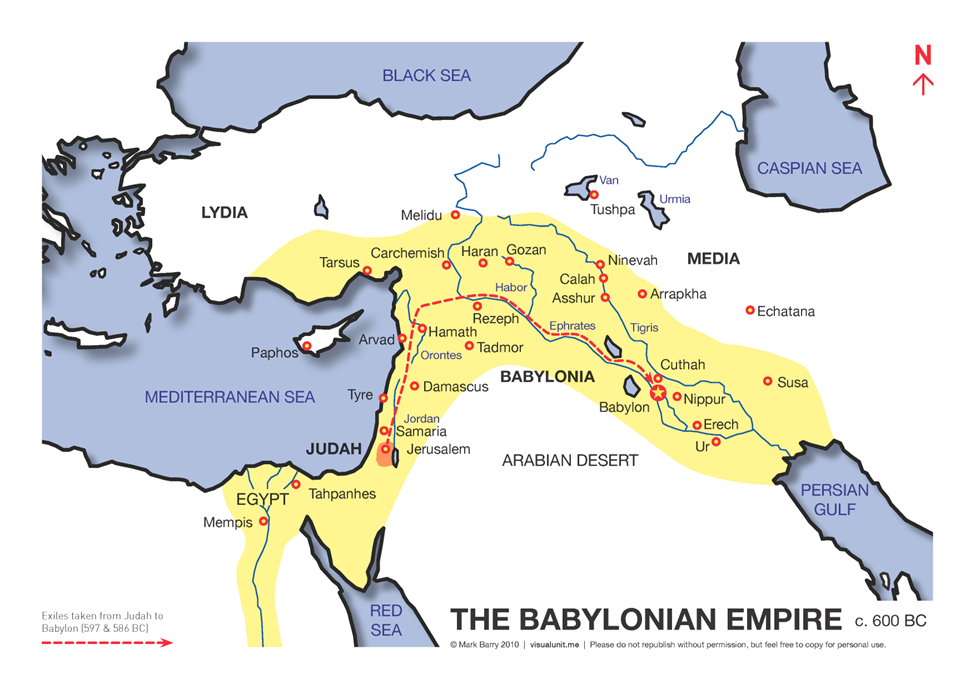
“41Behold, a people is coming from the north, And a great nation and many kings will be roused from the remote parts of the earth. 42 They seize their bow and javelin; They are cruel and have no mercy. Their voice roars like the sea; And they ride on horses, drawn up like a man for the battle Against you, daughter of Babylon.”(Jeremiah 50:41)
To know what this “remote parts of the earth” is referring to we have to keep it in its context, not just look at a modern map and pick one of those nations or areas north of Israel. And in fact, Jeremiah tells us what he is referring to:
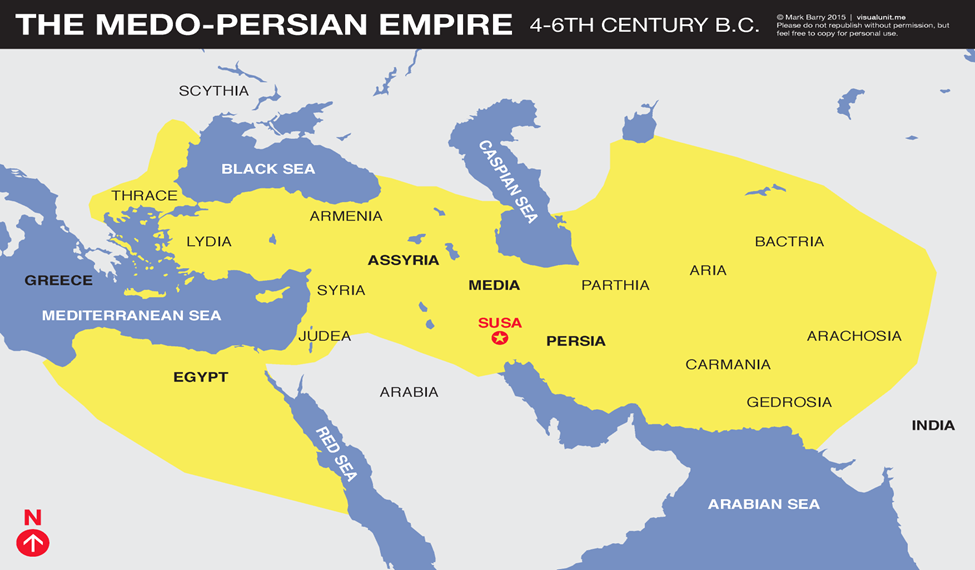
“11Sharpen the arrows, fill the quivers! The LORD has stirred up the spirit of the kings of the Medes, Because His plan is against Babylon to destroy it;” (Jeremiah 51:11)
27…Summon against her the kingdoms of Ararat, Minni, and Ashkenaz; Appoint an officer against her, Bring up the horses like bristly locusts. 28Consecrate the nations against her, The kings of the Medes, Their governors and all their officials, And every land under their control.” (Jeremiah 51:27-28)
“30That same night Belshazzar the Chaldean king was killed. 31So Darius the Mede received the kingdom at about the age of sixty-two.” (Daniel 5:30-31)
It is the kingdom of the Medes which conquered Babylon, which is referred to as coming “from the north …from the remote parts of the earth”. That empire was mostly east northeast of Israel, but not north of the Black Sea, as in modern Russia. The nations mentioned by Ezekiel are all Muslim nations surrounding Israel now, which have always been, and continue to be her enemies. Compared to them, modern Russia has only been indirectly and peripherally associated with Israel, and now by virtue of her unofficial alliance with Iran and Syria and some of those other middle eastern nations.
While it is true that just the existence of Israel as a nation, as well as the fact that her current enemies surrounding her are among those identified in Ezekiel 38, all are indicators that we are in the “end times”, this does not mean that the Gog Magog war is on the near horizon, as in for example the current situation in Israel today (the Israeli war against Hamas in Gaza as of this writing). If we pay much attention at all to the description of the situation in Israel at that time (living securely in her land with unwalled cities), or the outcome of this battle (God’s Spirit poured out on Israel, His name never to be profaned again, their enemies destroyed), there is no way this fits into a current time frame, and even less so any time during the 7 year Tribulation period. However, it is such presuppositions that drives this very temporal interpretation that “rosh” must be “Rosh” meaning Russia, instead of “chief” or something similar as it is normally translated in the over 500 instances where it appears in scripture.
However, there is a time frame in the context of end time prophecy when all of this fits perfectly, which is the only time any of it actually makes any sense. It is the interpretation we actually get by letting scripture interpret scripture. As one would surely expect, such a major event as this Gog/Magog war is found in Revelation – amazingly (or maybe not surprisingly at all) called Gog/Magog. In Revelation 20 John gives us only 2 verses to describe what Ezekeil describes in detail in 2 whole chapters, but there we are specifically told when this will occur relative to the other end time events. Furthermore, it is the only time in all of human history up to the future end of such history, when the setting and the outcome described by Ezekiel can possibly even be a reality, realistically and objectively speaking. Of course, those who subscribe to the “rosh” is Russia theory, and the associated Pretribulation Rapture version of Dispensationalism in general, find all kinds of reasons why the Gog/Magog in Revelation 20 can’t be the same as that of Ezekiel 38-39. These imagined discrepancies are addressed in detail in the related article, “Problems with the Arguments that the Gog of Ezekiel is not the Gog of Revelation”, but briefly consist of the following:
- Mostly they are based on the presupposition that the two accounts are about two very different time frames, assuming that their theory that Ezekiel’s prophecy is about a premillennial time frame (before or during the Tribulation Period), and John’s prophecy is about the end of the Millennium – which is a classic case of circular reasoning – arguing from their premise (assuming that what they are trying to prove is a fact);
- Differences between the two accounts which are only matters of details included in the 2 chapters in Ezekiel versus the very brief account in only 2 verses in Revelation, which obviously doesn’t mention all of them;
- Complete misinterpretations of key words to derive incompatible differences (e.g. katesthiō as only meaning consume entirely in Rev. 20:9);
- Blatant errors in logical reasoning.
An example of this is the argument that Ezekiel says Gog comes from the far north, but John’s account has them coming from the four corners of the earth. The simple truth is that John does not say that Gog comes from the four corners of the earth (which would be quite impossible), but that the nations which follow him are those nations surrounding Israel from all directions. By the same token, Ezekiel also tells us that the nations following Gog will come not only from the north, but from the east (Persia = Iran), south (Cush = Ethiopia), west (Put = Libya), as well as from the North (Gomer and Togarmah = Turkey). Why would anyone make such an inaccurate argument except for overriding presuppositions driving their interpretations? Every one of their arguments are of a similar nature, none actually making the case for requiring the two accounts to be entirely different – even though God inspired Ezekiel to use the same name for both, with descriptions that are 100% in agreement. There is nothing in the account in Revelation 20:8-9 which in any way differs in substance, or conflicts with Ezekiel 38-39.
The reality is that the only time Israel will ever be living securely in her land (no matter what she believes or feels like) will be during and immediately after the 1000-year Millennial Kingdom of God on earth. The only time all of her enemies will be defeated, and she will be whole-heartedly devoted to her God, and all God’s promises to Jacob will be fulfilled, and His Spirit will be poured out on all Israel, will be during and after the Millennial age, exactly where John puts it in Revelation. Surely everyone will have to admit that at no time before or during the 7-year Tribulation Period can it be truthfully said that God’s name will never again be profaned – that won’t happen until after Christ’s return to finally save His followers and judge the whole heaven and earth, and establish His Millennial kingdom on the recreated earth. All of these have to be true for Ezekiel 38-39 to be said to be fulfilled (not just some, as in the regathering of Israel in the promised land).

 end times revisited