
“The Seven-year Tribulation Period“- Scripture does not explicitly tell us in a few words that there will be a 7 year time period called “the Tribulation Period” in the last days before Jesus returns at the second coming. That there is such a future period is pretty clear and is the main subject of the book of Revelation and much of the Old Testament prophecies, especially Daniel (though many deny that, arguing that it is all symbolic, or hyperbolic, some believing it is historical more than future). Thus it is necessary to put together many pieces of the puzzle to get the picture right. That however is not necessarily easy or obvious. It actually involves a lot of letting scripture interpret scripture, and even some mathematical calculations, some of which are addressed in the following.
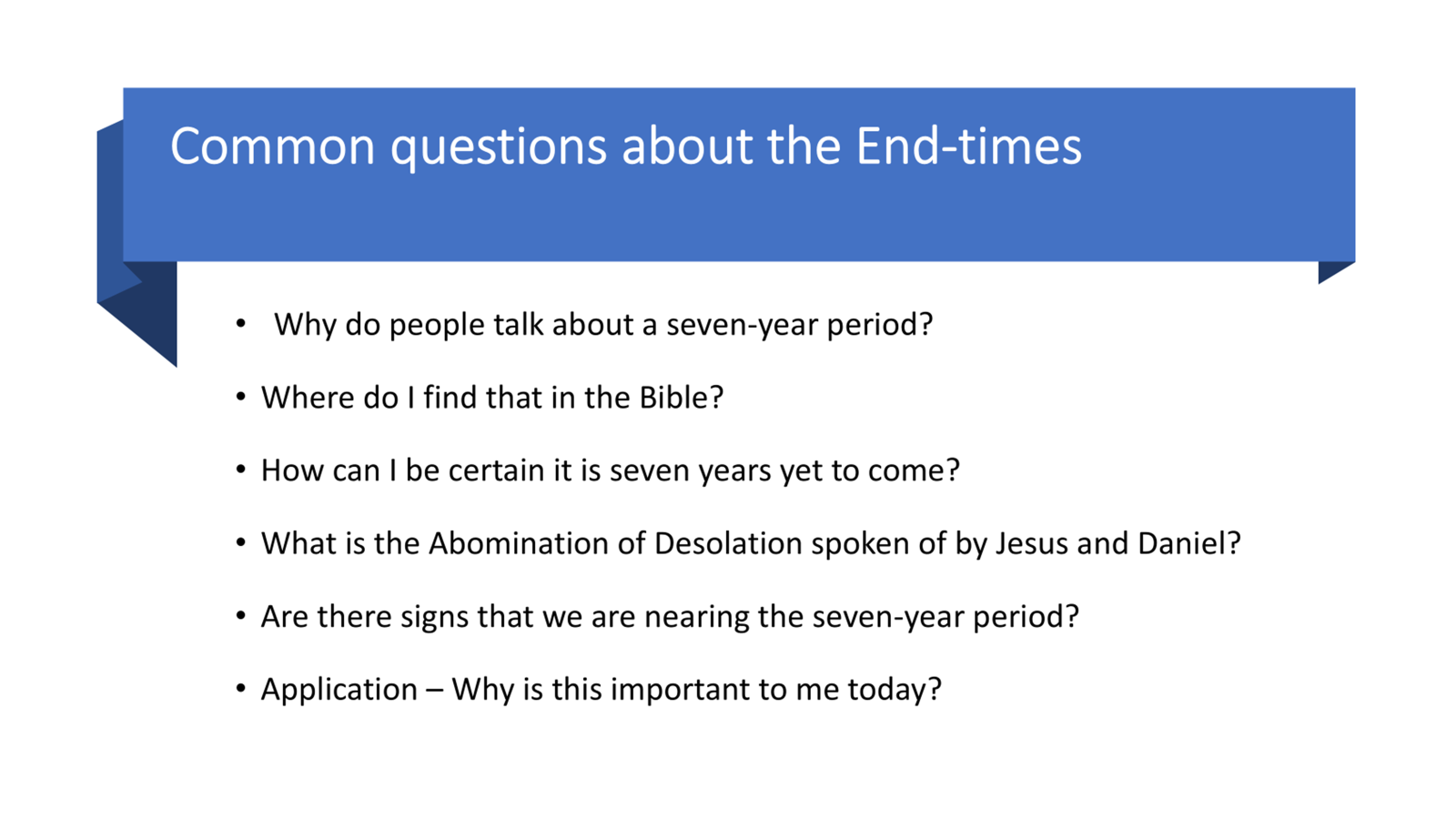
So the challenge is to try to answer these questions
The first 4 questions are actually answered in the following passage from Daniel 9:24-27:

Ok, do you see the answers there. I guess we can close in prayer now – unless maybe someone doesn’t see the answers – anyone here who doesn’t see it yet?
The reality is that this whole broad subject of end time prophecy in general, and a future Tribulation Period in particular, is pretty complex – it is like a complex multipiece puzzle – many pieces spread throughout scripture which have to be recognized, and put in the right place, and they all have to fit together without forcing them to fit, and we can’t ignore or leave out any of the pieces to get the right picture – like this puzzle I once put together – what a job that was. But that was nothing like putting together this puzzle to get a picture that really made sense, and included all the pieces – which has taken me about 20 years and counting.
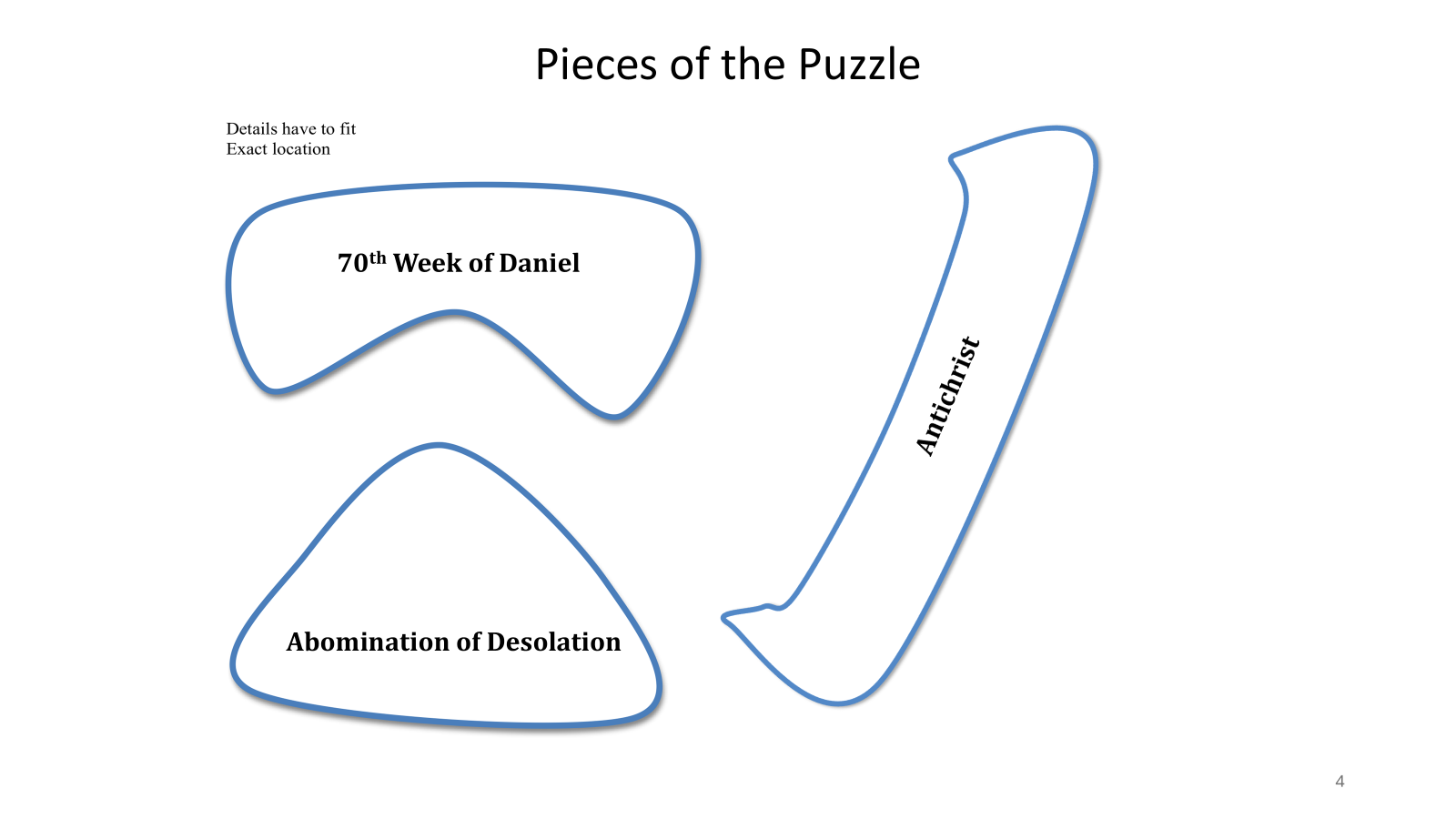
This piece in Daniel 9 is a big part of the puzzle, with key pieces which have to be accurately interpreted and arranged to get the right picture – and frankly, I have found that most scholars and theologians haven’t gotten it right, thus we get all kinds of theories and end times scenarios that prove to not be entirely biblical, and usually don’t really make much sense.
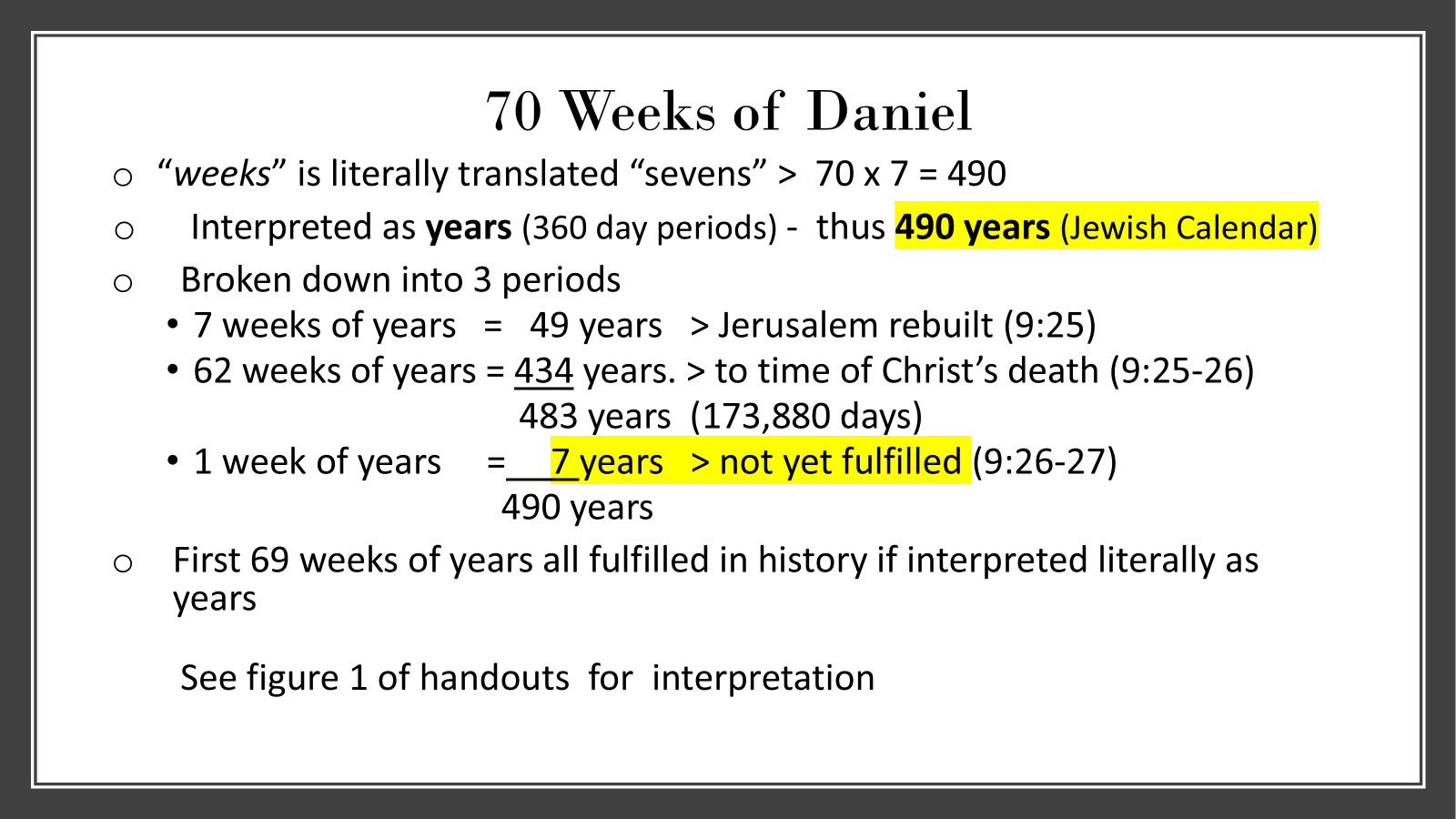
First, we see Daniel prophesies that there will be 70 weeks, which gives us the key and critical time-line for all the prophetic developments and events to happen up to what he refers to as “the end”. That word in the original Hebrew, here translated “weeks” is the Hebrew word shabooah (šāḇûa), which is literally just “sevens” in English. Thus, Daniel is prophesying here about a period in his future which will cover 7 x70 or 490 periods of time.
It turns out, if we take these periods of time as literal years, it is absolutely amazing how accurate his prophecies were with respect to their actual fulfillment in history – but that’s only true if we interpret it as literal years, or weeks of years. Otherwise, the interpretations men come up with are almost entirely a matter of speculation, with a lot of diversity with respect to the puzzle picture they come up with – and there are many.
So Daniel breaks this 70 weeks of years, or 490 years, into 3 periods:
- 7 weeks of years = 49 years > this first period in which Jerusalem was to be rebuilt (9:25)
- 62 weeks of years = 434 years. > the following time period up to the time of Christ’s death (9:25-26)
- all this adds up to 483 years which using the Jewish Calendar of 360 days/yr gives us 173,880 days
- then the 70th week, 1 week of years = 7 years > not yet fulfilled (9:26-27)
- this all adds up to 7 X 70 or 490 years.
Of course what we have to know to really make sense of this is what theologians call the terminus ad quo and the terminus ad quem, or in English, when does this timeline start, and when does it end.
When we lay this out as a timeline, we get this whole 70 weeks or 490 years beginning with the decree issued by Artaxerxes Longimanus to “restore and rebuild Jerusalem“, the 25th verse of Daniel 9, which is also mentioned in Nehemiah 2:1-8. Scholars and historians date this at about 444 BC. In fact, some have given an exact date of March 5th 444 BC. Then the end of that 69 weeks, or 434 years of 360 days/yr. (per the Jewish calendar) is according to Daniel what Daniel wrote, when “the Messiah will be cut off” – which again some scholars give us a specific date of March 30th – don’t ask me how they know this, but when we convert it to days it works out to be incredibly exact, as we will see on the next slide.
Then the next thing Daniel names in the 26th verse of that 9th chapter is one more week of years, which we see has to be a time still in the future, because unlike the prophecies about the other 69 weeks of years, it has not been. fulfilled yet any time in history.
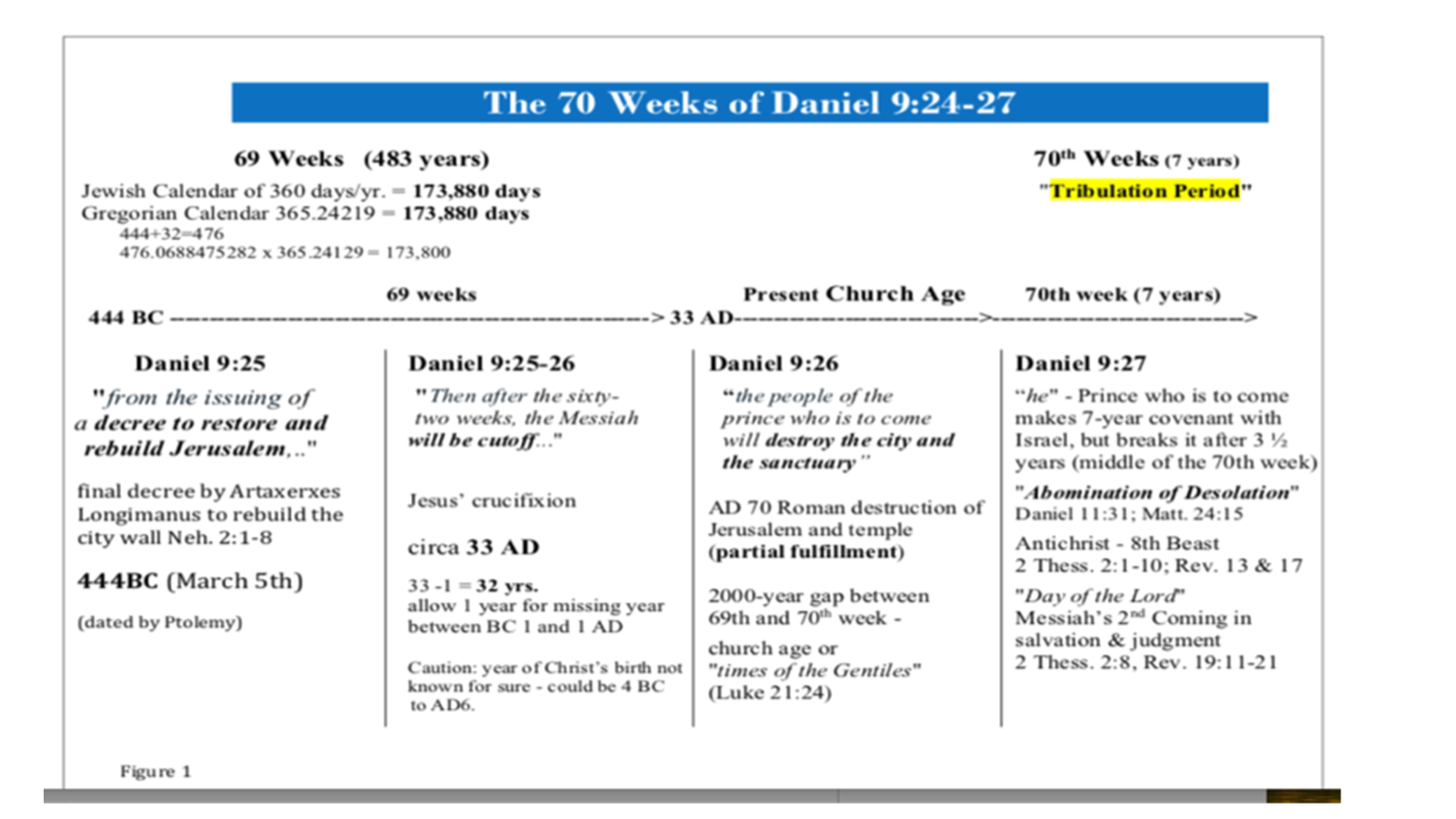
So here is where we have to do the math. First, we have to convert the times from the Jewish Calendar of 360 days/year to the Gregorian Calendar of slightly over 365 days/year to match up to the dates as we know them. Doing this, if we start with 444BC when the final decree was given to restore and rebuild Jerusalem, not just the temple but the walls also, and we go to the time or date of Christ’s death, at 33 AD, we add these two together to get 477 years. But we have to subtract 1 year, since BC 1 and AD 1 are the same year on the calendar, which then gives us 476 years
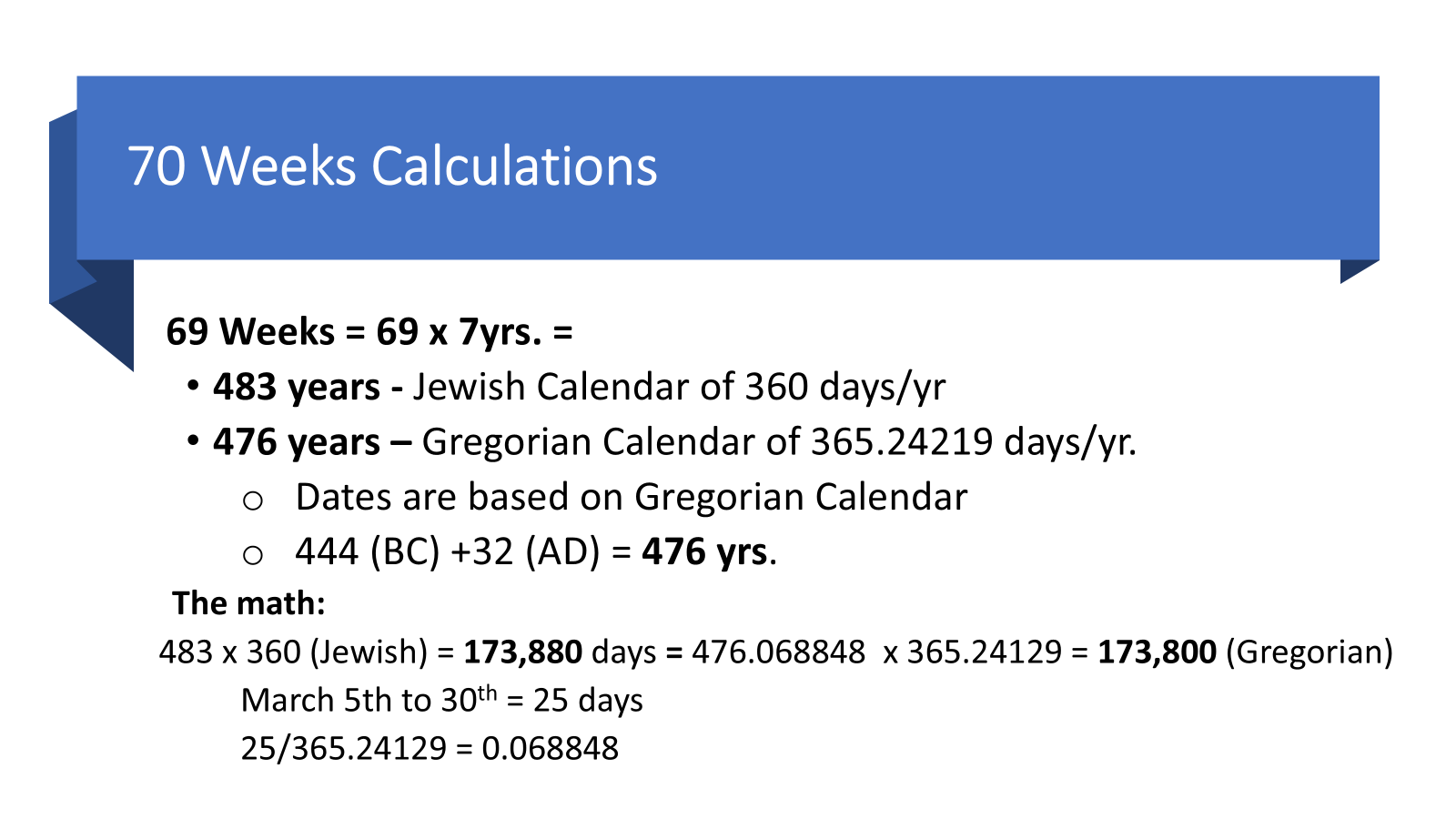
If we then convert this to exact dates, from March 5th 444 BC to March 30th 33 AD, which is 25 days, we get 476.068848 times 365.2129 days/year, which equals 173,800 days. This is exactly equal to Daniel’s 483 years using the Jewish Calendar, 483 times 360 days = also exactly 173,800 days.
Combining this with other pieces of this puzzle given to us in Daniel’s prophecies, we see that Daniel has not only given us this timeline which we can relate to actual historic dates, but he has even predicted actual kings and empires that would come and go over that time period, up to a point. We have amazing prophecies in chapters 2, 7, 8 and 11, that begin with his interpretation of Nebuchadnezzar’s dream about a giant statue. this is followed by Daniel’s own vision featuring 4 beasts in chapter 7, and another vision in chapter 8, in which he actually identifies and interprets 3 of those four beasts in terms of empires which were to come after his time. Here are one of the proofs that we have that what Daniel wrote here was divine revelation, inspired by God. What Daniel predicted, with some incredible details, has been fulfilled and is recorded for us in history.

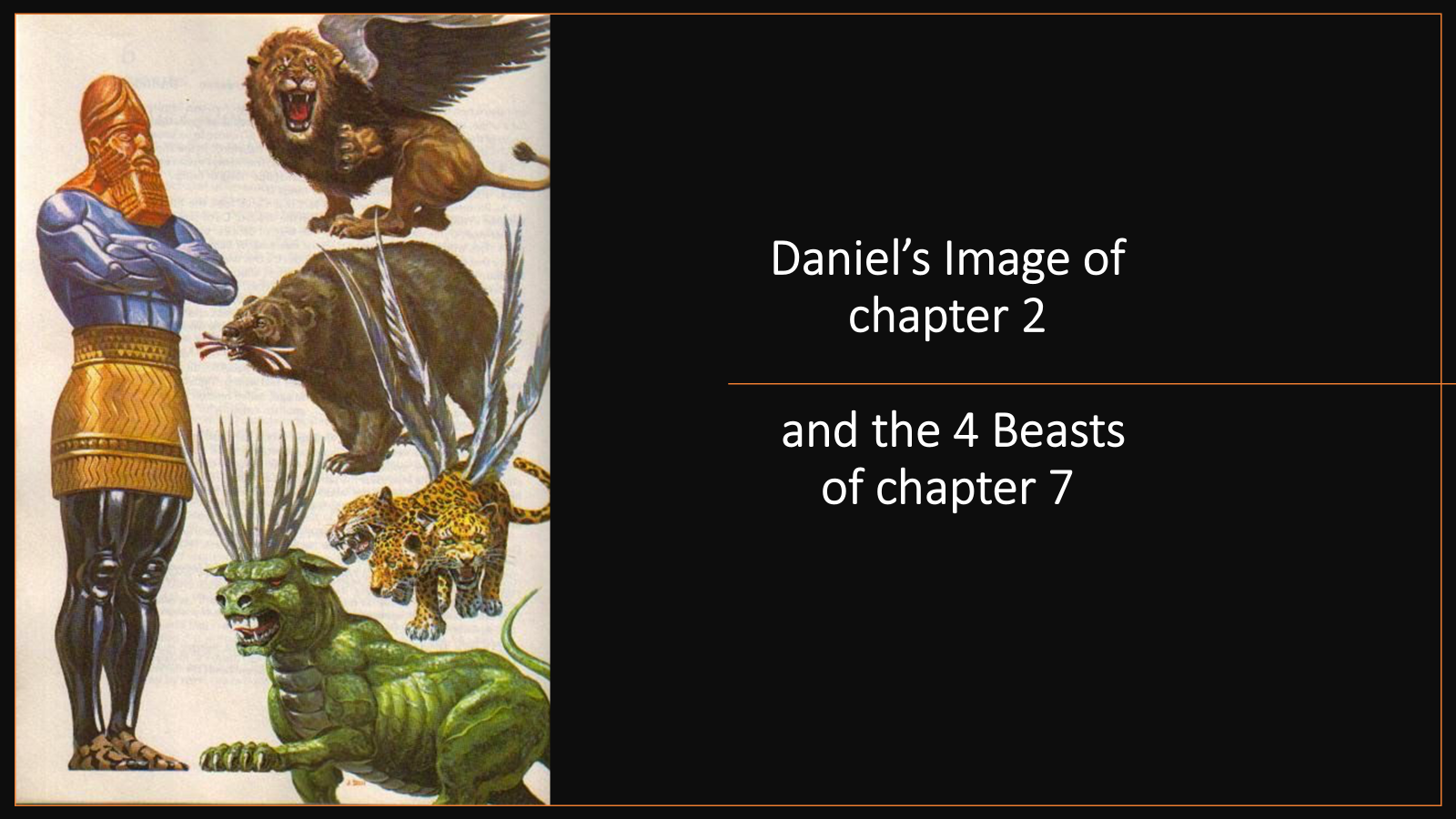
This slide gives us an artist’s rendition of Daniel’s statute in Chapter 2 as it corresponds to the Beasts in chapter 7. We see the head of gold of the image, which Daniel told Nebuchadnezzar was him and His Babylonian Empire. This corresponds to the winged lion of chapter 7. Then the arms and shoulders of silver of chapter 2, corresponds to the Bear of chapter 7, and the belly and thighs of bronze corresponds to the winged leopard of chapter 7. The legs of iron and their extension in the two feet and ten toes then correlate to the final terrible ten horned beast in chapter 7.
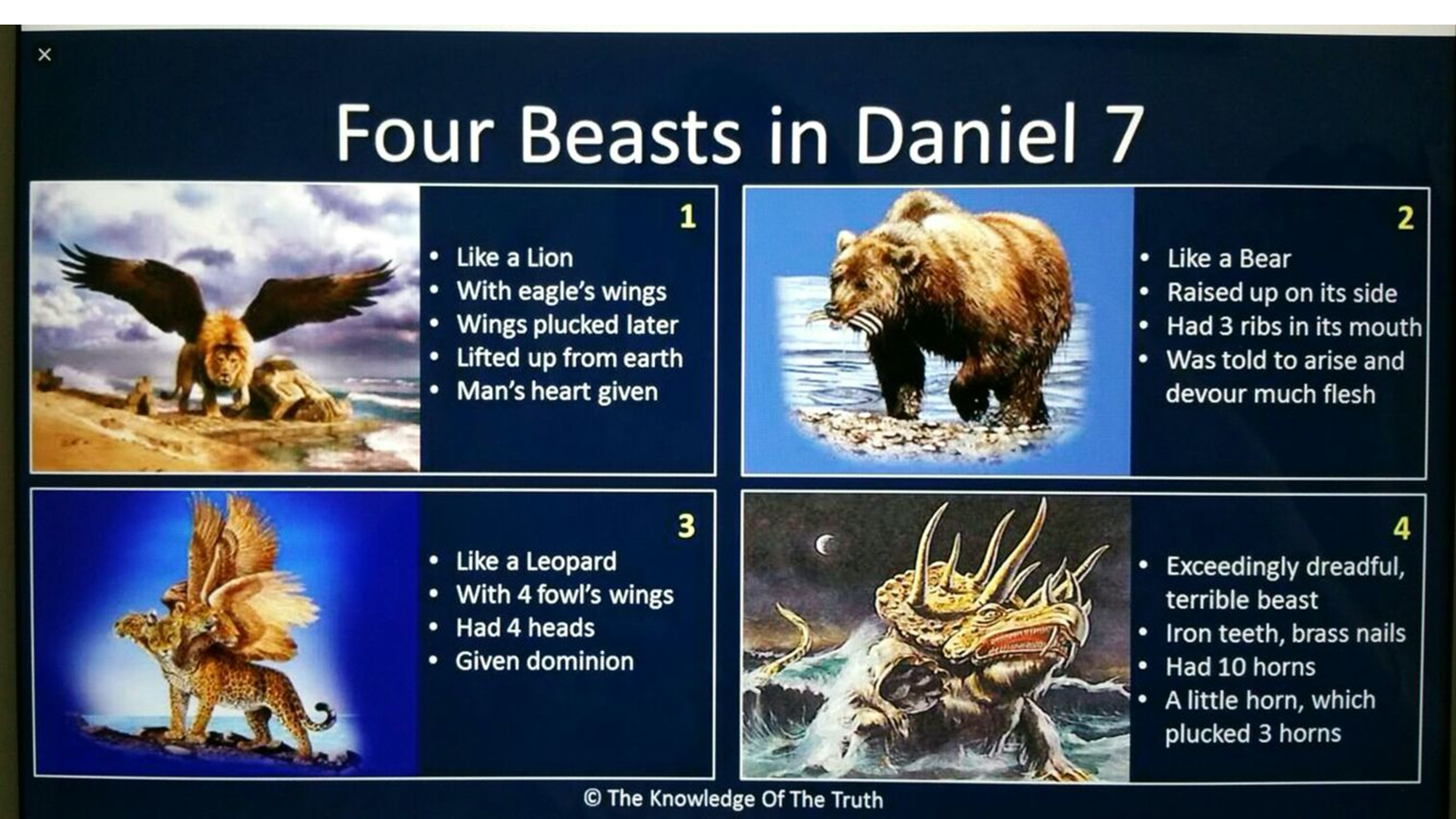
Here we see another artist’s conception of these four beasts of Daniel 7.
I wish I had time to go into them a little more, but that would be another class, maybe for another time
What I do want to point out though is how these relate or correspond to each other, as connected pieces of this puzzle, and the fact that we don’t really need to speculate as to what they symbolize, as some men do – Daniel interprets them for us. In chapter 2 he told us that the head of God was Nebuchadnezzar, the Babylonian Empire, which was also the winged lion of chapter 7. Then in chapter 8 he interprets the following two beasts, the bear and the leopard. In 8 he uses the symbol of the ram with 2 horns, which he then discloses as being the Medo-Persian Empire. He goes on in that 8th chapter to identify the next empire, there symbolized by the male goat with 1 large horn, as the Grecian Empire, which we know as the Empire of Alexander the Great. The following empire identified we also know well from actual history, as the four Generals symbolized by the four heads and wings of the leopard in chapter 7, and the four horns replacing the one large horn in chapter 8. After that Daniel sees a little horn, like the little horn of the 4th beast of chapter 7, which also grows into a larger more powerful empire, which invades the “beautiful land”, Israel, and puts an end to sacrifices in the temple. This last has been partially fulfilled in history in the Seleucid Empire ending with the historic figure known as Antiochus IV Epiphanes, whom we will see is interpreted later as the one associated with another key puzzle piece, the “Abomination of Desolation”

I know this slide has too much information, but we have already looked at the first three columns of chapters 2, 7, and 8, as well as our text in chapter 9, now we add to that what we see in Daniel 11, and how it all corresponds to what we find prophesied in Revelation, especially in Revelation 13 and 17. In Daniel 11 he begins with that Medo-Persian empire, which just as he had foretold in the preceding prophecies in 2, 7 and 8, succeeds the Babylonian Empire, beginning with the historic Darius the Mede, which is followed by 4 Persian kings. He then refers to the Grecian Empire, the 3rd beast of chapter 7, the ram with 1 large horn of chapter 8, and now the “mighty king” of chapter 11, which we know as Alexander the Great. Then, as in the 8th chapter, he goes on in this 11th chapter to mention those four rulers that would divide Alexander’s kingdom between them, which we know from history were Seleucus, Ptolemy, Antigonus and Cassander.
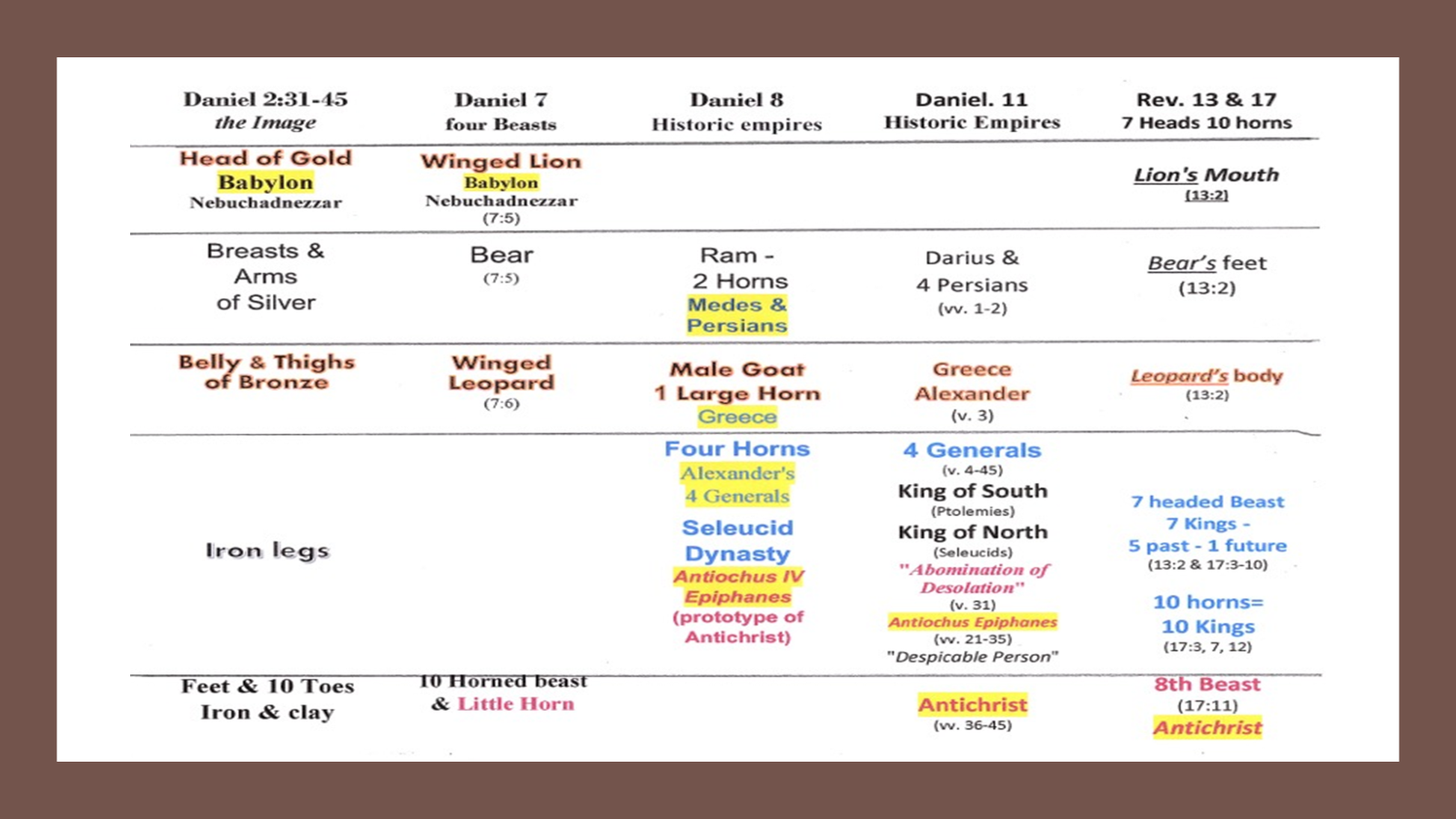
But then he continues to prophesy about two kings, identified as the king of the South and the king of the North, which are easily identified as Ptolemy who ruled over the Egyptian kingdom, and Seleucid which ruled over the more northern and eastern empire, which included the Mesopotamian regions, now known as the Middle-East, which we can see from this map. It is that Mesopotamian area which is the focus of Daniel’s prophecies. But it was the Seleucid kings which were in ongoing conflict with the Ptolemies in the south, which are recorded for us in amazing detail in this 11th chapter. Interestingly Israel is caught in the middle between the two, which Daniel refers to as “the beautiful land“.

But from this Seleucid Dynasty of kings came one Daniel identifies as “a vile person” in the King James Version, or “a contemptible person” in the NIV, or “a despicable person” in the NASB, who will invade Jerusalem, “desecrate the sanctuary fortress, and do away with the regular sacrifice“, and this is where we see again this “abomination of desolation” with which he will desecrate the temple. Historically all of this has happened in the person of Antiochus IV Epiphanes in the year 164 BC. Thus, most Bible scholars who accept the more literal interpretation approach and are thus futurists, consider this Antiochus to be a prototype of the future ruler, the “little horn” of the 4th beast of Daniel 7 and of the 8th and final beast of Revelation, which we identify as “the Antichrist”.

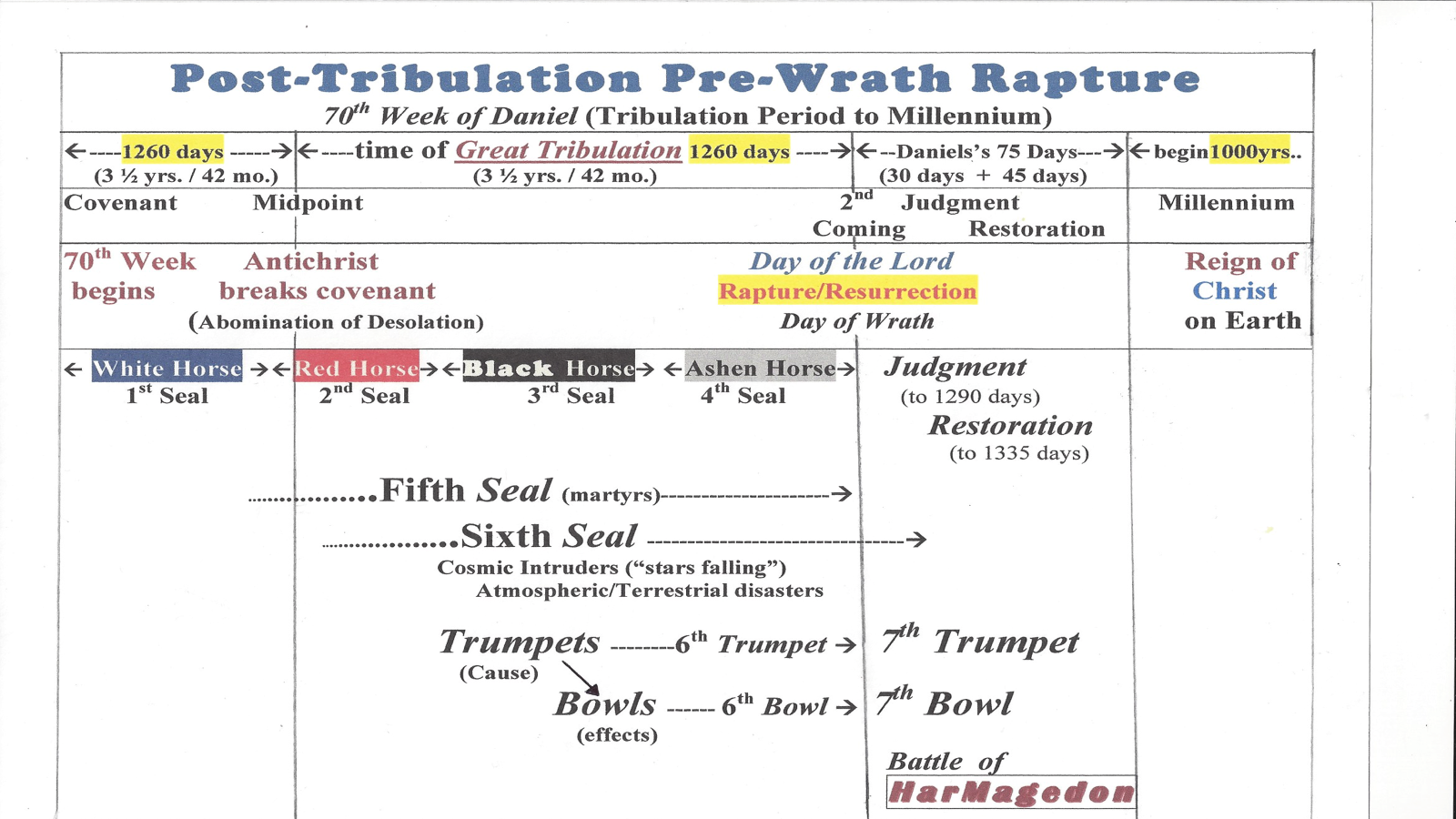
Going back then to where this “Abomination of Desolation” is first mentioned, our original text in Daniel 9:27, we see that it is this “prince” who is to come, which we have identified as the future Antichrist, who breaks his 7-year covenant with Israel after 3.5 years – the midpoint of that still future 7-year period, which we know as the “7-year Tribulation Period”. This is when that future Antichrist sets himself up in the temple claiming to be God, and demanding worship, which is prophesied in 2 Thessalonians 2 in detail, and again in Revelation 11 and 13.
If time allowed we would go into the 7 heads of the beast of Revelation, and the one head with 10 horns, one of which becomes a most prominent horn which John also calls the 8th Beast, which is the Antichrist.

Summing it up by putting all the puzzle pieces together where they actually fit together, we begin with the 70 weeks of Daniel 9:25-27. Sixty-nine of those 7 year periods (called “weeks”) have already been fulfilled in history, some explained in chapter 8 (the Medo-Persian and Greek empires), the rest in chapter 11 (the Ptolemaic (Egyptian) empire and the Seleucid (Syrian) empire down to Antiochus IV Epiphanes). However, the 70th week of 9:27, and the last part of chapter 11 and chapter 12 have not yet been fulfilled, and are thus understood to be still future, which Daniel refers to as “the end time” (11:40, 12:9) and “the end of the age” (12:13).
This Antiochus IV Epiphanes partially fulfilled the prophecy in Daniel 11:21-35, but is seen as a prototype of the Antichrist, who will completely fulfill those prophesies through the end of that 11th chapter and chapter 12. The end times Antichrist is the one who will make the 7 year covenant with Israel, and break it after 3 1/2 years (Daniel 9:27). He will commit the fulfillment of the “abomination of desolation” prophesied by Daniel (9:27 and 11:31). That this is about that future Antichrist is known by what Jesus prophesied in the Olivet Discourse of Matthew 24, where he referred to this “abomination of desolation which was spoken of through the prophet Daniel” (Matthew 24:15), clearly in context predicting an event yet future to him, thus not to be confused with the historic event of the prototype Antiochus in 167 BC.
Further evidence that Daniel’s 70th week is about a time still in the future, is the repeated prophecy appearing again in this 27th verse of Daniel 9 that this 70th week concludes with “a complete destruction, one that is decreed, is poured out on the one who makes desolate.” That is inarguably referring to the second coming of Christ on that final “day of the Lord”, the “day of the Lord’s wrath”. Thus we have the 7 year period, which we know as “the Tribulation Period”.
However, we also see another set of references to time periods, which are identified as part of this 7 year period, what Daniel and Revelation first refers to as “time, times, and half a time”, and is equated to 1260 days and 42 months in Revelation.

The fact that this same time period, “time, times and half a time“, appears first in Daniel (7:25 and 12:7) and then again in Revelation (12:14), is another clear indication that both Daniel and John in Revelation are referring to the same period, “the end time” as Daniel defines it. This concurs with the period of 1260 days of Revelation 11:3 and 12:6, and the 42 months of 11:2 and 13:5, which equal 3 1/2 years – half of the 7 year Tribulation Period. Since they all three are referring to the same time period in Revelation, it can be confidently understood that the “times” are years, thus 1 year, plus 2 years, plus 1/2 year, equaling 3 1/2 years, the same as the 1260 days and the 42 months. This is what is known as keeping each passage in context and letting scripture interpret scripture, as opposed to the many speculative interpretations so many men resort to.
Additionally we see a clear description of this “abomination of desolation” Daniel and Jesus prophesied about in Paul’s second letter to the Thessalonians, chapter 2, which leaves no doubt about the timing of the rapture of the church: ” 3Let no one in any way deceive you, for it will not come unless the apostasy comes first, and the man of lawlessness is revealed, the son of destruction, 4who opposes and exalts himself above every so-called god or object of worship, so that he takes his seat in the temple of God, displaying himself as being God.” (2 Thessalonians 2:3-4)

We also see 1290 days and 1335 days prophesied in Daniel 12:11-12, which would be the 1260 days of the last half of the 7-year Tribulation Period, with an additional 30 for the “day of the Lord” judgment on the whole earth, and an additional 45 days for the restoration, as in the new heavens and earth of 2 Peter 3:10-13 being created to become the perfect Kingdom of God on earth, the Millennial age.

 end times revisited