The main claim with respect to the supposed biblical truth of the whole Nephilim theology is based primarily on one passage of scripture, Jude 14-15, which also appears almost verbatim in Enoch 1, chapter 1, the 9th-10th verses, which says:
“And behold! He cometh with ten thousands of [His] holy ones To execute judgment upon all, and to destroy [all] the ungodly: And to convict all flesh Of all the works [of their ungodliness] which they have ungodly committed, And of all the hard things which ungodly sinners [have spoken] against Him.”
The Book of Jude says:
“14It was also about these people that Enoch, in the seventh generation from Adam, prophesied, saying, ‘Behold, the Lord has come with many thousands of His holy ones, 15to execute judgment upon all, and to convict all the ungodly of all their ungodly deeds which they have done in an ungodly way, and of all the harsh things which ungodly sinners have spoken against Him.’”
However, the critical question is like the proverbial chicken or the egg question – which came first. If this line from Enoch 1 was written before the book of Jude, then it appears that Jude was just quoting from that earlier source,1 Enoch 1:9-10. That would be strong evidence that the Book of Enoch, at least that first of five books, was divinely revealed truth, inspired by God. It also strongly implies that Jude was getting his information from other sources other than just divine inspiration, specifically this Book, or the supposed oral tradition of a prophecy from Enoch, which predated the Christian era. Of course, if it is assumed that Enoch 1 was inspired by God that would be no different than the other inspired writers of scripture when they quoted from other passages of inspired scripture. But that then is the critical question, whether such an assumption is based on the reality of the matter, that the book of Enoch is accurately dated to before the book of Jude, and what evidence is there that such is the case?
Dating of the Book of Enoch
Perhaps the most prominent advocate for the whole Nephilim theology, Timothy Alberino, which he basis mostly on this Book of Enoch, gives the following explanation:
Modern scholars believe that the Book of Enoch was originally composed in Aramaic or Hebrew (or a combination of both), but a complete manuscript in either language has never been found. Although significant Aramaic fragments of Enoch were discovered among the Dead Sea Scrolls in the caves of Qumran (circa 1946), confirming its considerable antiquity, a decisive dating of the work remains elusive. The difficulty arises from the observation that portions of the text appear to have been produced at various periods of time by different authors. The older sections, namely, the Book of the Watchers (chapters 1–36) and the Book of Parables (chapters 37–71), were undoubtedly compiled long before the birth of Christ, as their content was known to and referenced by the writers of the Old Testament, including the author of Genesis. The later sections, especially those containing astronomical exposition, may have been added between 100 BC and 200 AD. Because the author (or authors) cannot be positively identified, the Book of Enoch is considered pseudepigraphal (a work that falsely claims to be authored by a biblical character); nevertheless, there remains a distinct possibility that the oldest portions of the text were indeed written by the hand of Enoch in the antediluvian age and preserved through the deluge by Noah.
Adding to the confusion concerning authenticity, three separate works bearing the name of Enoch have been circulating since the early eighteen hundreds. As the differences between the texts are too numerous to detail in this modest introduction…” (The Book of Enoch Volume 1 in the Nephilim Series Relic Press First Paperback Edition, 2024 Copyright © 2024 by Relic Press).
First, while ostensibly a convinced believer and strong advocate for the view that this Book of Enoch is on par with divinely inspired scripture, extant at least 100 years before the book of Jude was written, one should note his implicit admissions:
“Modern scholars believe that the Book of Enoch was originally composed in Aramaic or Hebrew (or a combination of both), but a complete manuscript in either language has never been found.”
To the discerning objective critical thinker this should be a matter of no little concern, with regard to his claims for its early dating. The only extant manuscript evidence is not even in the original language, but translations.
“Although significant Aramaic fragments of Enoch were discovered among the Dead Sea Scrolls in the caves of Qumran (circa 1946), confirming its considerable antiquity, a decisive dating of the work remains elusive.”
So, the strongest advocate for the authenticity, and reliability of the book has to admit that the only evidence we have, in what may have been the original language of Aramaic, are “fragments” found among the Dead Sea Scrolls (DSS). However, even with regard to the dating of those fragments “a decisive dating of the work remains elusive” – i.e. scholars don’t really know, which is true because of the lack of evidence, and the very poor and degraded quality of the evidence they do have. While Alberino is to be congratulated for his honesty at this juncture, unfortunately the rest of what he writes assumes and conveys the impression that it is a well-known fact that this source document is from the pre-Christian era, dated somewhere between about 100 to 300 BC. He writes:
“The older sections, namely, the Book of the Watchers (chapters 1–36) and the Book of Parables (chapters 37–71), were undoubtedly compiled long before the birth of Christ.”
Thus, he insists that Jude was quoting from this book of Enoch, and much of what we find in the NT Gospels also originated with Enoch. However, he does qualify this stating that this only applies to the 1st and 2nd books of Enoch, not the other 3 books.
He proceeds to admit that “portions of the text appear to have been produced at various periods of time by different authors.” In other words, what we do have in the way of manuscript evidence, the few DSS fragments, are recognized to be from texts written at different times and by different authors (what happened to the prophecies coming from Enoch, or his descendants?). Indeed, he goes on to admit that “the author (or authors) cannot be positively identified”, and that is why it is considered “pseudepigraphal” (a work that falsely claims to be authored by a biblical character)”. In other words, he is telling us the truth, that this is one of the primary reasons why this Book of Enoch is not included in the Canon of scripture, among other very valid reasons. However, to him that does not matter because he makes it clear that he has no regard for the Canon, or Canonicity, which he discredits by accusing the early church fathers as having somewhat ulterior motives in the choices they made – instead of the objective and reasonable criteria they claimed to be using. An objective critical thinker will find this a matter of considerable concern, asking the reasonable question, without such an objective standard (canon), with a well-defined set of criteria, how could anyone discern what actually is to be accepted as divinely inspired scripture, and what is not. Apparently, men like Alberino don’t find that to be of any importance.
The reality is that there are many very old works of literature, some BC and others 1st and 2nd century AD, making claims to be the word of God, which have given rise to all kinds of heretical ideas and teachings, such as The Gospel of Thomas, The Gospel of Judas, the Gospel of Mary, and the Gospel of Philip, and other sources as appealed to by non-Christian writers like Dan Brown of The DaVinci Code. In reality, there is about as much credible evidence for The Gospel of Thomas, supposedly a collection of 114 sayings of Jesus, than for the Books of Enoch. They all have what look like portions of Canonical scripture, similar to the Books of Enoch, but they also not only add to and subtract from, but actually contradict inspired canonical scripture in many points, exactly as does this book of Enoch (as identified in the following).
After admitting essentially that the manuscript evidence for the early dating of the book is very weak and lacking in any kind of substance, the strongest argument he can make is:
“nevertheless, there remains a distinct possibility that the oldest portions of the text were indeed written by the hand of Enoch in the antediluvian age and preserved through the deluge by Noah.” (p. 3).
Thus, we have the actual certitude of his most essential underlying truth claim with respect to this earlier dating of the book as the source for what Jude wrote – it is “a distinct possibility”. This is a far different claim from what is assumed and communicated in all the rest of his writings, and his whole Nephilim-based theology.
Continuing on with his introduction to his most important basis for all his other Nephilim centered revelations, he adds another consideration which should cast further doubt on his somewhat non sequitur conclusions:
“Adding to the confusion concerning authenticity, three separate works bearing the name of Enoch have been circulating since the early eighteen hundreds … the differences between the texts are too numerous to detail in this modest introduction …”
So, pretending as if it doesn’t really matter, he informs us that there are three important sources and they don’t agree with each other, having too many differences between them to cite there, so he proceeds to summarize them. Again, to the discerning thinking person this raises the question – which words did God inspire, and which were the uninspired words of the various human writers. Does anyone still wonder why these Pseudographical writings were not included in the Canon of scripture?
Finally, we have the honest admission which should end the whole argument:
“Whereas the precise dating of the Book of Enoch remains elusive, there is no question that the story it relates was regarded as veritable history by the ancient Hebrews.”
The reality is that the date or dates of this very pivotal book, or books, is not really known – though scholars have made many guesses about it. However, even those dates commonly given, usually 300 to 150 BC (or BCE), are not about any of the specific pieces of the Book, even Book 1, and are not associated with the actual extant DSS fragments, all of which tend to have different estimated dates. Thus, with respect to the key critical text, Enoch 1:9, there is no actual dating ascertaining an earlier pre-Christian era origination, such that it could have been a source document for Jude. A somewhat thorough search of internet sources by this author has not found any ascriptions to any specific dated manuscripts, such as DSS Qumran fragments associated with the text in question, Enoch 1:9. Advocates of this critically important claim, such as Alberino, while claiming a pre-Christian, pre-Jude date of authorship, fail to provide or cite their actual specific sources, while admitting that all the evidence is very fragmented and incomplete, and even then their dating is “very elusive”. This is curious, if not very telling, inasmuch as they often do cite their specific sources when they have them, and very likely would cite them as convincing evidence, if they existed.
It is typical of those who are making truth claims that are unsubstantiated, to make this kind of generalization, which are then generalized to apply to their specific instance or point of contention. Claiming that most of the extant copies and fragments of the Book of Enoch, and Enoch 1 in particular, being commonly dated at around 300-100 BC, means that this specific passage should have that date ascribed to it as well, without the need for a specific dated fragment containing that contested passage. In light of the fact that what is known is that there are no complete manuscripts among the DSS, and the many fragments are very scattered, most with only a few paragraphs or words, and all dated differently (some AD), such generalizations are intellectually dishonest at best. The flawed assumption is that if some of those fragmentary pieces of evidence can be dated, and are believed to be earlier or older than Jude, then the corresponding passage in Book 1 of Enoch can be assigned the same or similar date – without the actual fragmentary evidence to substantiate such a claim. This is nothing more than a logic fallacy, though a little difficult to recognize as such.
Known Facts about the Book of Enoch
“1 Enoch was written in Hebrew or Aramaic, then translated to Greek, then translated from the Greek to Ethiopic. It is the Ethiopic version that is the only complete extant version remaining today. About 1/5 of 1 Enoch was found among the Dead Sea Scrolls. … No fragments of the longest portion of the work (chapters 37–71, the Book of Parables), however, were found among the Qumrān writings.” (https://www.toughbiblestuff.org/lesson/dating-the-book-of-enoch/)
“Until the discovery of the DSS, the text of 1 Enoch was best preserved in the Ethiopic MSS, twenty-nine of which are known. Most of these contain the complete work, sometimes together with certain Biblical or Apocryphal books. Within this group of MSS, two text types are distinguishable. The Ethiopic MSS are late, however, the earliest belonging prob. to the 16th cent.
Portions of the book have also been preserved in Gr. Two MSS dating from the 8th cent. or later were discovered in 1886-1887 in a Christian grave at Akhmim, Egypt, and preserve chs. 1-32:6 and 19:3-21:9.
… Because the book is a composite work it is necessary to speak of “dates” rather than “date.” The many historical events alluded to in the course of the work serve at least as a partial means of dating. Experts in the field are not agreed concerning the question of dating…. The book itself was prob. compiled in the 1st cent. b.c., the actual dates suggested being 95 b.c., 63 b.c. and during Herod’s reign (37-4 b.c.).” (https://www.biblegateway.com/resources/encyclopedia-of-the-bible/Books-Enoch).
In summary then what is known is that the only extant complete version of this Book of Enoch is the Greek translation in the Ethiopic MSS which is dated approximately 16th century, that AD (or CE) – not BC (or BCE). Portions of the Greek translations of the book in 2 MSS are dated 8th century or later. This is hardly any evidence for a very early date to substantiate the claim that Jude was quoting from this Book of Enoch, or that portions of the Gospels were coming from that pseudepigraphal source.
Then when the supposed DSS evidence is of the very uncertain nature as disclosed above, especially with regard to the scholarly dating, “Houston we have a problem”. It seems as though the supposedly more knowledgeable than all the rest of us (like the secret knowledge of Gnosticism) advocates of the Nephilim theology is engaging in the “burden of proof” logic fallacy – their claims must be true unless proven otherwise. Because it can’t be, or hasn’t been conclusively proven otherwise, Enoch 1:9 was written before Jude, thus Jude took his revelation from Enoch, or actually from whoever it really was that wrote that particular portion of what is now represented as the Book of Enoch.
One source who has researched the subject dares to go against what has apparently become the mainstream giving probably the most accurate assessment of this whole issue:
“It has become fashionable to say that Jude is quoting from this uninspired book. But given that no one can pinpoint the date in which it was written (with guesses ranging from 200 BC to AD 200), it is just as likely that whoever wrote ‘the Book of Enoch’ was quoting from Jude.
If Jude was quoting from the Book of Enoch, then he lied when he said he was quoting from the real ‘Enoch, the seventh from Adam.’ Hopefully, you can see that the charge leveled against Jude is a serious one. If Jude was quoting from the ‘Book of Enoch’—written no earlier than 200 BC—then the book of Jude cannot be inspired, for it would be speaking a lie as though it were truth—proving it was not from God.”
(Bible Q&A – How did Jude Get Enoch’s Prophecy? January 9, 2015 BradleyCobb (/https://thecobbsix.com/bible-qa-how-did-jude-get-enochs-prophecy/))
Cobb goes on to address three possible explanations:
“So, how this all be settled? Where did the information come from? Why is Jude 14-15 so similar to Enoch 1:9?
Here are some plausible possibilities.
Possibility #1: There was an oral tradition that Enoch had given this prophecy, though it was not ever written down in the Old Testament Scriptures. If indeed this is the case, then the prophecy of Enoch was passed down by word of mouth accurately for over 2500 years. While it is possible, it seems very unlikely that any oral tradition could be passed down for 2500+ years and remain anything close to accurate. However, if there was an oral tradition to this effect, then Jude was confirming its authenticity and application (by inspiration), and there would be no surprise that the so-called “Book of Enoch” would have included it.
Possibility #2: Jude was given this information directly by inspiration of the Holy Spirit. This possibility assumes there was no oral tradition, but instead that Jude was given information that wasn’t in the Old Testament record. This should not be a surprise, because the apostle Paul was given the names of two Egyptian magicians who withstood Moses—even though those two men were never named in the Old Testament (see 2Ti. 3:8). This was information given by inspiration without any reliance on an outside source.
Possibility #3: The Book of Enoch, though uninspired, contained an accurate quote of Enoch which was afterwards affirmed by God through Jude. What must be kept in mind is that this does not mean that everything in the Book of Enoch is accurate. This is just like when Paul quoted from two uninspired poets. He was only saying that the part he quoted was accurate—nothing more (see Act. 17:28, Tit. 1:12). The problem with this is again that no one knows when Enoch was written (some guesses are as late as the second century AD—long after Jude was written).
Of the three, I am convinced that the second is the most likely, though the other two are possible. ”
(ibid)
It would seem that for those who subscribe to the essential doctrine of the Christian faith, the doctrine of the supernatural, divine, verbal plenary inspiration of scripture, known as the “high view of scripture”, will agree with Mr. Cobb’s conclusion. Men like Alberino, and his like-minded associate, Michael Heiser, are known for their “low view of scripture”, believing that those writers of the Masoretic texts were writing what they believed to be true at the time of their writing, being mostly influenced by their contemporaries and contemporary literature, and the progression of beliefs of their time (such as 2 temple era Judaism), and their own personal preferences and agendas. Hence, they also reject the whole notion of the Canon, which essentially opens the door to all kinds of pseudepigrapha (spurious writings, especially writings falsely attributed to biblical characters or times).
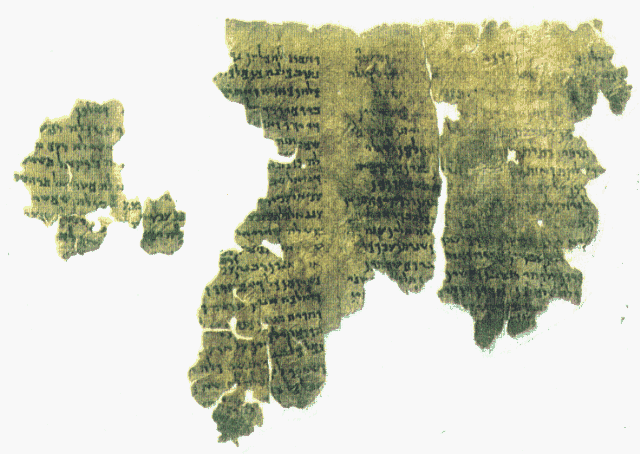
Perhaps when one actually sees the nature of the DSS evidence we are dealing with it becomes more apparent what the problem is, and why the dating is so often referred to as “elusive”. The following is a picture of the typical piece of evidence, the nature of a Qumran Scroll fragment of Enoch used to come up with the estimated dates:

4Q201(En ara) Parchment, Copied ca. 200-150 B.C.E.,Courtesy of the Israel Antiquities
“…The displayed fragment describes the heavenly revolt of the fallen angels, and their descent to earth to cohabit with the daughters of men and to reveal secret knowledge to mankind, a story hinted at in Gen. 6:1-4.”
From: The Dead Sea Scrolls Digital Library (https://www.ibiblio.org/expo/deadsea.scrolls.exhibit/Library/enoch.html
Authority (11) https://www.ibiblio.org/expo/deadsea.scrolls.exhibit/full-images/enoch-b.gif
Furthermore, it is very hard to believe that anyone who actually reads the Book of Enoch, even just the first book, or the first 10 to 20 chapters, would still believe it is on par with what is accepted as inspired scripture – the canonical 66 books of our Protestant Bibles. Aside from the fact that it is generally more like the writings of Joseph Smith in the Book of Mormon, or the Koran of Islam, somewhat fanciful and disorganized, it is riddled with inconsistencies and self- contradictions, not to mention contradictions of what is inspired scripture, as discussed in the following.
This issue of canonicity is disregarded by those who want to treat the Book of Enoch, and other extrabiblical sources as if they were equal to inspired scripture, treating it as irrelevant. However, the reality is that it is not peripheral, but central and essential to the integrity and defense of the true, biblical, Christian faith and doctrine – no wonder it should be coming under attack by the enemy of that faith. The very valid and rational reasons for why this Book of Enoch should or should not be, and in fact isn’t included in the Canon, are summarized by the Bible Hub commentary on the subject, included in Endnote [i].
Problems with the Book of Enoch
There are to be sure a lot of passages in Enoch which appear to agree with canonical scripture, almost as if it came from said scripture, or as is being proposed, was an original source of the corresponding scriptural passages. Was there a prophet name Enoch? Yes according to Genesis the 7th from Adam, who didn’t die but was just translated to heaven. Did he prophesy? Apparently so according to Jude, warning about impending judgment. In fact, it is that prophesy in Jude which most closely corresponds to Book 1 of Enoch, verse 9, as discussed above. And in fact, there is a lot in Enoch, especially the first 2 books, which include teachings very similar to what we find in scripture, especially the Gospels. This will of course always be true counterfeits designed to fool those who may or may not have much knowledge of the real, the truth. Certainly, no professing Christian, with any degree of knowledge of the Bible, will be fooled by claims that are on the face of it refuting and contradicting what the Bible says. Nor is our arch enemy, Satan, so blatantly foolish as to try to deceive would-be believers, by openly telling obvious lies, some of which will only work with the unbelievers, such as Atheists. Jesus warned us about false teachers which would come, some even in His name, but describing them as “wolves in sheep’s clothing” (Matthew 7:15), and Paul warns us that Satan will disguise Himself as “an angel of light” (2 Corinthians 11:14). At the end of this book we call the Bible, John gives a very dire warning about those who add to or take away from “the words of this book” (Revelation 22:18-19). The book of Enoch is all about adding to and taking away from “the words of this book”, the Bible, as well as Revelation. And its additions, and subtractions, are at best perversions, and often contradictions of “this book”, the Bible.
However, those who have chosen to elevate this extrabiblical Book to the status of being the Word of God, on par with the inspired scripture, have to overlook the many incredibly obvious flaws with the book itself. First, it fails the test of Internal Consistency.
Internal Consistency
Internal consistency essentially means that the truth claims in the text are consistent such that there are no contradictions between statements about what the truth is. One of the tests with regard to the authenticity of any piece of literature to determine whether or not it is actually inspired by God is known as the internal consistency of the text. Such is one of the most important proofs we have for the authenticity, authority, and reliability of our Bible. What we find in this Book of Enoch are many inconsistencies making contradictory truth claims, though they are embedded in what is very unclear, but also very verbose and highly repetitious text. That lack of clarity and understandability may tend to obscure the message and thus conceal the contradictions, such that they can be construed to mean whatever the reader wants them to be saying.
For example, when supposedly prophesying about the judgment God will bring on the wicked men and the fallen angels and their offspring (which some are calling the Nephilim), we see the following apparent contradictions:
“And to Gabriel said the Lord: ‘Proceed against the bastards and the reprobates, and against the children of fornication: and destroy [the children of fornication and] the children of the Watchers from amongst men [and cause them to go forth]: send them one against the other that they may destroy each other in battle: for length of days shall they not have. … And the Lord said unto Michael: ‘Go, bind Semjaza and his associates who have united themselves with women so as to have defiled themselves with them in all their uncleanness. And when their sons have slain one another, and they have seen the destruction of their beloved ones, bind them fast for seventy generations in the valleys of the earth, till the day of their judgement and of their consummation, till the judgement that is for ever and ever is consummated. In those days they shall be led off to the abyss of fire: and to the torment and the prison in which they shall be confined for ever. And whosoever shall be condemned and destroyed will from thenceforth be bound together with them to the end of all generations. And destroy all the spirits of the reprobate and the children of the Watchers, because they have wronged mankind.” (Enoch 1, chapter 10 emphasis added)
So, what exactly is the judgment here, directed against the offspring of those fallen angels (“Semjaza and his associates”), which men are calling the Nephilim (based on a very flawed interpretation of Genesis 6:1-4). Is it that they would “fight against and destroy each other in battle”, or to “bind them fast for seventy generations in the valleys of the earth”, or to be “led off to the abyss of fire: and to the torment and the prison in which they shall be confined forever”, or to just be “destroyed” as in “destroy all the spirits”? What does it mean to destroy spirits, or the consummation of such spirits and how is this compatible with being imprisoned and confined forever? Does any of this actually make any sense especially in light of the fact that it is supposed to be the judgment of the flood of Noah, as indicated in the very first verse of that same chapter:
“Then said the Most High, the Holy and Great One spake, and sent Uriel to the son of Lamech, and said to him: ‘Go to Noah and tell him in my name “Hide thyself!” and reveal to him the end that is approaching: that the whole earth will be destroyed, and a deluge is about to come upon the whole earth, and will destroy all that is on it.” (chapter 10, p. 9 Kindle).
Now here is one of those instances where this book does agree with the biblical record in Genesis, but unfortunately it goes on to disagree with itself, and the revelations in Genesis. If the judgment is the destruction of the whole earth by the flood, how can it also be the binding fast of these offspring they are calling the Nephilim in the valleys of the earth[1] – and that for a specific amount of time, 70 generations (or 10,000 years as per chapters 18 and 21)? Won’t they all be destroyed by drowning, exactly as the biblical record indicates (Genesis 7:21-23). Of course, this raises the obvious question which is a problem for these Nephilimites (adherents to the Nephilim theology) – how do these Nephilim, these offspring of the Angels’ copulation with women, continue to appear on the earth down to today, after the global deluge, Noah’s universal flood? Now of course the smarter ones do have an answer to this – the same event of fallen angels having sex with human women happened again after the flood – which neither the Bible nor the Book of Enoch tells us about (a little oversight on God’s part one must suppose – talk about adding to scripture).[2]
So, which of the several options mentioned as God’s judgment on these evil subjects is the right one, since they can’t all be true. Do these judged ones drown and die, are they thus destroyed forever? Or are they confined like in a prison? And is that confinement forever, or only for 70 generations, or is it for 10,000 years as we see in chapters 18 and 21of Enoch 1?
“He was wroth with them, and bound them till the time when their guilt should be consummated (even) for ten thousand years.’” (chapter 18, p. 16)
“These are of the number of the stars of heaven, which have transgressed the commandment of the Lord, and are bound here till ten thousand years, the time entailed by their sins, are consummated.” (chapter 21, p. 17).
Now it is true that scripture tells us that the “mighty men of old”, the offspring of that forbidden sexual union, were destroyed physically in the flood, because they were in fact just humans – giants possibly, hence Nephilim (which is just a transliteration of the Hebrew word which when translated into English is “Giants”), but not any kind of Gods, or even demigods (both God and human, divine humans), as in Greek Mythology. As with all mankind, their bodies were destroyed, but their spirits go to the prison of Hades, or Sheol, to await their final judgment and eternal destiny in the Lake of Fire, called Hell. We see this in 1 Peter 3:19-20. Those Angels which sinned, according to 2 Peter 2:4, and Jude 6-7 are also confined in a place of punishment, awaiting that final day of judgment and their eternal destiny in the Lake of Fire, Hell. Neither they, not their spirits, survived the flood, to continue to haunt us, or to embody themselves again as giants, or “Nephilim”, down to today – such a notion blatantly contradicts scripture as cited above. While this “prophecy” in Enoch seems to feature the various elements of what scripture tells us about God’s judgement on the ungodly, and the fallen Angels, it conflates[3] the various aspects of that multi-phased judgment in a manner that is confused and confusing – not characteristic of actual divinely inspired scripture.
Then again, we can go to chapter 15 where we see the following prophecy:
“And now, the giants [Nephilim], who are produced from the spirits and flesh, shall be called evil spirits upon the earth, and on the earth shall be their dwelling. Evil spirits have proceeded from their bodies; because they are born from men and from the holy Watchers is their beginning and primal origin; they shall be evil spirits on earth, and evil spirits shall they be called. [As for the spirits of heaven, in heaven shall be their dwelling, but as for the spirits of the earth which were born upon the earth, on the earth shall be their dwelling.] And the spirits of the giants afflict, oppress, destroy, attack, do battle, and work destruction on the earth, and cause trouble: they take no food, but nevertheless hunger and thirst, and cause offences. And these spirits shall rise up against the children of men and against the women, because they have proceeded from them.” (chapter 15, p. 13)
According to this verse these Nephilim become the evil spirits on earth. That would seem to be the demons in scripture, which possess men such as the demoniacs. However, it is also saying about these fallen angels, referred to as the “spiritual ones in heaven”, that “in heaven is their dwelling … as for the spirits in heaven [the fallen angels], in heaven shall be their dwelling”. But this contradicts all the statements about their judgment, as in Chapter 14:
“And from henceforth you shall not ascend into heaven unto all eternity, and in bonds of the earth the decree has gone forth to bind you for all the days of the world”.
Or chapter 21:
“These are of the number of the stars of heaven, which have transgressed the commandment of the Lord, and are bound here till ten thousand years, the time entailed by their sins, are consummated. … ‘This place is the prison of the angels, and here they will be imprisoned for ever.’ And from thence I went to another place”.
How can both be true at the same time, and does this agree with scripture? Especially since the previous chapters cited above tell us about them being confined on the earth.
All of this is just a sample based on the first 27 chapters of the first part of the first book, in the Book of Watchers. As we have demonstrated above, this Book of Enoch, even just the 1st chapter of the 1st book, fails that critical test of internal consistency.
If we continue on in that 1st book, we see several lists of the names of those fallen angels. In chapter 6 we have a list of names starting with Semjaza, followed by 19 other names identified as the chiefs of tens.
“And it came to pass when the children of men had multiplied that in those days were born unto them beautiful and comely daughters. And the angels, the children of the heaven, saw and lusted after them, and said to one another: ‘Come, let us choose us wives from among the children of men and beget us children.’ And Semjaza, who was their leader, … And these are the names of their leaders: Samlazaz, their leader, Araklba, Rameel, Kokablel, Tamlel, Ramlel, Danel, Ezeqeel, Baraqijal,Asael, Armaros, Batarel, Ananel, Zaqiel, Samsapeel, Satarel, Turel, Jomjael, Sariel. These are their chiefs of tens.” (chapter 6, p. 6)
However, in chapter 69, in the Book of Parables, we have 21 names of angels, followed by another 5 names referred to as the chiefs of over hundreds and fifties and tens.
“first of them is Samjaza, the second Artaqifa, and the third Armen, the fourth Kokabel, the fifth Turael, the sixth Rumjal, the seventh Danjal, the eighth Neqael, the ninth Baraqel, the tenth Azazel, the eleventh Armaros, the twelfth Batarjal, the thirteenth Busasejal, the fourteenth Hananel, the fifteenth Turel, and the sixteenth Simapesiel, the seventeenth Jetrel, the eighteenth Tumael, the nineteenth Turel, the twentieth Rumael, the twenty-first Azazel. …And these are the chiefs of their angels and their names, and their chief ones over hundreds and over fifties and over tens]. The name of the first Jeqon: … And the second was named Asbeel: … And the third was named Gadreel: … and he led astray Eve, … And the fourth was named Penemue: And the fifth was named Kasdeja: …” [4] (chapter 69, p. 50)
It is very telling that these lists of names do not match, in fact only a few of them are the same which includes the leader, Semjaza or Samjaza, though that tells us they are meant to be the same list of angels. Further, Azazel, which is very prominent in the first Book of Watchers is not even mentioned in that initial list in the Book of Watchers, but appears twice in this list in the 69th chapter in the Book of Parables. While these men who insist that this pseudepigraphical Book of Enoch is the inspired word of God, or on par with other books included in the canon, and a source for the writers of scripture, they have a lot of explaining to do. One has to wonder whether they have actually read the whole book, or what in the world they are using for criteria to determine what is and what is not inspired scripture – since they openly reject the canon.
Scriptural Consistency
Perhaps the most important criteria, or test to determine the acceptability of the text is its fidelity to and consistency or agreement with inspired scripture.[5] For anyone claiming to be a biblical Christian, that is obviously a problem. While the Bible is held to be the inspired Word of God based on the abundance of evidence (as documented in numerous sources such as Josh McDowell’s Evidence that Demands a Verdict), the frequently reoccurring revisionists, with new revelations and the emergence of new and improved versions of Christianity and Theology (such as the Deuteronomy 32 worldview, and the associated Nephilim centered theology), are nothing new, just the enemy’s ongoing war against God’s truth revealed in His word.
This Book of Enoch was well known to the early church, as evidenced by the references to it by some 1st and 2nd century church leaders and Theologians. It was not accepted then as inspired scripture, except apparently by the Ethiopic church, thus it was not included in the Canon of scripture, including the Jewish canon, and the later Roman Catholic and Orthodox churches, even though they did accept most of the Apocryphal books.
One of the mains reasons why it is not considered inspired scripture is because of the teachings or truth claims articulated there which are not consistent with what is accepted as the inspired word of God. The following are a few examples, associated with Book 1 of Enoch.
The Scapegoat
Strangely this fallen angel named Azazel suddenly shows up in the 8th chapter of Enoch 1, but is not even mentioned in the previous chapter naming all the fallen angels and their leaders:
“And Semjaza, who was their leader, …And these are the names of their leaders: Samlazaz, their leader, Araklba, Rameel, Kokablel, Tamlel, Ramlel, Danel, Ezeqeel, Baraqijal,Asael, Armaros, Batarel, Ananel, Zaqiel, Samsapeel, Satarel, Turel, Jomjael, Sariel. These are their chiefs of tens.” (chapter 6, p. 6)
This is strange in that Azazel is one of, if not the most prominent angel in this whole Book of Watchers.
“And Azazel taught men to make swords, and knives, and shields, and breastplates, and made known to them the metals of the earth and the art of working them, and bracelets, and ornaments, and the use of antimony, and the beautifying of the eyelids, and all kinds of costly stones, and all colouring tinctures. And there arose much godlessness, and they committed fornication, and they were led astray, and became corrupt in all their ways.” (Chapter 8, p. 7)
“Thou seest what Azazel hath done, who hath taught all unrighteousness on earth and revealed the eternal secrets which were (preserved) in heaven, which men were striving to learn:…” (chapter 9, p. 8)
“And again the Lord said to Raphael: ‘Bind Azazel hand and foot, and cast him into the darkness: and make an opening in the desert, which is in Dudael, and cast him therein. And place upon him rough and jagged rocks, and cover him with darkness, and let him abide there for ever, and cover his face that he may not see light. And on the day of the great judgement he shall be cast into the fire. And heal the earth which the angels have corrupted, and proclaim the healing of the earth, that they may heal the plague, and that all the children of men may not perish through all the secret things that the Watchers have disclosed and have taught their sons. And the whole earth has been corrupted through the works that were taught by Azazel: to him ascribe all sin.’” Chapter 10, p. 9)
“And Enoch went and said: ‘Azazel, thou shalt have no peace: a severe sentence has gone forth against thee to put thee in bonds: And thou shalt not have toleration nor request granted to thee, because of the unrighteousness which thou hast taught, and because of all the works of godlessness and unrighteousness and sin which thou hast shown to men.’” (chapter 13, p. 11)
Here again, as is too often the case with those who are trying to make scripture fit their preconceived theological views, a word in the original language, in this case Hebrew, is transliterated instead of translated into English. In this case that word is לַעֲזָאזֵֽל transliterated Azazel, which when translated into English is “scapegoat”. This is the word that appears in Leviticus 16:
“6Then Aaron shall offer the bull as the sin offering, which is for himself, so that he may make atonement for himself and for his household. 7He shall then take the two goats and present them before the LORD at the doorway of the tent of meeting. 8Aaron shall cast lots for the two goats, one lot for the LORD and the other lot for the scapegoat. 9Then Aaron shall offer the goat on which the lot for the LORD fell, and make it a sin offering. 10But the goat on which the lot for the scapegoat fell shall be presented alive before the LORD, to make atonement upon it, to send it into the wilderness as the scapegoat.” (Leviticus 16:6-10)
In that account, on the “day of atonement” the priest would take 2 goats, one of which would be the sacrifice for the sins of the people, including the Priest (Aaron) and his whole family, and to purify the tent of meeting, the Holy Place and everything in it including the Altar. This is referred to as “atonement” and cleansing. The other goat is called the “scapegoat,” which is “Azazel” in Hebrew. This goat is to represent the sin bearer, and is sent out into the wilderness.
We know from the New Testament, especially the book of Hebrews, that all of this including the Priests, the Holy Place, and the rituals such as the sacrifices, were symbolic types of what was to be fulfilled in Christ, the sacrificial Lamb of God. Isaiah explains that it was to be the promised Messiah (sometimes referred to as “the Suffering Servant”) which would be the scapegoat:
“8By oppression and judgment He was taken away;
And as for His generation, who considered
That He was cut off from the land of the living
For the wrongdoing of my people, to whom the blow was due?” (Isaiah 53:8)
“10But the LORD desired
To crush Him, causing Him grief;
If He renders Himself as a guilt offering,
…My Servant, will justify the many,
For He will bear their wrongdoings.
…Yet He Himself bore the sin of many,
And interceded for the wrongdoers.” (Isaiah 53:10-12)
In Jesus work of atonement He paid the penalty for our sin, the curse of the Law – “for the wages of sin is death” (Romans 3:23). He was the sacrificial lamb, the goat that was slain and offered on the altar. In so doing He reconciled us to God, but He did so by becoming sin for us:
“We beg you on behalf of Christ, be reconciled to God.21He made Him who knew no sin to be sin in our behalf, so that we might become the righteousness of God in Him.” (2 Corinthians 5:20-21)
Is this not what the scapegoat of Leviticus was a symbol of? These two symbolic goats were the foreshadowing of the atoning work of Christ on the cross. This included propitiation (1 John 2:2), reconciliation, cleansing and sanctification, making forgiveness possible while satisfying the justice of God’s perfect holiness.
Again, we see this spelled out for us in the 9th-10th chapters of Hebrews. There the writer explains that all those OT rituals, especially the sacrifices, were about Christ and His work on the cross. As He Himself declared, He was the fulfilment of the Law (Matthew 5:17). He was the High Priest, and even as such He was Himself the sacrificial lamb. Scripture is clear that His completed work on the cross was all that was required to provide for our salvation. It is also clear that He alone is our mediator, our intercessor (1 Timothy 2:5, Isaiah 53:12) – not Mary, or other venerated saints, or any kind of Angels. Scripture also makes it clear that Christ is “the end of the Law for righteousness” (Romans 10:4), not Christ plus anything else.
The variety of theories about what the scapegoat represented are at best in ignorance of the unambiguous teaching of inspired scripture, or just willful rejection of what is written in God’s word. Instead of letting scripture interpret scripture, they resort to extrabiblical sources, such as Apocryphal books, the Book of Enoch in particular. They follow the lead of the Serpent in the Garden of Eden, Satan,[6] with the original temptation, asking the most fundamental question – “Has God really said…” (Genesis 3:1). This is the proverbial “camel’s nose under the tent”. It opens the door to virtually every kind of heretical teaching, and that is exactly what has come out of it. This “scapegoat” issue is a perfect example of the problem with such an approach to God’s Word. Some, on the authority of such sources as the Jewish Mishna and Targum, interpret it as the place to which the goat was sent, while others believed that it was the name of some “power.” An increasingly popular interpretation today, based on the authority of this Pseudepigraphical Book of Enoch, extrapolating on the Hebrew word Azazel, interpret it as the original fallen angel who led others in having sex with woman, per their flawed interpretation of Genesis 6:1-4 (though in Enoch such original sin is also ascribed to Semjaza). According to that view it is a demonic spiritual entity which becomes the sin bearer. Or, according to one source another variation of this is:
“ [that] which sees Azazel as a supernatural power, also treats the word as though it were written עַזָזֵאל. This opinion is based on Leviticus (16:8): ‘One lot for the Lord and the other lot for Azazel,’ i.e., just as the first goat is set aside for the Lord so the second is set aside for Azazel, Azazel being a parallel to the Lord (cf. PdRE ch. 46, p. 111a). God gets a burnt offering while Azazel gets a sin offering. This view is reinforced by the widespread belief that the wilderness was the habitat of demons (see Lev. 13:21; 34:14; esp. Lev. 17:7). The demonic identification would indicate that the original purpose of the ritual was to get rid of the evil by banishing it to its original source.”
(Jewish Virtual Library, “Azazel” (https://www.jewishvirtuallibrary.org/azazel
Such approaches actually involve the rejection of the most basic and fundamental doctrines of the Orthodox or true Christian faith, the doctrines of the divine verbal inspiration of scripture, and the closed canon defining what is and is not inspired scripture. Once this is abandoned the authority of scripture is lost entirely, its reliability and accuracy, as it becomes a matter of very flawed human judgments and opinions about what actually is the Word of God, and what is not. This leaves us with no rational basis for any kind of consensus with respect to interpretations of scripture. It also reflects a disregard for the claim that inspired scripture makes for itself, according to 2 Timothy 3:16, that scripture alone is all that we need to “be fully capable, equipped for every good work”.
Other Contradictions with Scripture
Throughout Enoch we see the good angels being portrayed as our intercessors:
“And they petitioned and interceded and prayed for the children of men, And righteousness flowed before them as water,..” (chapter 39, p. 26)
“And after that I saw thousands of thousands and ten thousand times ten thousand, I saw a multitude beyond number and reckoning, who stood before the Lord of Spirits. And on the four sides of the Lord of Spirits I saw four presences, different from those that sleep not, and I learnt their names:…And the third voice I heard pray and intercede for those who dwell on the earth and supplicate in the name of the Lord of Spirits. And I heard the fourth voice fending off the Satans and forbidding them to come before the Lord of Spirits to accuse them who dwell on the earth. … the second, who is set over all the diseases and all the wounds of the children of men, is Raphael: and the third, who is set over all the powers, is Gabriel: and the fourth, who is set over the repentance unto hope of those who inherit eternal life, is named Phanuel.’ And these are the four angels of the Lord of Spirits and the four voices I heard in those days.” (chapter 40, p. 27 – emphasis added)
So according to this particular passage in Enoch, its these angels which intercede for us, and are our protectors, in particular one named Phanuel. It also tells us that our accuser is actually accusers, plural, called “Satans” (which in context of the rest of the book would be those fallen angels, or their spirits), and it is this angel Phanuel which is our advocate defending us against these Satans, which is also the one who somehow brings about repentance unto salvation. Thus, these angels then are credited with what the Bible ascribes to Jesus, and the Spirit of God referred to as “the Holy Spirit”.
Inspired scripture gives us the following truth statements about who it is that is the intercessor, the advocate, and the one who brings us to repentance:
“3This is good and acceptable in the sight of God our Savior, 4who wants all people to be saved and to come to the knowledge of the truth. 5For there is one God, and one mediator also between God and mankind, the man Christ Jesus, 6who gave Himself as a ransom for all, the testimony given at the proper time.” (1 Timothy 2:3-6)
“My little children, I am writing these things to you so that you may not sin. And if anyone sins, we have an Advocate with the Father, Jesus Christ the righteous;” (1 John 2:1)
“26When the Advocate comes, whom I will send to you from the Father—the Spirit of truth who goes out from the Father—he will testify about me.” (John 15:26 NIV, see also John 14:26)
“26Now in the same way the Spirit also helps our weakness; for we do not know what to pray for as we should, but the Spirit Himself intercedes for us with groanings too deep for words; 27and He who searches the hearts knows what the mind of the Spirit is, because He intercedes for the saints according to the will of God..” (Romans 8:26-27 emphasis added)
“5But now I am going to Him who sent Me; and none of you asks Me, ‘Where are You going?’ 6But because I have said these things to you, grief has filled your heart. 7But I tell you the truth: it is to your advantage that I am leaving; for if I do not leave, the Helper will not come to you; but if I go, I will send Him to you. 8And He, when He comes, will convict the world regarding sin, and righteousness, and judgment: 9regarding sin, because they do not believe in Me; 10and regarding righteousness, because I am going to the Father and you no longer are going to see Me; 11and regarding judgment, because the ruler of this world has been judged.” (John 16:5-11 NASB)
“30Jesus responded and said, ‘This voice has not come for My sake, but for yours. 31Now judgment is upon this world; now the ruler of this world will be cast out. 32And I, if I am lifted up from the earth, will draw all people to Myself.” (John 12:32)
While those men who invoke the Book of Enoch as if it were inspired words of God are working on the premise that what we have in our Bibles, recognized as the inspired word of God, is not enough, and does not tell us the whole story, and isn’t always accurate. Thus, we need these revelations appearing in this pseudepigraphical book, to give us the whole truth, filling in important details these other canonical writers of scripture left out. Again, what we have is what Revelation 22:18 refers to as adding to scripture. But in the process, we also have what are in actually contradictions of those relevant biblical truths. Scripture presents Jesus Christ as the preeminent one, the one in whom “the fullness” dwells, including the fullness of Deity, or “fullness of the Godhead” (KJV).
“15He is the image of the invisible God, the firstborn of all creation: 16for by Him all things were created, both in the heavens and on earth, visible and invisible, whether thrones, or dominions, or rulers, or authorities—all things have been created through Him and for Him. 17He is before all things, and in Him all things hold together. 18He is also the head of the body, the church; and He is the beginning, the firstborn from the dead, so that He Himself will come to have first place in everything. 19For it was the Father’s good pleasure for all the fullness to dwell in Him, 20and through Him to reconcile all things to Himself, whether things on earth or things in heaven, having made peace through the blood of His cross.” (Colossians 1:15-20)
“9For in Him all the fullness of Deity dwells in bodily form, 10and in Him you have been made complete, and He is the head over every ruler and authority;” (Colossians 2:9-10)
There we are also told that “the full assurance of understanding, resulting in a true knowledge of God’s mystery, … is, Christ Himself, 3in whom are hidden all the treasures of wisdom and knowledge.” (Colossians 2:2-3)
The point is that it is Christ alone to whom all the glory and praise is to be given, not any of His created beings. With that in mind Paul goes on again to warn us:
“18Take care that no one keeps defrauding you of your prize by delighting in humility and the worship of the angels, taking his stand on visions he has seen, inflated without cause by his fleshly mind, 19and not holding firmly to the head, from whom the entire body, being supplied and held together by the joints and ligaments, grows with a growth which is from God.” (Colossians 2:18-19 emphasis added)
The primary focus of the Book of Enoch is angles, both good and bad. It ascribes to the good angels qualities and functions that the Bible only ascribes to God and His Son Jesus and the Holy Spirit. If its actually these angels to whom we owe all these works of goodness and grace, to whom then should the praise and glory belong? If an angel is actually our scapegoat, our sin bearer, another angel or other angels our intercessors and advocates before God, do they not deserve our gratitude and veneration (i.e. worship) – which is actually exactly what this supposed Enoch is doing throughout this book by his name? And these men who hold that book in such high esteem, are they not inflated by their fleshly minds – claiming to revelations that all those theologians and Bible scholars before them, and contemporaneous to them haven’t had revealed to them – which we might call arrogance approaching grandiosity? Are they holding firmly to the head, which is Christ, God incarnate, the one who unites us into one body, or are they causing divisions within the Body of Christ with their new and progressive revisionism of Christian theology?
This is not to deny or ignore the fact that scripture also does teach clearly that God uses His created servants to accomplish His purposes. He has commissioned men to communicate His messages and revelations to other men – prophets, priests, preachers, teachers, etc.. He has used angels to deliver His messages, and to carry out His will on the earth. Michael and Gabriel are specifically mentioned several times in the Bible. But a passage in the book of Hebrews defines for us what is that ontogeny (nature of being) and role of the Angels:
“7 …Of the angels he says, ‘He makes his angels winds, and his ministers a flame of fire.’ …14Are they not all ministering spirits sent out to serve for the sake of those who are to inherit salvation?”
The word translated here “winds” is the Greek word “pneumata” (πνεύματα), the same word that is usually translated “spirits” [7] in most passages, such as we also see here in the NKJV and the NIV. To the extent that Enoch portrays them as ministers to us humans, especially saved believers, it is true and biblical. To the extent that it portrays them as “guardians”, as in “guardian angels” it appears to agree with such passages as:
- Matthew 18:10 referring to the angels of “these little ones”, which “continually see the face of My Father who is in heaven”.
- Psalm 92:11-12 “For He will give His angels orders concerning you, to protect you in all your ways. On their hands they will lift you up, so that you do not strike your foot against a stone.”
Even the numerous references to angels as “the watchers” has some scriptural basis as per 1 Peter 1:12 and 1 Corinthians 11:10 “Therefore the woman should have a symbol of authority on her head, because of the angels.”
With respect to angels carrying out God’s judgment, that is also scriptural. We see that God sent an angel to punish David and Israel when David tried to count them, in 2 Samuel 24:15-17, though it is also called a plague which killed 70,000 men. It is also true that angels, messengers, took on what appeared to be a human body, as in the case of 3 men appearing to Abraham (Exodus 18), and what appears to be an angel which wrestled with Jacob (Genesis 32:24-32), as well as those which appeared to the Sodomites to protect Lot and to instruct him to leave Sodom (Genesis 19:1-22).
Because of these parts of the Book of Enoch which do correspond to what is found in scripture, the claim is made that the rest must also be true (even if it is not found in the Canonical scripture – as Timothy Alberino states emphatically). That is what is known as a non-sequitur (an inference or conclusion that does not follow from the premises or evidence). The book of Enoch, and all the theories and theology based on it, go way beyond anything found in scripture, and in many respects contradicts it, in some cases undermining the intended message, which glorifies Christ instead of the angels.
This is even the case with respect to Enoch’s version of our archenemy, the Devil, Satan. We see in the text cited above from chapter 40 a plurality of “satans”, elsewhere defined as evil spirits, the fallen angels or their spirits, or as Michael Heiser defines it:
“…demons are consistently cast as disembodied spirits of dead Nephilim and their giant clan descendants. Those spirits are the offspring of the angels that sinned before the flood, so the demons cannot be those fallen angels.” (Heiser, Demons, p. 242)
However, this is the same Michael Heiser which makes the following admission:
“By way of telegraphing my positions, I offer the following summaries.
Position statements on Psalm 82 and the divine council with which many evangelicals would probably disagree and with which many Latter-day Saints would likely agree …” (“You’ve Seen One Elohim, You’ve Seen Them All? A Critique of Mormonism’s Use of Psalm 82, Michael S. Heiser, Scripture Central, (https://scripturecentral.org/archive/periodicals/journal-article/youve-seen-one-elohim-youve-seen-them-all-critique-mormonisms-use-psalm-82))
In context this is followed by 8 position statements which he admits Mormons would agree with more than evangelicals. Now ironically this appears in what is supposed to be a refutation of Mormon theology, but is also a statement about those aspects of theology in which he agrees with the Latter-day Saints interpretation more than those in the evangelical community – i.e. the generally accepted conservative Orthodox doctrines of our Christian faith. A Google search will reveal how popular his work is with Mormons. Most of his arguments presented there which agree with Mormon theology are refuted in the associated article and chapter in this book, “Psalms 82”, and other points he makes are simply illogical and untrue.[8]
According to inspired scripture this is what we can know about this Satan, and his followers, the fallen angels [9]:
“ 7And there was war in heaven, Michael and his angels waging war with the dragon. The dragon and his angels waged war, 8and they were not strong enough, and there was no longer a place found for them in heaven. 9And the great dragon was thrown down, the serpent of old who is called the devil and Satan, who deceives the whole world; he was thrown down to the earth, and his angels were thrown down with him. 10Then I heard a loud voice in heaven, saying, ‘Now the salvation, and the power, and the kingdom of our God and the authority of His Christ have come, for the accuser of our brethren has been thrown down, he who accuses them before our God day and night. 11And they overcame him because of the blood of the Lamb and because of the word of their testimony, and they did not love their life even when faced with death. 12For this reason, rejoice, O heavens and you who dwell in them. Woe to the earth and the sea, because the devil has come down to you, having great wrath, knowing that he has only a short time.’”
First according to everything in scripture this name Satan is about a personal being, a spiritual being, which was created by God, rebelled against Him, and wars against Him and His followers. We see from this passage that He was “the serpent of old”, who appeared in the form of a serpent to tempt Eve in the garden of Eden. While according to the Book of Enoch it was a fallen angel named Gadreel as per Enoch 1 chapter 69, Scripture unambiguously tells us it was the actual leader of all these fallen angels, Satan, not Gadreel, nor Semjaza, nor Azazel, but Satan, the Devil, the Serpent of old. But then, that’s just the Holy Bible.
Now according to Enoch 1, chapter 6, there were only 200 of those angels which followed their rebellious leader, Semjaza (not Satan, the Devil). From what we learn from this book, the original sin was this occasion, barely mentioned in scripture, which was this occasion of angels having sex with women. The story in Genesis 3 of the original temptation and the fall, didn’t happen until one of those already fallen angels, Gadreel (not the serpent Satan), led Eve and in turn Adam into sin – which is actually what the Bible tells us is the original sin. According to Enoch, that was pretty inconsequential in light of the real fall, the angels having sex with women and their Nephilim offspring, which is what corrupted earth and all mankind. Such is not just additional information, complementary to inspired scripture, it is a deceptive perversion, a corruption of the words God inspired the writers of scripture to write for us, such as:
“12Therefore, just as through one man sin entered into the world, and death through sin, and so death spread to all mankind, because all sinned— 13for until the Law sin was in the world, but sin is not counted against anyone when there is no law. 14Nevertheless death reigned from Adam until Moses, even over those who had not sinned in the likeness of the violation committed by Adam, who is a type of Him who was to come…. 18So then, as through one offense the result was condemnation to all mankind, so also through one act of righteousness the result was justification of life to all mankind. 19For as through the one man’s disobedience the many were made sinners, so also through the obedience of the One the many will be made righteous.” (Romans 5:12-19)
Apparently, the Apostle Paul, like many informed Bible believing Christians today and all down through the history of the church, didn’t know or understand, or believe this gospel of Enoch, though like many of the other 1st century Christian theologians they surely knew about it, especially if in fact it was a pre-Christian era document (which is doubtful). But then, as it turns out, even this Enochian writer couldn’t keep his story straight from one paragraph to the other. While telling us initially that it was Semjaza who was the original bad guy, the leader of the whole rebellion, by chapter 9 it is Azazel (who was not even mentioned among the original list of fallen angels) which is becoming the real bad guy, and by chapter 10 we see the following:
“And again the Lord said to Raphael: ‘Bind Azazel hand and foot, and cast him into the darkness: and make an opening in the desert, which is in Dudael, and cast him therein. And place upon him rough and jagged rocks, and cover him with darkness, and let him abide there forever, and cover his face that he may not see light. And on the day of the great judgement he shall be cast into the fire. And heal the earth which the angels have corrupted, and proclaim the healing of the earth, that they may heal the plague, and that all the children of men may not perish through all the secret things that the Watchers have disclosed and have taught their sons. And the whole earth has been corrupted through the works that were taught by Azazel: to him ascribe all sin.’” (chapter 6, p. 9 Kindle, emphasis added)
But then this text returns to Semjaza in the same paragraph, almost as if it was an afterthought – oops almost forgot about Semjaza, the original chief bad guy, the original source of all original sin.
Contrary to the logic of men like Michael Heizer, the fact that there is so little about all of this is in scripture is probably not because those purely human writers just knew that their audience would know all about it from that book of Enoch, or other Apocryphal and Pagan sources (which are their primary sources, the basis for their superior knowledge and discernment), as they contend. It is more reasonable that it is because its not supposed to be such a big deal. Certainly, the theology found in the Bible has very little to do with fallen angels, the Nephilim, or their descendants, though they are addressed. What is revealed there is actually quite enough to put the whole subject to bed – the human descendants, supposedly the wicked Nephilim (the “mighty men”), were destroyed in the global flood, and their spirits and the spirits which were the fallen angels were confined in that place of waiting and punishment, Sheol or Hades, until the judgment day, when they will be cast into Hell for eternity future. Period. End of story.
However, all this focus on those subjects, is actually leading to a very different theology than that which emerges from scripture. Unfortunately, this involves at best impactful distractions from the truths of scripture, but also opens the door to all kinds of deceptive heresies, such as Mormonism and modern variations of Gnosticism. But in these “end times” it gives rise to a new Eschatology that features all kinds of extraterrestrial alien encounters, the UFOs or UAPs (unidentified anomalous phenomena) etc. – no need for the prophecies of Daniel and Revelation (which have little correspondence to the Nephilim-based mystical eschatological fantasies of these modern-day prophets, such as Michael Heiser and Timothy Alberino). Perhaps the real question is, how do men who supposedly know the scripture, who are so intelligent and knowledgeable, become so fooled by such poor imitations as this Book of Enoch. I submit it begins with that original epistemological question, “Hath God said”? Men have to decide what they are going to believe about the Bible – that is a starting point. When they choose to decide that what we have is not necessarily a matter of God supernaturally inspiring them to write what they wrote – it’s a downhill slide from that point on. Like Eve, Satan’s got you. God inspired Peter and Paul to write:
“19And so we have the prophetic word made more sure, to which you do well to pay attention as to a lamp shining in a dark place, until the day dawns and the morning star arises in your hearts. 20But know this first of all, that no prophecy of Scripture becomes a matter of someone’s own interpretation, 21for no prophecy was ever made by an act of human will, but men moved by the Holy Spirit spoke from God.” (2 Peter 1:19-21)
“16All Scripture is inspired by God and beneficial for teaching, for rebuke, for correction, for training in righteousness; 17so that the man or woman of God may be fully capable, equipped for every good work.” (2 Timothy 3:16-17)
It is not a secret to Bible scholars that there are variations in the manuscripts upon which our modern versions of the Bible are based, and there are some differences in the way some passages are translated. There are even a few apparent discrepancies or inconsistencies within the same versions and translations – especially with respect to the genealogies (such as the mention of Canaan in Luke 3:36 compared to Genesis 10 and 1 Chronicles 1 which do not include him as a son of Shem). These are explainable as being because of transcription errors, given the fact that we do not have the original manuscripts, which would have been inerrant, as the divinely verbally inspired word of God. They are however minimal, and relatively inconsequential. But, once this foundational tenet of our faith is abandoned, the rational basis for believing that the Christian faith is any more divinely revealed truth from the one true God, than the competing truth claims of other religions with their holy books (Islam based on the Koran, Mormonism based on the Book of Mormon, etc.). It too becomes another case of faith-based reality, as opposed to reality-based faith. In that case, what one is going to believe God has actually revealed to us is all a matter of what men say He has said – men like Heiser or Alberino, or any number of other self-proclaimed modern-day prophets, most of whom do not agree with these men. Then it just becomes a matter of which of these men we are going to choose to believe and follow – which indeed is actually much of what is going in the church today anyway, and that not with such good results.
Evidence of Early Church Fathers for Book of Enoch
Alberino cites as evidence for the scriptural validity of 1 Enoch the early church fathers who cited it or recognized it as such:
“The Greek translation of 1 Enoch was known to and referenced by many of the early church fathers, including Clement and Barnabas (the friends of Paul), Irenaeus, Origen, Tertullian, Athenagoras of Athens, and Justin Martyr, all of whom held an affirming view of the text. (Birthright, p.133, p. 153 Kindle)
The reality is that the early church fathers cited, or quoted from, or made reference to many sources, including such known and pseudepigraphical sources as the Epistle of Barnabas, The Shepherd of Hermes, and The Book of Enoch. They also quoted from and referenced many known Heretics, and secular philosophers, such as Plato, Hermes, Homer, Pythagoras, and many others. A search of the literature produces many statements similar to that of Alberino above, but no actual references as to where to find such references in the writings of these respected church fathers. One source, selected only because it does attempt to give such specific information is the following:
“The Book of Enoch and its exegesis of Genesis permeates early Christian thought. It is quoted as Scripture by the Epistle of Barnabas (4.3; 16.5), Origen (First Principles 4.1.35), and Tertullian (On Idolatry 4,15). Commodian (3d c) draws from it (Comm 3). St. Irenaeus includes much of its interpretation of the Deluge in his Proof of the Apostolic Preaching (also Against Heresies 4:16:2). Justin Martyr (100–65) makes the same use of Enoch in his apology (II Apol 5) and Clement of Alexandria in his Stromata (5.1). Tertullian comments that the Book of Enoch was written by Enoch and entrusted to Noah. Tertullian regarded it as Scripture, reliably protected by the power of the Spirit (Apparel of Women 3).” (Πεμπτουσία in the world: ENGLISH (https://pemptousia.com/2015/02/do-not-add-to-his-words-the-fathers-and-the-canon/)
Both of these sources refer to Clement, which Alberino identifies as an associate of Paul, but does not identify what he wrote that recognizes the book of Enoch. It is more likely the other source cited above, Joel Kalvesmaki, is correct that it would have been the 1st-2nd century Clement of Alexandria (150-215), head of the school in Alexandria known for his written works in which he supposedly quoted from Enoch (in Stromata 5:1). According to other sources it was Clement of Alexandria, who along with Tertullian (late 1st-2nd century) seemed to accept 1 Enoch as scripture.
When we examine what is actually being referred to it is not all that clear that these men were all buying into the Enoch is scripture claim. For example, Clement, in his Stromata 5.1, when examined reveals no actual reference to the book of Enoch, but only one possible paragraph which vaguely resembles some of what we find in 1 Enoch. It actually appears in a context which is about a quote from Plato, speaking about “the deluge”:
“”But when, again, the gods deluge the earth to purify it with water, those on the mountains herdsmen and shepherds, are saved; those in your cities are carried down by the rivers into the sea.’ And we showed in the first Miscellany that the philosophers of the Greeks are called thieves, inasmuch as they have taken without acknowledgment their principal dogmas from Moses and the prophets. To which also we shall add, that the angels who had obtained the superior rank, having sunk into pleasures, told to the women the secrets which had come to their knowledge; while the rest of the angels concealed them, or rather, kept them against the coming of the Lord. Thence emanated the doctrine of providence, and the revelation of high things;…” (Early Christian Writings – Clement of Alexandria,The Stromata, or Miscellanies Book V CHAPTER I — ON FAITH (https://www.earlychristianwritings.com/text/clement-stromata-book5.html)
Apparently, the brief reference to the fallen angels is supposed to be from 1 Enoch. Clement actually addresses and quotes from all kinds of sources which he makes no pretense to agree with, nor to substantiate their truth claims, most of which he is actually refuting. In this case it is Plato, and the Greek philosophers . To suggest that this reference somehow corroborates the claims about the book of Enoch is at best intellectually dishonest.
Apparently, the brief reference to the fallen angels is supposed to be from 1 Enoch. Clement actually addresses and quotes from all kinds of sources which he makes no pretense to agree with, nor to substantiate their truth claims, most of which he is actually refuting. In this case it is Plato, and the Greek philosophers. To suggest that this reference somehow corroborates the claims about the book of Enoch would at best be intellectually dishonest. He does mention Enoch in several other of his works, but only as the prophet mentioned by Jude, including commentary on the passage in Jude. Only once is there a clear reference to what appears in the book of Enoch (1 Enoch 8:1), which is as follows:
“’… Day to day pours forth speech and night to night declares knowledge. … Night to Night’: All the demons knew that it was the Lord who arose after the passion, for Enoch already said that the angels who transgressed taught humanity astronomy, divination, and the other arts.’” (“Clement of Alexandria Selections from the Prophets 53:4, Eclogae Propheticae” (Intertextual Bible https://intertextual.bible/text/1-enoch-8.1-clement-of-alexandra-selections-from-the-prophets-53.4))
Barnabas (ca 70 AD – 132 AD) is another one cited, based on what is known as The Epistle of Barnabas (16:5), which quotes from 1 Enoch 89.56, calling it “Scripture” (https://evidenceunseen.com/world-religions/roman-catholicism/why-did-some-of-the-early-church-fathers-cite-the-apocrypha). However, the authorship of the book is very questionable:
“The Epistle is traditionally attributed to Barnabas, the leader of the Christian community at Antioch, Syria, who is mentioned in the Acts of the Apostles. However, the late date of composition and the possible Egyptian setting of the Letter, however, make it very unlikely. According to tradition, Barnabas died in the 60s. The Epistle is now generally attributed to an otherwise unknown early Christian teacher, perhaps of the same name, who lived in Egypt at the end of the first century, beginning of the second.”(The Online Encyclopedia of Second Temple Judaism and Christian Origins, Enoch, Category:Letter of Barnabas (https://4enoch.org/wiki5/index.php?title=Category:Letter_of_Barnabas_(text))
Justin Martyr (110 AD – 165 AD), in his Second Apology, writes about the fallen angels and the origin of demons from the angels’ adultery with women (from Wikipedia). Aside from the problems with the authorship, the book is fraught with discrepancies, and its late date of around 130 AD does nothing to help establish the validity of the Book of Enoch, even though it does also quote from it in 4:3 quoting from Enoch 80:2.
Athenagoras (133 AD – 190 AD) in his Plea for the Christians uses Enoch to establish doctrine about Genesis 6:1-4, calling Enoch a prophet: “you know that we say nothing without witnesses, but state the things which have been declared by the prophets.” However, little is known for certain about Athenagoras and there is little mention of him by other known Christian apologists, and very little of his works have been preserved. He called himself the Athenian Philosopher and there is evidence he was a Platonist. However, his recognition of Enoch as a prophet could have come from Jude, and his doctrine about the fallen angels from Genesis, not necessarily the Book of Enoch.
Origin was a 3rd century theologian, an early Catholic theologian. In his book one he espoused the heretical teaching known as “apokatastasis”:
“In Christianity, the term refers to a form of Christian universalism, often associated with Origen, that includes the ultimate salvation of everyone, including the damned and the Devil.” (Wikipedia (https://en.wikipedia.org/wiki/On_the_First_Principles))
Origin (185 AD – 254 AD), is not really a good reference with respect to the validity of Enoch as scripture, especially since he never recognized it as Holy Scripture.
St. Iraneous, (d. 202 AD), does make mention of Enoch, not the book of Enoch, in his Against Heresies (Book IV, Chapter 16:2) as follows;
“Enoch, too, pleasing God, without circumcision, discharged the office of God’s legate to the angels although he was a man, and was translated, and is preserved until now as a witness of the just judgment of God, because the angels when they had transgressed fell to the earth for judgment, but the man who pleased [God] was translated for salvation. (New Advent. “Against Heresies (Book IV, Chapter 16” (https://www.newadvent.org/fathers/0103416.htm)
Jerome (340-420 AD) does say that Jude quoted from the book of Enoch:
“Jude the brother of James, left a short epistle which is reckoned among the seven catholic epistles, and because in it he quotes from the apocryphal Book of Enoch it is rejected by many. Nevertheless, by age and use it has gained authority and is reckoned among the Holy Scriptures.” (De Viris Illustribus (On Illustrious Men).
While this is a fourth-fifth century endorsement of the Book of Jude as canonical scripture, it merely reflects the widespread belief still persistent today that the Book of Enoch preceded the Book of Jude, for which actual evidence seems to be very lacking. However, it also affirms the fact that the Book of Enoch was rejected by many at that time, certainly rejected as inspired scripture by the church at that time.
Tertullian (155 AD – 222 AD), also a 2nd-3rd century theologian, was reportedly at one time declared a heretic by the church because he embraced and endorsed a cult known as the Montanists, the earliest known charismatic movement. He later formed his own sect which became known as Tertullianists. He was also condemned as a heretic by St. Augustine.
It is somewhat telling that these men do not mention the fact that St. Augustine rejected the book of Enoch, contending that “the writings which are produced under his name, and which contain these fables about the giants, saying that their fathers were not men; are properly judged by prudent men to be not genuine.” (from: “City of God”, I, XV, XXIII,). He did, however, credit the passage from Jude to Enoch. But even then, as is the case today, no one knew where this book came from, or when it was actually created. Obviously, it was extant in that late first to early second century AD along with many other Pseudepigraphical[10]and Apocryphal documents, such as Clement’s Letter to the Corinthians, The Shepherd of Hermes and the Epistle of Barnabas, which were also cited or quoted from by these early church fathers. Some even credit portions of scripture to The Gospel of Thomas, just as they do Jude and parts of the Gospels to Enoch.
While the few references of these early church fathers to the Book of Enoch attest to its existence and perhaps even a degree of prominence in the second century of the early church history, it actually is at best very weak evidence for its credibility as inspired scripture. And in fact, it is not actually proof that it existed before the Book (or books) of Jude and the other inspired scriptures, such that it was a source from which the writers of scripture quoted or gained their information. Authorship of Jude is dated as being between 60-80 AD, at least a half a century before any of these references to it by those church fathers – plenty of time for it to have been written and even circulated, like many of the other Pseudepigraphical and Apocryphal books extant at that time. While many have claimed that the Dead Sea Scrolls evidence an early date of sometime BC, none seem to cite the specific scroll or fragment of a manuscript with the primary portion in question, the quotation appearing in Jude – which is a glaring omission if such is actually available. Such is not the case for other passages, such as Iasiah 53, where the exact scroll fragments (Scroll 1Q Isaiaha) are specifically identified. If ever such information is needed this would be it – but alas, it is apparently not available. Should such information be available, much of what appears above becomes negated with respect to whether or not Jude came before the Book of Enoch. However, if such is the case the following is a better explanation than those of the Nephilim conspirators cited above:
“The biblical book of Jude quotes from chapter 1 of the Book of Enoch in Jude 1:14–15, “Enoch, the seventh from Adam, prophesied about these men: ‘See, the Lord is coming with thousands upon thousands of his holy ones to judge everyone, and to convict all the ungodly of all the ungodly acts they have done in the ungodly way, and of all the harsh words ungodly sinners have spoken against him.’” Jude’s quotation does not mean the Book of Enoch is inspired by God or that it should be in the Bible.
Jude’s quote is not the only quote in the Bible from a non-biblical source. The apostle Paul quotes Epimenides in Titus 1:12, but that does not mean we should give any additional authority to Epimenides’ writings. The same is true with Jude 1:14–15. Jude quoting from the Book of Enoch does not indicate the entire Book of Enoch is inspired, or even true. All it means is that particular passage of Enoch is true. It is interesting to note that no scholars believe the Book of Enoch to have truly been written by the Enoch in the Bible. Enoch was seven generations from Adam, prior to the flood (Genesis 5:1–24). Evidently, though, the words Jude quotes were genuinely something that Enoch prophesied—or the Bible would not attribute it to him: “Enoch, the seventh from Adam, prophesied about these men” (Jude 1:14). This saying of Enoch was somehow handed down through the generations and eventually recorded in the Book of Enoch.
We should treat the Book of Enoch (and the other books like it) in the same manner we do the other apocryphal writings. Some of what the Apocrypha says is true and correct, but much of it is false and historically inaccurate. If you read these books, you should consider them interesting but fallible historical documents, not as the inspired, authoritative Word of God. “ (Got Questions, “What is the book of Enoch and should it be in the Bible?” (https://www.gotquestions.org/book-of-Enoch.html))
Summary of Conclusions
In conclusion, the book of Enoch is not only not inspired scripture on par with the Word of God as in our Protestant Bibles today (which do not include the Apocryphal books found in some Catholic Bibles), but it is a poor imitation filled with discrepancies and contradictions with inspired scripture. It is very preoccupied with angels and demons, and the associated offspring of the sexual encounter of fallen angels with women – which gives rise to the Nephilim-based theology of today, a reversion to beliefs similar to Greek and Roman Mythology and Gnosticism. Hence any theology or worldview which involves an appeal to this source should be recognized by any informed Bible believing Christian as what Paul warned us about:
“See to it that there is no one who takes you captive through philosophy and empty deception in accordance with human tradition, in accordance with the elementary principles of the world, rather than in accordance with Christ.” (Colossians 2:8)
“18Take care that no one keeps defrauding you of your prize by delighting in humility and the worship of the angels, taking his stand on visions he has seen, inflated without cause by his fleshly mind, 19and not holding firmly to the head, from whom the entire body, being supplied and held together by the joints and ligaments, grows with a growth which is from God.” (Colossians 2:18-19)
“3Just as I urged you upon my departure for Macedonia, to remain on at Ephesus so that you would instruct certain people not to teach strange doctrines, 4nor to pay attention to myths and endless genealogies, which give rise to useless speculation rather than advance the plan of God, which is by faith,…” (1 Timothy 1:3-4)
“But the Spirit explicitly says that in later times some will fall away from the faith, paying attention to deceitful spirits and teachings of demons,” (1 Timothy 4:1)
“3If anyone advocates a different doctrine and does not agree with sound words, those of our Lord Jesus Christ, and with the doctrine conforming to godliness, 4he is conceited and understands nothing; but he has a sick craving for controversial questions and disputes about words, from which come envy, strife, abusive language, evil suspicions, 5and constant friction between people of depraved mind and deprived of the truth, who suppose that godliness is a means of gain.” (1 Timothy 6:3-5)
“3For the time will come when they will not tolerate sound doctrine; but wanting to have their ears tickled, they will accumulate for themselves teachers in accordance with their own desires, 4and they will turn their ears away from the truth and will turn aside to myths.” (2 Timothy 4:3-4).
In reality, the book, or books of Enoch are not even a good read. They certainly are no credible source of absolute truth which should be used to interpret what is recognized as the canon of inspired scripture.
Endnotes
[1] Some may argue that Sheol is sometimes referred to as the lower parts of the earth where the spirits of the deceased are kept, awaiting the judgment day, which is what this “valleys of the earth” is referring to.
[2] Others contend that the flood did not actually cover the whole earth, thus Nephilim lived in or escaped to the parts which were not flooded – an outright contradiction of inspired scripture, such as Genesis 7:16-23.
[3] It seems that part of the problem which appears to be conflation is the fact that it becomes difficult to determine who the writer is referring to at times, whether it’s the angels in heaven, the fallen angels, or the so-called Nephilim, the children of the fallen Angels. And when it is about the spirits, is it the fallen Angels which sinned, which are spirits or spiritual beings, or the spirits of their offspring which survive the physical death of their human part? This kind of confused and confusing communication is not evidence of the inspiration of the Holy Spirit or divine revelation, but more typical of the writings of men, not unlike the kind of literature we see in a lot of extrabiblical literature, even such as the Book of Mormon, or the Koran.
[4] If we allow for the double entry of Azazel and only count him as one, both lists do add up to just 20, but most of the other names are quite different, and Azazel does not appear to be in the first list, where his names appears many times in the following context.
[5] This may seem to be aa case of circular reasoning, based on the assumption or premise that what has been accepted as canonical scripture is the inspired word of God. However, when the premise is already established as truth, based on the objective evidence, to reason from that premise is not a logic fallacy. It is demonstrably true that the Word of God, the Bible, the Protestant Canon, is divine revelation, verbally inspired by God. However, that basic fundamental tenet of our faith is and always has been constantly challenged, as it is now by the adherents to and advocates of this Nephilim centered theology. What they fail to realize is that once they abandon that critical doctrinal belief, they shoot themselves in the Proverbial foot – their whole theological belief system and world-view becomes no more than a matter of their own opinion, no more authoritative than many other competing world-views – such as Greek Mythology, or Mormonism. No wonder that they would then give so much credence to those other unbiblical world views, which they do. Several conservative Bible scholars are recognizing their liberal progressive versions of Christianity as Neo-Gnosticism, for good reason.
[6] According to scripture it was Satan in the form of a serpent which tempted Eve, however according to 1 Enoch chapter 69 it was the fallen angel Gadreel.
[7] “4151 pneúma – properly, spirit (Spirit), wind, or breath. The most frequent meaning (translation) of 4151 (pneúma) in the NT is “spirit” (“Spirit”). Only the context however determines which sense(s) is meant.” (https://biblehub.com/greek/4151.htm)
[8] Heiser: “Position statement” #7 reads: ““Spirit beings,” such as the plural ʾĕlōhîm of Psalm 82, are created and therefore made of something. Invisibility does not mean that the invisible thing is immaterial. All things created were made, and are made of some form of matter, whether we can detect it by our sense or science or not. To deny this would mean that “spirit beings” are not part of the created order.”
This is not only unscriptural it is just plain illogical, very unscientific, seemingly uninformed. The very definition of “spirit”, or something “spiritual” is that which is immaterial, i.e. does not consist of matter. Spirit beings, like angels, demons, and God Himself are not physical, but spiritual, immaterial. Again, Heiser’s belief about this sounds a lot like Mormon theology, with no basis in reality, nor even a rational explanation. His argument that “to deny this would mean that ‘spirit beings’ are not part of the created order’ is just another logical non-sequitur – pure nonsense. Spirit beings, such as angels, take on material forms, thus become visible, but that is always very temporary. If they were in fact material matter such coming and going, appearing and disappearing, would not be possible. Apparently Heiser has his own secret definition of spirit, and material and matter, which he never articulates (for good reason) – sure doesn’t come from science. According to his own Nephilim theology, the giants he calls Nephilim drowned physically, that is materially, in the flood, but their spirits lived on – what then according to his physiology, or theology, are those spirits that are no longer in their physical/material bodies? If the spirits in hell are physical, made of matter (like atoms and molecules, Quarks and Gluons etc.), how are they not just immediately consumed by the fire in that “Lake of Fire” called “Hell”?
[9] Other passages such as Isaiah 14:3-23 and Ezekiel 28:1-19 are often interpreted as referring to Satan and his fall, the former is literally addressed to the King of Babylon and the latter to the King of Tyre.
[10] “There are many books that fall under the category of pseudepigrapha, including the Testament of Hezekiah, the Vision of Isaiah, the Books of Enoch, the Secrets of Enoch, the Book of Noah, the Apocalypse of Baruch (Baruch was Jeremiah’s scribe according to Jeremiah 36:4), the Rest of the Words of Baruch, the Psalter of Solomon, the Odes of Solomon, the Testaments of the Twelve Patriarchs, the Testament of Adam, the Testament of Abraham, the Testament of Job, the Apocalypse of Ezra, the Prayer of Joseph, Elijah the Prophet, Zechariah the Prophet, Zechariah: Father of John, the Itinerary of Paul, the Acts of Paul, the Apocalypse of Paul, the Itinerary of Peter, the Itinerary of Thomas, the Gospel According to Thomas, the History of James, the Apocalypse of Peter, and the Epistles of Barnabas. (from: Got Questions,” What are the pseudepigrapha?” (https://www.gotquestions.org/pseudepigrapha.html)
[i] Arguments for Inclusion:
1. Historical Value: Because fragments were discovered at Qumran, some argue the Book of Enoch was esteemed in early Judaism, suggesting it might hold unique relevancy.
2. Apostolic Quotation (Jude): The citation of a prophecy attributed to Enoch indicates early Christian awareness of its concepts.
3. Ethiopian Tradition: Proponents note that the Ethiopian Orthodox Tewahedo Church has honored 1 Enoch among its scriptural texts, preserving it consistently.
Arguments against Inclusion
1. Canonical Consistency: The Jewish people, keepers of the Old Testament Scriptures, never recognized 1 Enoch as part of their canon, and subsequently the early Church followed suit.
2. Pseudepigraphic Nature: Most scholars and early Christian leaders concluded Enoch the patriarch could not have authored the text that circulated centuries after his lifetime. Therefore, it does not meet the recognized standard of prophetic witness.
3. Council Decisions and Widespread Consensus: Historic councils that shaped the recognized biblical canon did not include Enoch, showing the broad agreement of early Christian communities.
4. Focus of New Testament Authors: While Jude alludes to an Enochic saying, it does not endorse the entire document any more than Paul endorses every line of pagan poetry he quotes in his writings.
 end times revisited