Rapture vs. Second Coming
According to the popular Pre-tribulation Rapture (PTR) view the return of Christ is not one future coming or event, but is actually two, which Tim LaHaye prefers to call “phases”, or “installments” of that future “second coming”. In fact, he purports to identify the scripture for each, and the differences between them, to prove his point, as in the following:
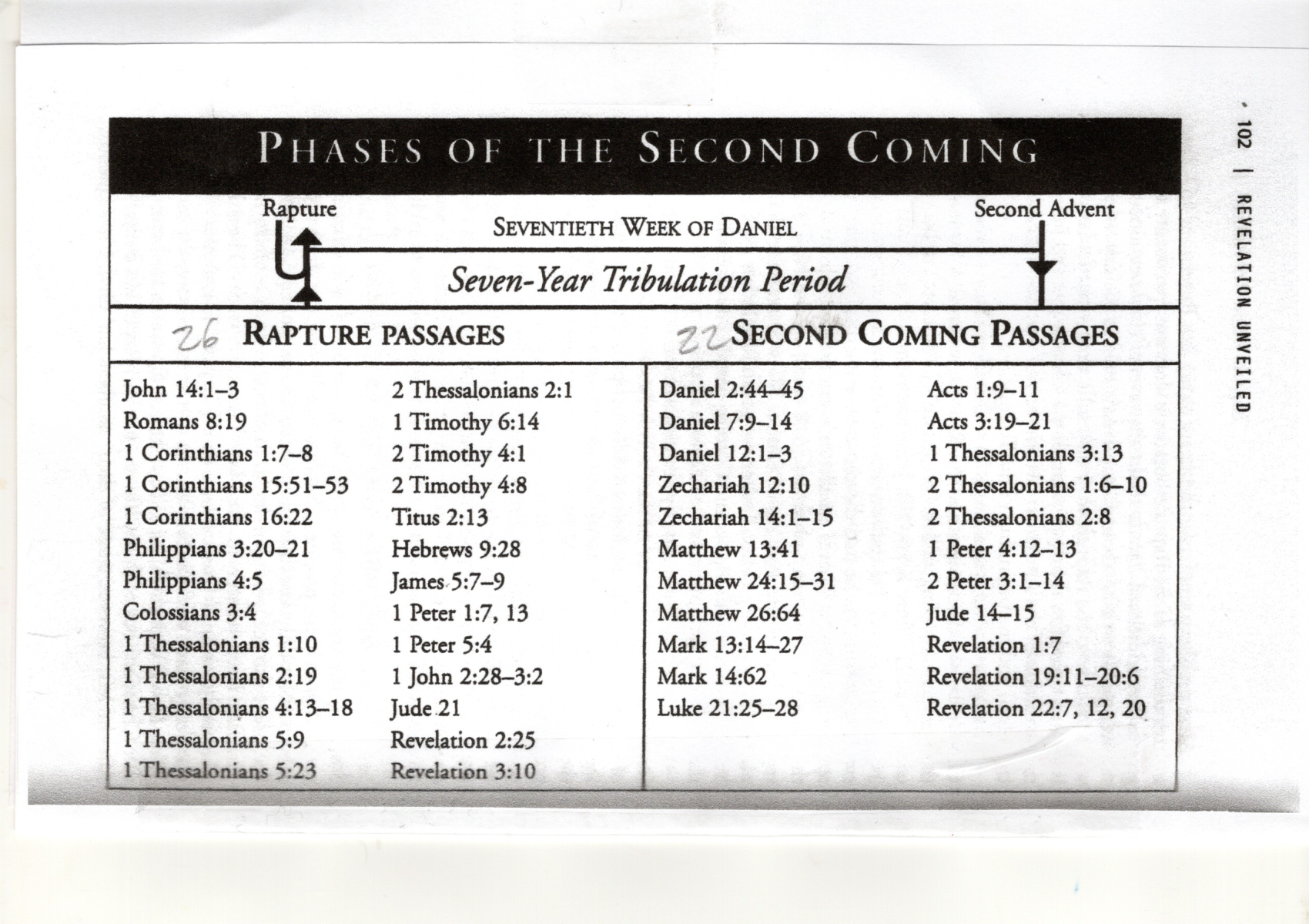
“The following chart, used by permission from my friend, Dr. Thomas Ice, the executive director of the PreTrib Research Center, locates some of the main references to the two different phases of the Second Coming. You will note that most of those that describe the Rapture come from the writing of the Apostle Paul. This chart reveals that when all the promises of the Second Coming are pieced together, the Bible teaches one coming of Christ in two installments. The first is His coming in the air to rapture His Church prior to the Tribulation, and the second describes the Glorious Appearing, when He comes to the earth for everyone else at the end of the Tribulation period, just before He establishes His thousand-year kingdom-all subjects that we will study in this book.” (LaHaye, Revelation Unveiled, p. 101)
“Do not be surprised if you cannot correlate these two installments of our Lord’s second coming. They are totally different. And when we include additional Rapture events like those described in 1 Corinthians 15:51-55 and add Glorious Appearing descriptions like the one we will study in Revelation 19:11-16, we can only conclude they are not describing the same event. In fact, I have discovered fifteen differences between the Rapture before the Tribulation and the Glorious Appearing after it. Please examine the accompanying chart carefully to get the impact.” (LaHaye, Revelation Unveiled p.103)
“Many important observations could be made about the fifteen contrasting events that describe the two phases of our Lord’s coming. One is that it is impossible for them to be describing the same event!” (LaHaye, Revelation Unveiled p. 105)

There is of course some truth to what LaHaye is saying. There clearly are at least two events (actually more like 5 if we include the Judgment Seat of Christ, and the Marriage Supper of the Lamb). That “day of the Lord” includes first the resurrection of the saved dead, the rapture of the church, Christ return to earth with His armies to judge the world and all those in it (includes the Battle of HarMagedon, the eternal damnation of the Antichrist and his False Prophet to Hell, and the imprisonment of Satan). It also could be said to include the instantaneous (being in the spiritual timeless realm) judgment Seat of Christ in which the saints are given their reward, and the marriage supper of the Lamb (also outside the earthly time realm). Some passages address some of these events, or aspects of that day of the Lord, others address other of these events – but none give any indication that they are separate phases 7 years apart. Contrary to LaHaye’s claim, there is nothing in any of these 48 passages that would even imply, let alone necessitate them to be divided between two such separate events, one before the Tribulation Period (the “rapture”), and the other 7 years later after that period, which he refers to as the “Glorious Appearing”. But let’s just look at his proof texts to see if they are saying what he claims they are saying.
John 14:1-3 tells us that there will be a rapture/resurrection of all those who are saved. This could be a rapture verse, and could just as well be a “Glorious Appearing” verse – and in fact that is exactly what it is, both. Nothing in this verse tells us when it is going to happen relative to everything else in the day of the Lord. LaHaye’s interpretation is solely based on his Dispensationalist PTR presuppositions – which he is trying to use to prove those very presuppositions, a classic case of circular reasoning.
On the other hand, LaHaye tells us that Acts 1:9-11 is not about the rapture, can only be about the Glorious Appearing, the second coming at the end of the Tribulation Period. But, here is what it actually says:
“9And after He had said these things, He was lifted up while they were watching, and a cloud took Him up, out of their sight. 10And as they were gazing intently into the sky while He was going, then behold, two men in white clothing stood beside them, 11and they said, “Men of Galilee, why do you stand looking into the sky? This Jesus, who has been taken up from you into heaven, will come in the same way as you have watched Him go into heaven.” (Acts 1:9-11)
This will probably surprise the unindoctrinated truth seeking Bible reader, as similar to Matthew 24:29-31 it will normally be understood as being about the rapture, since it is telling us that Christ will return to get us just as He went, appearing in the clouds. Ironically, a distinction often made between the two hypothetical comings is that the one is to the clouds in the air (as per 1 Thessalonians 4:17), the other to the earth, not stopping in the air. Here we have another reference to Jesus appearing in the clouds when He comes to get us, but no, according to LaHaye this one is not about the rapture – where is he getting this? Not from the passages of scripture that much is clear.
One might also wonder how much sense it makes to say Jesus would come all the way down to the clouds when coming to rescue us (the church not including those who will be the church in the Tribulation Period) from the pursuing judgment, as if He has to meet us part way, but it could not possibly be the same trip down when He is coming to the earth. This is especially curious since according to their own interpretations that is exactly what happens anyway as per Matthew 24:29-31, only then, according to them, it is only the Tribulation Period saints. Then they argue it would make no sense if it was the church. Here we see the powerful effects of doctrinal presuppositions imposed on scripture – presuppositions which themselves are entirely unscriptural.
One could go through every one of these passages (as this author has done) cited by LaHaye and not find one that supports his contention. But if one were to do so what emerges from just letting the inspired words of God speak for themselves would completely refute his point and provide strong evidence for the very position he is arguing against. Consider the following, which LaHaye includes as Pretrib Rapture proof texts:
“and to wait for His Son from heaven, whom He raised from the dead, that is, Jesus who rescues us from the wrath to come.” (1 Thessalonians 1:9)
According to LaHaye it is impossible for this to be describing the second coming when Christ comes in judgment, as in the Pre-wrath view, even though it explicitly says this coming is to “rescue us from the wrath to come”. This verse supports the Pre-wrath view, not the Pre-trib Rapture view. But again, because of the doctrinal presupposition defining the “wrath to come” as the whole Tribulation Period, it becomes support for that PTR interpretation.
However, again, he has a problem. According to another of his proof texts 1 Thessalonians 5:9 for this supposed Pre-trib Rapture, God’s people (the “elect” of Matthew 24:31), are not “destined us for wrath, but for obtaining salvation through our Lord Jesus Christ”. First, we have a glaring discrepancy in that he takes this 9th verse out of context to interpret it as applying to the church before the Tribulation Period. To get to the truth of the matter one may want to follow the most basic hermeneutic (rule of interpretation) – keep it in context. In other words, just read the preceding 7 verses, 5:2-8:
“2For you yourselves know full well that the day of the Lord is coming just like a thief in the night. 3While they are saying, ‘Peace and safety!’ then sudden destruction ]will come upon them like labor pains upon a pregnant woman, and they will not escape. 4But you, brothers and sisters, are not in darkness, so that the day would overtake you like a thief; 5for you are all sons of light and sons of day. We are not of night nor of darkness; 6so then, let’s not sleep as others do, but let’s be alert and sober. 7For those who sleep, sleep at night, and those who are drunk, get drunk at night. 8But since we are of the day, let’s be sober, having put on the breastplate of faith and love, and as a helmet, the hope of salvation. For God has not destined us for wrath, but for obtaining salvation through our Lord Jesus Christ”” (1Thessalonians 5:2-9)
It is difficult for the honest truth seeker to miss or overlook verse 3: “3While they are saying, ‘Peace and safety!’ then sudden destruction ]will come upon them like labor pains upon a pregnant woman, and they will not escape”. This is very clearly about the second coming of Christ in judgment – not a Pre-tribulation Rapture. One must question how, or why, did Mr. LaHaye miss this verse, or this whole passage in his list of the “Second Coming Passages”? Then, why would he take the 9th verse out of context to include as one of the “Rapture Passages” which are supposed to be impossible to confuse with the second coming passages?
However, this exposes another problem with his interpretation. According to his view the Tribulation Period saints will be going through the whole Tribulation Period, which is what he is defining as “the wrath to come”. And yet, this very verse, 5:9, which is specifically about those alive when Christ returns at His “second coming”, will not undergo that wrath – which is why LaHaye cites it as a Rapture verse. An incredible feat of manipulation, or more accurately just distortion of the text.
However, this brings us to another distortion based on the same violation of the most basic Hermeneutic principle, taking out of context, involving the same passage. Big on his list (and every PTR advocate’s list) of the proof texts for the Pre-trib Rapture, is 1 Thessalonians 4:13-18. And indeed, it is a proof text for the rapture of the church. However, taken out of context of the following verses, 5:1-12, it tells us nothing about the timing of that rapture, Pre, Mid, Post Tribulational, or Pre-wrath. But, as noted above, we have the following:
“1Now as to the periods and times, brothers and sisters, you have no need of anything to be written to you. 2For you yourselves know full well that the day of the Lord is coming just like a thief in the night. 3While they are saying, ‘Peace and safety!’ then sudden destruction will come upon them like labor pains upon a pregnant woman, and they will not escape.” (1 Thessalonians 5:1-3)
Of all those proof texts cited by LaHaye for his Pre-trib Rapture view, this is one of only two that address the timing of that rapture at all, as related to any of the other eschatological events or developments. How do we know this verse is telling us about the timing? How about because the 1st verse explicitly tells us so, and in fact tells us what the subject of the following 11 verses are about. First, kept in context we see that Paul calls this whole scene, beginning with the rapture of the preceding verses, 4:16-17, continuing with this 5th chapter, “the day of the Lord”. If one is letting scripture interpret scripture they would let this verse, or any of the other 24 verses where this expression “the day of the Lord’ appears, define what is meant by that key phrase. LaHaye, and his fellow PTR advocates seem to think they know better, using their Dispensational doctrines and PTR presuppositions to determine the meaning of that phrase, just as they do with “the wrath to come” discussed above. But here we have it rather clear, also referred to as the “thief in the night” metaphor, which in every occurrence only refers to the second coming of Christ in judgment (see Matthew 24:43, 2 Peter 3:10, Revelation 16:15). It also refers to the rapture of the church (which is why they use it to bolster their arguments for “Imminence”), but only because that rapture happens at the second coming of Christ – no 7-year gap, but in rapid succession. However, if kept it in context, the primary proof text for the rapture of the church is Pre-wrath, not Pre-tribulational, as they all contend.
As mentioned above, there are two texts which actually do address the “when” with respect to the timing of the rapture versus the Tribulation Period and the so-called “second coming”. The other is the following:
“1Now we ask you, brothers and sisters, regarding the coming of our Lord Jesus Christ and our gathering together to Him, 2that you not be quickly shaken from your composure or be disturbed either by a spirit, or a message, or a letter as if from us, to the effect that the day of the Lord has come. 3No one is to deceive you in any way! For it will not come unless the apostasy comes first, and the man of lawlessness is revealed, the son of destruction, 4who opposes and exalts himself above every so-called god or object of worship, so that he takes his seat in the temple of God, displaying himself as being God. 5Do you not remember that while I was still with you, I was telling you these things? 6And you know what restrains him now, so that he will be revealed in his time. 7For the mystery of lawlessness is already at work; only He who now restrains will do so until He is removed. 8Then that lawless one will be revealed, whom the Lord will eliminate with the breath of His mouth and bring to an end by the appearance of His coming; 9that is, the one whose coming is in accord with the activity of Satan, with all power and false signs and wonders, 10and with all the deception of wickedness for those who perish, because they did not accept the love of the truth so as to be saved. 11For this reason God will send upon them a deluding influence so that they will believe what is false, 12in order that they all may be judged who did not believe the truth, but took pleasure in wickedness.” (2 Thessalonians 2:1-12)
It is very telling that LaHaye cites the first verse of this passage as one of his proof texts for his Pre-tribulation Rapture view, but only the first verse. As one reads on in this text it becomes pretty obvious why he only wants us to read that first verse, because if we keep it in context we see the same problem for their PTR view as we saw in the passage in 1 Thessalonians 4-5 discussed above. Again, we see that Paul refers this obvious reference to the rapture of the church as “the day of the Lord” – just as he did in 1 Thessalonians 5:2. STOP!
Here we have the first deceptive maneuver. The PTR advocates want us to believe that Paul is changing the subject here, from the rapture of verse 1, to the “day of the Lord” of verse 2, which they say is the whole 7- year Tribulation Period, and most say includes the 1000-year Millennium (if you can believe that). Now they go into a long explanation that these poor Thessalonians were being told they were already in that Tribulation Period, so the rest of the passage is just to explain what that period will involve, and how they will recognize it, to assure them they weren’t their yet. While it is probably true that many did believe they were in that Tribulation Period, because they believed that Nero and Domitian were the Antichrist, this is nothing but a diversionary tactic to distract their followers from what the passage is actually saying. It is explicitly about the rapture of the church, telling them when it is going to happen relative to the other end times events. Paul did not digress and change the subject between verse 1 and verse 2 – as these magicians using intellectual sleight of hand want us to believe. As the saying goes, we need to keep our eyes on the ball. We need to keep each verse in its context, which again LaHaye does not do, as we see he then cites the 8th verse (2 Thessalonians 2:8) as one of the Second Coming Passages. Strangely he skips over all those contextual verses in between – which are certainly very germane to the subject.
Another almost unbelievable oversight on their part in their interpretation of this very key text is the obvious self-contradiction, when one actually thinks about what they are trying to make it say. First they try to change the subject from the rapture of verse 1, to “the day of the Lord” of verse 2. Then they define that “day of the Lord” as being at least the whole Tribulation Period. Then that passage goes on to define what all has to happen before that “day of the Lord” will happen – which they acknowledge. But given their definition of the “day of the Lord” being the whole Tribulation period, their interpretation has this passage saying that the whole Tribulation Period can’t happen until after the major events of that Tribulation Period happens:
“…let no one deceive you for it (the whole tribulation period) will not come unless the apostasy comes first, and the man of lawlessness is revealed, the son of destruction, who opposes and exalts himself above every other so-called god or object of worship, so that he takes his seat in the temple of God displaying himself as being God.”
This is what happens when men, with agendas, try to manipulate God’s inspired word – they end up with nonsensical interpretations like this.
Unlike about 24 of the 26 passages cited by LaHaye in his list cited above of the passage purportedly only about the rapture, This 2 Thessalonians 2 passage is the clearest most explicit and conclusive passage in the Bible actually addressing this critical, controversial question about the timing of the rapture. Without any manipulation of the words or wording, or any prejudicial speculative explanations, it simply tells us:
- Its about the rapture of the church (v. 1)
- It is “the day of the Lord” (v. 2)
- It, (the day of the Lord Rapture of the church) can’t happen until the following (v. 3):
- The “apostasy” – falling away happens (v.3)
- The “man of Lawlessness”, the Antichrist is revealed (v.3)
- The “abomination of desolation” event occurs, when the Antichrist sets himself up as God, defiling the temple (v. 4).
Any student of scripture who has any knowledge of end time prophecy knows that verse 4 is a reference to the mid-point of the Tribulation Period (per Daniel 9:27 and 11:31, Matthew 24:15). God is telling us here, as clearly as it can possibly be stated, that this rapture of the church won’t happen until after those events and developments of the Tribulation Period have already happened. He is telling us that it happens as part of the “day of the Lord”, which is the one and only return of Christ, called “the second coming”, which we find in Revelation 11:15-19.
“15Then the seventh angel sounded; and there were loud voices in heaven, saying, ‘The kingdom of the world has become the kingdom of our Lord and of His Christ; and He will reign forever and ever.’ 16And the twenty-four elders, who sit on their thrones before God, fell on their faces and worshiped God, 17saying, ‘We give You thanks, Lord God, the Almighty, the One who is and who was, because You have taken Your great power and have begun to reign. 18And the nations were enraged, and Your wrath came, and the time came for the dead to be judged, and the time to reward Your bond-servants the prophets and the saints and those who fear Your name, the small and the great, and to destroy those who destroy the earth.’ 19And the temple of God which is in heaven was opened; and the ark of His covenant appeared in His temple, and there were flashes of lightning and sounds and peals of thunder, and an earthquake, and a great hailstorm.” (Revelation 11:15-19)
There we see it all, the same “day of the Lord” as described by the Old Testament prophets, and Matthew and Mark in the Olivet Discourse, and the fact that it is that final, second coming of Christ to begin His reign on earth. But notice what else is part of that “day of the Lord” event:
“18And the nations were enraged, and Your wrath came, and the time came for the dead to be judged, and the time to reward Your bond-servants the prophets and the saints and those who fear Your name, the small and the great, and to destroy those who destroy the earth.’”
Here we have a resurrection, which we know, and PTR advocates agree, is only a resurrection of the saved (the resurrection of the unsaved is recorded in Revelation 20:5). Not only that but we have what is known as “the bema seat judgment”, or “the judgment Seat of Christ”, when the saints, the church, will be judged and rewarded – again this is acknowledged by the PTR advocates, who also tell us this happens at the rapture/resurrection of the church. But here we have it in Revelation as part of the second coming event, together with the wrath of God being poured out on an unsaved world.
This is actually the only place in Revelation where such a rapture resurrection event is mentioned, telling us when it will happen. If this is not about the rapture and resurrection of the church, then it is not mentioned anywhere in this whole book which is primarily about what all is going to happen in those last days – what a strange oversight that would be for God to forget to even mention it, if such were the case.
Or, alternatively, perhaps these men have it wrong, trying to convince us that “the church is not in Revelation”, because the Greek word for “church”, “ekklēsia”, does not appear there after the 3rd chapter. Of course, they do say that the church is back in chapter 19 for the “marriage supper of the Lamb”, and in chapters 21-22, even though that key word doesn’t appear there either. In fact, the truth is that “ekklesia” doesn’t appear in the gospels of Mark, Luke or John. Would anyone ever suggest that the church is not in in 1 John or 2 John or 1 Peter or 2 Peter or Jude? According to their logic it must not be there in any of these other books, because the word for church doesn’t appear in any of them.
Furthermore, the notion that the first three introductory chapters to the book of Revelation are written specifically, and explicitly to and about the church, but what follows for the next 15 chapters are not about or to the church at all, doesn’t really make a whole lot of sense – maybe John (or God) should have inserted something somewhere that actually tells us that before we should believe it, just taking their word for it.
The very fact that they resort to this kind of intellectually dishonest argument tells a lot about the weakness of their case. To suggest, as at least one apologist for their view does, that “It is rather odd that the Revelation 19 passage [cited above] is the most precise picture of the second coming of Christ, yet it does not mention a resurrection” (Rev. Danny Formhals, 21 Proofs of a Pre-tribulation Rapture) is again remarkable. Seriously? So when it says “the time came for the dead to be judged, and the time to reward Your bond-servants the prophets and the saints and those who fear Your name, the small and the great”, there is no resurrection here? How will the dead be judged and the saints be rewarded, without a resurrection? Is it because the word “resurrection” is not used here? Maybe he could find where the word “rapture” is used in those passages about the rapture. Could this be just another indication of the effects of a bias in his interpretation of the passage? This is exactly the kind exegesis and logic that gives us the PTR doctrine.
One could go through every one of LaHaye’s 48 passages of scripture, or Rev. Formhals 21 proofs, and demonstrate rather easily that not one of them actually supports their argument for the Pre-tribulation Rapture – but that would be too tedious, and overkill. However, following on the subject of the resurrection we should look at one more of LaHaye’s proof texts, and his and others explanations to make them fit their view. According to LaHaye 1 Corinthians 15:51-53 is only about the first 2nd coming of Christ to rapture the church. But we are told there that this resurrection will happen “at the last trump”. Now an honest truth seeker, who wants to follow the cardinal rule of interpretation, to let scripture interpret scripture, might just look up this word trumpet in a concordance, or do a word search in a digital Bible for “last trumpet”, and discover that there are 7 trumpets in Revelation 8-11, and one is called the 7th trumpet, which is the last trumpet. That trumpet is the one addressed above in Revelation 11:15-19, which is clearly describing the “day of the Lord”, the so-called “second coming” of Christ, at the end of the whole 7-year Tribulation Period. However, in order to make this verse fit with the PTR presuppositions and theory, they have to come up with a different interpretation of this trumpet – just as they do with “the day of the Lord”. To do so we have to get a little creative. According to LaHaye and others:
“The problem is that many trumpets are used in Scripture. Every day had a first and last trumpet just as armies do today. Paul’s ‘last trumpet’ reference is the last trumpet for the Church to be raptured from the earth. The seventh trumpet is one of an entirely different set of trumpets for Israel during the Tribulation. And again, there is no evidence that the Church is on earth during the first half of the Tribulation.” (LaHaye, Revelation Unveiled)
Did we miss something here? What about the part where some passage of scripture is telling this? Or how about what we saw in 2 Thessalonians 2:1-12, telling us as clearly as it can be stated in human language that the rapture LaHaye is taking about, can’t happen until the “abomination of desolation” event at the midpoint of the Tribulation Period? Or what about what we just saw in Revelation 19:15-19 featuring the resurrection and rewarding of all the saints at that same last trump. Would LaHaye actually want us to believe that there is a different set of trumpets related to a Pre-tribulation Rapture – which obviously scripture is silent about (unless he goes back to the Old Testament rituals, which of course has not been in effect for the over 2000 years of the church age). The rather obvious truth is that the only arguments the PTR advocates have to substantiate this rather forced distinction or interpretation about the “last trumpet” are their doctrinal presuppositions, their Dispensational Distinctives and PTR theories, for which there is no actual literal scripture when accurately interpreted. However, if we don’t like LaHaye’s alternate explanation we have several other options to choose from, such as a more contemporary (as of 2024) PTR expert on the subject:
“Paul says that this will happen, ‘at the last trumpet. For the trumpet will sound, and the dead will be raised incorruptible, and we shall be changed.’ What does that ‘last trumpet’ refer to? Some people see ‘last trumpet’ and think that this has to be part of the seven trumpet judgments found in the book of Revelation. From there they assume the Rapture has to be at the end of the Tribulation period. But this trumpet has nothing to do with that. The whole context of this trumpet is referring to the gathering together of God’s people. In chapter 10 of the book of Numbers, God told Moses to make two trumpets out of silver that were to be used for the calling together of the congregation. When one trumpet was blown, the leaders of Israel would be summoned. But when both trumpets were blown—the first trumpet and the last trumpet—God was calling together the entire assembly of the people. One trumpet = an incomplete gathering. Two trumpets = everyone assembles. At the Rapture, the entire assembly of Church-age believers are being summoned—both the dead in Christ and we who are alive and remain.” (Jack Hibbs, Countdown – All Eyes on God’s Ultimate Endgame)
Ok, sounds good, perhaps better than LaHaye’s lame explanation, more like letting scripture interpret scripture, but just a few questions. First, why go to a passage in Numbers, which has nothing to do with end times prophecy, and by pass those in Revelation which are all about that same subject of the end time when that resurrection will occur? Second, if the 2nd trumpet in Numbers 10 is symbolic of the rapture/resurrection of the church, what does the first trumpet represent? Will there be a partial rapture (as some propose) of just the leaders of the church?
Maybe we should go with another PTR explanation, which carries more authority because it is even more Jewish – like from Torah scholars (most of whom don’t accept Christ at all):
“There has been much debate over the ‘Last Trumpet.’ One common mistake is to assume it is speaking of the seventh angel who blows his trumpet, signaling the final group of judgment in the Tribulation, called the bowls. … But there is a better explanation. On the Jewish feast of trumpets there are four significant shofar blasts: the final one is called the Tekiah ha-Gedolah, the longest and loudest which lasts about ten seconds. Perry Stone states ‘It is the last trumpet’ sound’. As well, those in the early church would have understood the meaning of Paul’s words “at the last trumpet” (1 Cor. 15:52). We know this because Paul didn’t feel the need to explain the connection in 2 Corinthians, or any of his other writings, about what the last trump was.” (Danny Formhals, 21 Proofs of the Pre-tribulation Rapture, Kindle, p. 13)
Again, a few questions. First, do we interpret scripture today in terms of what the early church may or may not have known or believed (the old “Historical Context” hermeneutic)? In reality it is very debatable and much debated about what that early church believed – especially about this subject. It is my understanding and belief that God inspired the writers of scripture to reveal truths that are timeless, as much for us today as for the earliest church, again especially with respect to end times prophecy. There were then, as now, many divisions between members of those early churches, some of which John addresses in the 2nd and 3rd chapters of Revelation.
But men often glibly refer to how the early church would have understood a passage of scripture to make their interpretation sound more authoritative – as is the case here. However, when we examine what we know from scripture about this Corinthian church, or for that matter the Thessalonian church, the true believers were not all Jewish, such that they would have known all about the trumpets in the Torah. In fact, it was the religious Jews who persecuted the true believers. Many, if not most in that early church in Corinth as elsewhere, were Gentiles, to whom Paul mostly ministered after being rejected by the Jews. So no, it is not very likely that the early church, or churches, would have understood Paul’s reference to the “last trump” as being about the Jewish shofar blasts. And no, the fact that Paul did not go on to give that unique explanation is not because they all would have understood it as such, but more like because that it is not the correct explanation or meaning, which just might also explain it.
So, according to these very knowledgeable and no doubt sincere Bible scholars, instead of letting another scripture passage which is actually addressing the same subject – Christ’s return to gather His elect to Himself, as in Revelation 11, we need to look for some other trumpet somewhere else. We should go back to the Old Testament passages about the use of the trumpet on a daily basis, which had nothing to do with any end times prophecies. Or we could go to how trumpets are used in in armies today, like reveille and taps, as LaHaye says we should. Or we could go to Numbers 10 where they were used to assemble the people, which was no longer the case at the time Paul was writing to the Thessalonicans, nor for many centuries before that. Or maybe we should go to the Torah and interpret it in light of the ceremonial “Tekiah ha-Gedolah”, the last of four blasts of the shofar, as we are enlightened by Perry Stone and Rev. Formhals. Heaven forbid that we should do what they all bemoan the fact so many people seem to tend to do – see the clear connection with a related passage in Revelation, and let that help interpret what is meant here. According to these men, they know better.
Hopefully as such naïve truth seekers we can be forgiven for asking the question – why exactly is it wrong to let Revelation 11:15-19 interpret 1 Corinthians 15:52. LaHaye attempts to answer that for us in his commentary above, in case we missed it:
“ Paul’s ‘last trumpet’ reference is the last trumpet for the Church to be raptured from the earth. The seventh trumpet is one of an entirely different set of trumpets for Israel during the Tribulation. And again, there is no evidence that the Church is on earth during the first half of the Tribulation.” (LaHaye, Revelation Unveiled)
One of the problems these men have with respect to their preferred interpretations of the 7th and thus last trumpet of Revelation 19, is that their most recognized authority for the PTR view, former President and Professor at Dallas Theological Seminary (the recognized bastion of Dispensationalism and Pretribulationism, since its founder Lewis Sperry Chafer) has had to be honest about this passage in his book The Revelation of Jesus Christ:
“The dead are judged at this time. The context seems to indicate that the resurrection of the righteous dead is especially in view rather than that of the wicked dead, who are not raised until after the Millennium. The comment, which follows immediately, speaks of the reward given to the prophets who are servants of God, to saints in general, and to those who fear the name of God whether small or great. The time has also come when God destroys those who destroy the earth, referring to those living on the earth at that time who rebel against God.” (Walvoord, p. 185)
So here we have a resurrection of the righteous dead, including the Prophets, and all the rest of the Saints, and the one and only occasion when they are to receive their reward, but we are not supposed to relate it to the resurrection event of 1 Corinthians 15:52 or that of 1 Thessalonians 4:13-17, which would include the rapture of the church, why? Because some of these men say so, based on their Theology? It is noteworthy that Walvoord does not explain it as only being the Tribulation Saints, even though with respect to a rapture of course it would only be those living at that time, in the Tribulation Period. But giving him credit, he doesn’t try to fool us into thinking it is only those who have died during the 7 years of the Tribulation Period which are being resurrected at this time, (unlike some of His colleagues, such as Dr. Dwight Pentecost (see Things to Come, p. 253 – “only tribulation saints … the ones being resurrected and rewarded in Revelation 11;16-18) who invents a resurrection before the Tribulation Period, that of 1 Corinthians 15:52, and another one at the end of that period, that of this passage in Revelation 19 and 20). The very strained approaches these men quoted above take to try to find another interpretation of “the Last Trump” in past Jewish traditions or current armies, instead of the obvious scriptural interpretation, tells us a lot about their methodology, and brings into question their true intentions – is it to find and share God’s truth, or to find ways to maintain their predetermined doctrinal beliefs and preferences (tickling the ears with escapist eschatology).
Such critical questions are inarguably harsh, and in this current environment divisive – no denying those accusations. It is almost like insubordination, or even blasphemy to be discrediting, criticizing and even questioning the intentions of these men, who are ostensibly very Godly and respectable men of considerable knowledge and understanding. However, none of this is about ad hominin attacks on them, or their character. It can be assumed that their conscious intentions are very good, that none of them set out to deceive anyone. But there is a difference between what we call moral integrity and intellectual integrity. A person who sincerely believes what they are telling others is true, has moral integrity, even if they are mistaken and what they are saying isn’t actually true. But, if in their search for the truth they consistently violate known and established rules of interpretation, which they know and ostensibly subscribe to, and which they use to judge others, that is a lack of intellectual integrity. For example, everyone knows it is wrong to take words or phrases or texts out of context, or to argue using circular reasoning. And yet, as we have seen time and again, that is exactly what these men do. It is not a sincere quest to learn the truth to do what is called cherry picking – as in taking 1 Thessalonians 2:1 and then skipping to the 8th verse, to get a passage to say what one thinks it should say. It is never a sincere search for the truth to allow presuppositions and preferences determine one’s interpretation of any passage of scripture. And the list goes on. When men do this, not only do they come to the wrong conclusions, but they are sacrificing their intellectual integrity.
With respect to the common charge about being divisive – yes disagreeing with them is being divisive. However, all these men cited above are divisive inasmuch as they disagree with all the other schools of thought or theology. They in fact argue against the Covenant Theologians and Reformed Theologians, which represent a very significant share of the Christian community, even within the Protestant and Evangelical community. They strongly disagree with other futurists, even fellow Premillennialists, criticizing and at times even almost ridiculing their arguments – as they will the arguments in this presentation. Furthermore, if we consider the history of the Christian church, by far the majority of Christian Theologians knew nothing of this recent development known as Dispensationalism and Pre-tribulationism. Since at least the 4th century theologians, most notably St. Augustine, through the 16th century Protestant Revolution and John Calvin, up to the mid 19th century, the reigning paradigm was mostly Amillennial or Postmillennial. This was very understandable since there was no Israel in the promised land of Israel, thus they interpreted all those end times prophecies which were centered around Israel and Jerusalem as necessarily being symbolic, some with spiritualized interpretations (which explains why Augustine introduced the “allegorical method” of interpreting scripture, which in turn explains their non-literal interpretations). Thus, the modern Dispensationalist Theologians, strongly disagree with, and even show disrespect for the views and interpretations of all those men, as they do for other futurist who are also premillennialists, but not Pre-tribulationist. Is it not very hypocritical to accuse others of being divisive and argumentative in the process of being divisive and argumentative?
The reality is that short of being a true Postmodernist (there is no objective truth or reality), which no one truly is, there are and always will be differences between humans, especially with respect to our understanding, and use of scripture. A “Theology” is by definition only distinguishable as such by its doctrinal distinctives – that is the points in which it disagrees with and thereby refutes other Theologies. It is the right thing to do, in search of the absolute truth, to reason together – but this is also called arguing. Usually, the one who has clearly stated their point of view, as in their interpretation of scripture, especially end time prophecy, would say they are reasoning together. But when questioned about their reasoning or interpretations and perhaps countered with another interpretation, they will accuse their questioner of being argumentative, even divisive. Of course, the reality is that men, as often as not, do become emotional, and thus disrespectful and unloving, not at all under the control of the Holy Spirit – which then betrays their true unconscious motives, more about pride and control issues, than a sincere search for the truth. But the problem is not that they are disagreeing with each other, trying to reason together to get to the truth, but is about how they are going about it, and as usual, its the flesh vs. the Spirit.
But it needs to be kept in mind that anyone who has a theology, an opinion, an interpretation, who actually believes it, is thereby being divisive if they defend that position, believing that they are right, and everyone else who disagrees with them (which is always a majority on any significant issue) are wrong. How one goes about defending that position, and their attitude (as in prideful vs. humble), especially with respect to those with whom they disagree, is what makes the difference – is it Holy Spirit controlled and will it be in any way loving, or for that matter productive?
Having said all this, one need not be naïve. As Jesus and Paul and Peter and Jude warned us, there are and will be deceivers who will be used by the enemy to lead people astray. Not incidentally, Paul warns us in the clearest possible passage about this whole subject of the timing of the Rapture, “don’t let anyone deceive you” – which is exactly what men are doing today. All of the men mentioned above are also trying to preach the gospel, in some form, some reportedly having a very real ministry in bringing people to Christ. As Paul wrote in Philippians:
“15Some, to be sure, are preaching Christ even from envy and strife, but some also from goodwill; 16the latter do it out of love, knowing that I am appointed for the defense of the gospel; 17the former proclaim Christ out of selfish ambition rather than from pure motives, thinking that they are causing me distress in my imprisonment. 18What then? Only that in every way, whether in pretense or in truth, Christ is proclaimed, and in this I rejoice.” (Philippians 1:15-18)
We can glean from this that, first Paul did not take it personally, and thus hold it against them, even though some were attacking him personally, causing him distress. He even dared to question their motives, but his bottom line was that they were nonetheless preaching the Gospel. In fact, while essentially accusing some of ministering “in pretense”, he could see that God was able to still use them to get the message out, for which he was thankful. But at the same time, as we read the rest of what he wrote, especially to the Corinthians, and the pastoral epistles, he did not hesitate to call a spade a spade, as we say. He even called out several by name, and in any case was very clear in refuting their false teachings. That whole epistle of 2 Thessalonians was doing just that – refuting false teachings of that time.
Interestingly the topic in that 2nd chapter was very similar to the hot topic giving rise to so much division and controversy in the church today – the timing of the rapture, versus the day of the Lord second coming of Christ. Probably most evangelical Christians today who are futurists recognize that what the majority of the church believed about this question was wrong, and in fact counterproductive for at least 1500 years (4th century to 19th century). But it didn’t matter that much then, as long as the gospel was being preached, as they weren’t living in the end times. But, if we believe we are living in the end times now, as most Bible believing Christians do, it is beginning to become more and more important. Believing 100 or even 50 years ago that what we read about in Revelation won’t really even affect us because we will be raptured before any of it happens, may not have mattered so much, except that it does nothing to motivate them or us to living differently in light of what we see predicted there – such as Christ’s coming in judgment.
Today, despite some preachers trying to use these warnings in scripture, and admonitions to live expectantly, their message appears to be falling on deaf ears. But how could they expect otherwise since they effectively take it all back with the escapist message, don’t worry we won’t even be here when it is all going to happen. As a result, we have a very impotent, disengaged church today, having very little redeeming influence on our culture and hence our world, which is degenerating into inconceivable depths of depravity at a pace that is unbelievable.
Furthermore, most of our leaders are acting out their escapist beliefs, either unaware of or too afraid to even address what is going on in our world. With a few exceptions, pastors and churches are doing church like they have always done church, like the orchestra on the Titanic playing calming music as the ship went down, or like the church in Germany as Hitler was destroying her and the whole nation (though some of those exceptions are admittedly PTR advocates, such as Jack Hibbs, cited above). It stands to reason that if we were believing that we are soon entering that time of unprecedented trial and testing, and persecution for our faith, our priorities might be a little different.
But obviously, it will make the most difference when we are actually in that time of Tribulation, or for those who will be. Only when we understand the message of scripture, that this rescue of the elect, the saints, possibly us, will come after Satan is allowed to do His evil virtually unrestrained, will we be able to understand, and thus not lose faith when that time of testing comes. Those who are only expecting the rapture before the Antichrist appears on the scene, will probably not be able to recognize him for who he is, as he is going to do a lot of amazing miracles, claiming to be empowered by God like Jesus was, even claiming to be Jesus. They will be the ones Paul refers to as “the apostasy” who will take the mark of the beast in order to survive, all the while still looking for that rapture. Sadly, that rapture will come, but not before they take the mark of the beast being deceived by him, only realizing too late who he really was.
Another problem with believing in the Pre-tribulation Rapture is the implicit message to unbelievers. According to that theory many will still be getting saved after the rapture, including many who will be left behind because they could not bring themselves to believe. How many will take a wait and see approach, since they are assured that they will have plenty of warning because of what David Jeremiah calls “the Great Disappearance”. As it turns out this is a false and very misleading gospel. Scripture is clearly warning us that when Jesus does return it is all over for us, or for them living at that time. Those who don’t have the oil for their lamps, or have let the oil in their lamps burn out before that bridegroom arrives, are thereby condemned for eternity in hell (as per the 5 foolish virgins in Matthew 25). No 7 year advance warning. No arrival of that bridegroom to collect the 5 wise virgins 7 years before his arrival to condemn the 5 foolish virgins. People need to hear the clear and uncompromising truth, “now is the day of salvation” – not a mixed message. As Jesus said, it will be like those in Noah’s day – if you wait to see if its really going to happen, the door of salvation will be closed like the door on the ark, and the judgment of the wrath of God will be your fate. Contrary to LaHaye’s very popular fictional novels and movies, being “left behind” means being too late – only eternal damnation follows. This is part of the Gospel, which needs to be preached now more than ever before.
 end times revisited